On this page
How to identify it
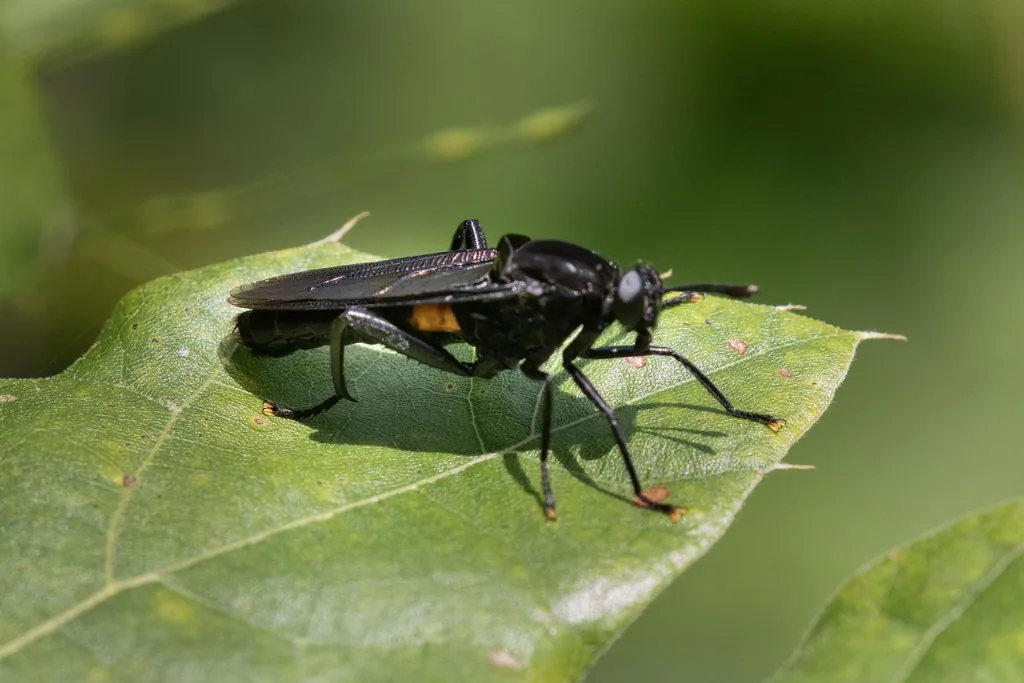
- Most are about 1 inch long, ranging from 1/4 to 1 1/4 inches; Clemson describes one at about 1 1/2 inches.[1][2]
- Many are black, dark or tan with red, orange or yellow bands; Mydas clavatus has a golden or reddish mark on the second abdominal segment.[1]
- Like all true flies they have one pair of wings, and unlike most flies they have clubbed antennae.[1]
Look-alikes
| Look-alike | How to tell them apart |
|---|---|
| Robber flies | A related group of large bee and wasp mimics, but robber flies lack clubbed antennae.[1] |
| Spider wasps | Mydas flies mimic blue-black spider wasps with an orange or red spot on the abdomen; wasps have four wings, flies two.[1] |
Where it lives
About 80 species live in North America, with the most in dry areas such as the desert Southwest; Mydas clavatus and others occur in the East.[1][2]
Biology and life cycle
Larvae live in soil or rotting wood, and most species probably spend at least a year as larvae.[1]
Adults are short-lived and feed on flower nectar and pollen.[1][2]
Damage and signs
- No damage; the larvae prey on beetle grubs, including root-eating lawn grubs, and have been proposed for biological control on sod farms.[1]
Health risk
Harmless; they do not sting or bite.[1]
Control
Prevention
No control is needed; these harmless flies are less common than other flies and feed on beetle grubs as larvae.[1]
Common questions
Sources
- Missouri Department of Conservation, “Mydas Flies (Field Guide).” mdc.mo.gov/discover-nature/field-guide/mydas-flies (accessed 2026-10-16)
- Clemson Cooperative Extension Home & Garden Information Center, “Meeting a Mydas Fly (HGIC, July 2024).” hgic.clemson.edu/meeting-a-mydas-fly/ (accessed 2026-10-16)
- iNaturalist, “Mydas clavatus taxon page (order and family).” www.inaturalist.org/taxa/123516 (accessed 2026-10-06)