On this page
How to identify it
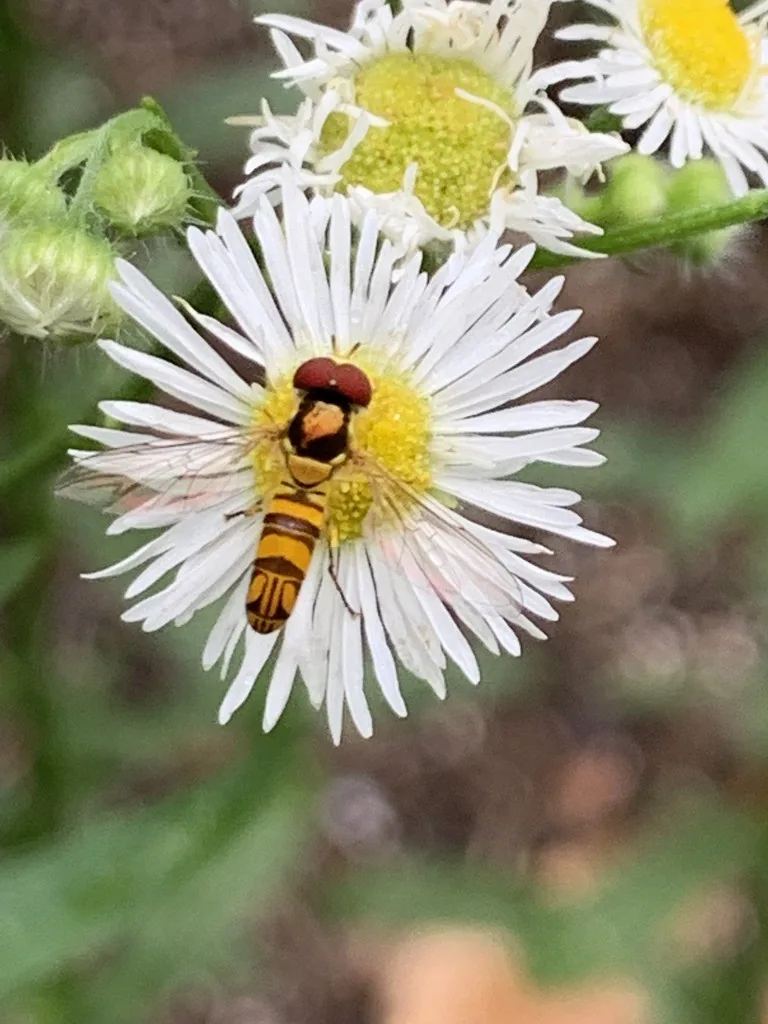
- Adults are 6 to 7 mm (about 1/4 inch) long, with yellow stripes on the thorax and yellow crossbands on the abdomen. On the fourth and fifth abdominal segments the yellow forms four slanting lengthwise stripes or spots.[1]
- The face is yellow without a complete dark stripe down the middle. The male's eyes meet on top of the head; the female's are separated.[1]
- The full-grown larva is 8 to 9 mm long, green with two narrow whitish stripes down the back, somewhat flattened on top, with the front end drawn out to a point when it stretches.[1]
- The pupal case is green at first and darkens as the black-and-yellow adult forms inside.[1]
Look-alikes
| Look-alike | How to tell them apart |
|---|---|
| Fruit flies | UF/IFAS notes that this is one of the colorful little flies most often mistaken in Florida for a harmful fruit fly. Watch how it flies: hover flies can hover in place or fly backward, which few other insects can do, and they are often seen at flowers or around aphid colonies.[1] |
| Allograpta exotica | A close relative that is uncommon in Florida; its larvae are almost indistinguishable from those of the oblique streaktail.[1] |
| Other hover flies | Many hover flies are banded yellow and black. In this species look for the four slanting yellow stripes or spots on the fourth and fifth abdominal segments and the yellow face without a complete middle stripe.[1] |
Where it lives
It occurs across almost all of the continental United States, from Washington to Maine and into Quebec and south to California and Florida, and also in Hawaii, Bermuda, Mexico and parts of the American tropics, including the West Indies.[1]
Biology and life cycle
Females lay eggs one at a time on leaves or twigs that carry aphids. The eggs hatch in two to three days in summer, and the whole life cycle takes as little as three weeks in summer and up to nine weeks in winter.[1]
Each larva eats a lot of aphids: one larva ate 265 aphids during its development, an average of 17 a day, and another report gives an average of 34 a day. When it is ready to pupate, the larva fastens itself to a leaf or twig, and the pupal stage lasts 8 to 10 days in summer and 18 to 33 days in winter.[1]
Its prey includes pea, cowpea, melon (cotton), apple, spirea, cabbage, walnut, rose, black cherry, green peach and corn leaf aphids, greenbugs and black citrus aphids, and whiteflies have also been reported as hosts.[1]
Adults visit flowers for nectar and gather around aphid colonies to feed on honeydew and lay eggs; they are considered important cross-pollinators of some plants. In northern Florida adults are present all year but are much more abundant in spring and summer.[1]
In Michigan soybean fields it was one of the most numerous predatory flies feeding on soybean aphid, most abundant while the soybeans were still growing leaves and stems. On California's Central Coast it made up 10% of the syrphid flies reared from organic romaine lettuce.[3][2]
Its own enemies are parasitic wasps: larvae, and sometimes pupae, are heavily parasitized, in some years over 50%.[1]
Damage and signs
- None: the larvae feed on aphids and the adults on nectar and honeydew. UF/IFAS reports that when the larvae are numerous they may provide 70 to 100% control of aphid populations.[1]
Health risk
UF/IFAS describes its larvae as important aphid predators and the adults as pollinators of some plants, and mentions no bite, sting or other risk to people.[1]
Control
Prevention
No control is needed: it is a beneficial aphid predator, and UF/IFAS reports that its larvae may provide 70 to 100% control of aphids when they are numerous.[1]
Biological control
Organic lettuce growers on California's Central Coast rely on native syrphid flies like this one to keep lettuce aphids in check and use habitat manipulation to help them. In a Quebec study of sweet alyssum flower strips in lettuce fields, the oblique streaktail was among the aphid-eating syrphid flies collected, and the authors concluded that alyssum flowers can attract natural aphid predators.[2][4]
Common questions
- Is this little yellow-and-black fly a bee or a fruit fly?
- Neither. It is a hover fly, whose larvae eat aphids, and UF/IFAS notes it is often mistaken for a harmful fruit fly. Hover flies can hover in place and fly backward.[1]
- What do oblique streaktail larvae eat?
- Aphids, on crops such as citrus, corn, alfalfa, cotton, grapes, lettuce and other vegetables, and on ornamentals. A single larva can eat more than 200 aphids while it grows.[1]
- How can I attract hover flies to my garden?
- Flowering plants can help. Adults feed on nectar and on aphid honeydew, and a Quebec study found that sweet alyssum strips in lettuce fields can attract aphid-eating syrphid flies; this species was among those collected.[1][4]
Sources
- University of Florida/IFAS Extension (Featured Creatures), “A Hover Fly, Allograpta obliqua (Say), EENY-185 (H. V. Weems; published December 2000, revised August 2004; archival copy).” journals.flvc.org/edis/article/view/129940 (accessed 2026-11-09)
- Journal of Economic Entomology (via NCBI PubMed), “A survey of syrphid predators of Nasonovia ribisnigri in organic lettuce on the central coast of California (H. A. Smith and W. E. Chaney; Journal of Economic Entomology 100(1): 39-48, 2007; abstract).” pubmed.ncbi.nlm.nih.gov/17370807/ (accessed 2026-11-09)
- Journal of Economic Entomology (via NCBI PubMed), “Seasonal abundance of resident parasitoids and predatory flies and corresponding soybean aphid densities (T. Noma and M. J. Brewer; Journal of Economic Entomology 101(2): 278-287, 2008; abstract).” pubmed.ncbi.nlm.nih.gov/18459389/ (accessed 2026-11-09)
- Ecology and Evolution (via NCBI PubMed), “Syrphid diversity in sweet alyssum flower strips in Quebec's lettuce fields (M. Kalboussi et al.; Ecology and Evolution 15(9): e72145, 2025; abstract).” pubmed.ncbi.nlm.nih.gov/40950790/ (accessed 2026-11-09)
- iNaturalist, “Allograpta obliqua taxon page (order and family).” www.inaturalist.org/taxa/118968 (accessed 2026-11-09)