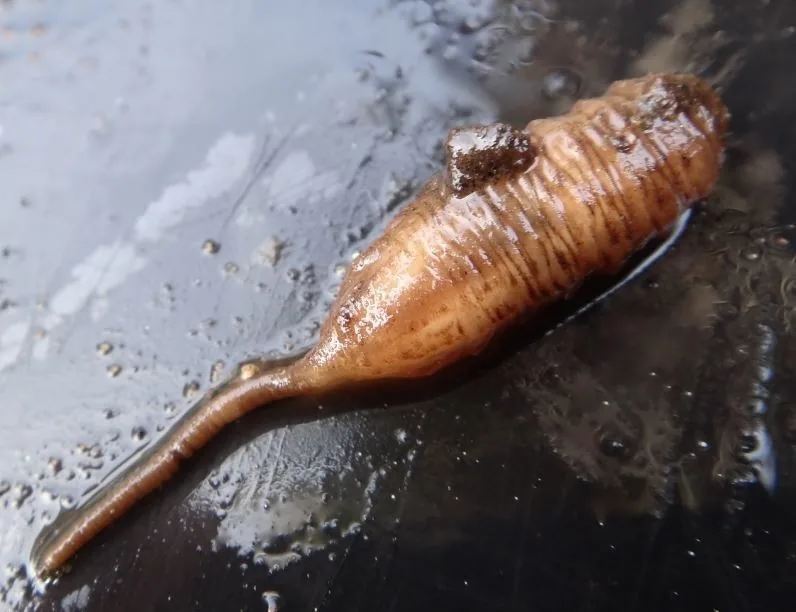
How to identify it
Look-alikes
| Look-alike | How to tell them apart |
|---|---|
| Honey bee | Adult drone flies mimic honey bees; old tales of bees arising from carcasses likely came from drone flies laying eggs in them.[1] |
| Hover flies | The drone fly is a syrphid, related to other hover flies.[1] |
Where it lives
It occurs on every continent except Antarctica; in the U.S. it ranges as far north as Alaska.[1]
Biology and life cycle
Larvae live in highly polluted water, such as manure lagoons and holding pits.[1]
Damage and signs
- It's usually not a serious pest, but larvae can migrate in large numbers from livestock waste sites in summer.[1]
Health risk
UF/IFAS describes it as a nuisance at most, not a health threat.[1]
Control
Sanitation
Keep manure lagoons and pits in good condition so manure doesn't break the water surface.[1]
Common questions
Sources
- University of Florida IFAS Extension (Featured Creatures), “Drone Fly, Rat-Tailed Maggot, Eristalis tenax (EENY-445).” edis.ifas.ufl.edu/publication/IN809 (accessed 2026-10-06)
- iNaturalist, “Eristalis tenax taxon page (order and family).” www.inaturalist.org/taxa/55719 (accessed 2026-10-06)