On this page
How to identify it
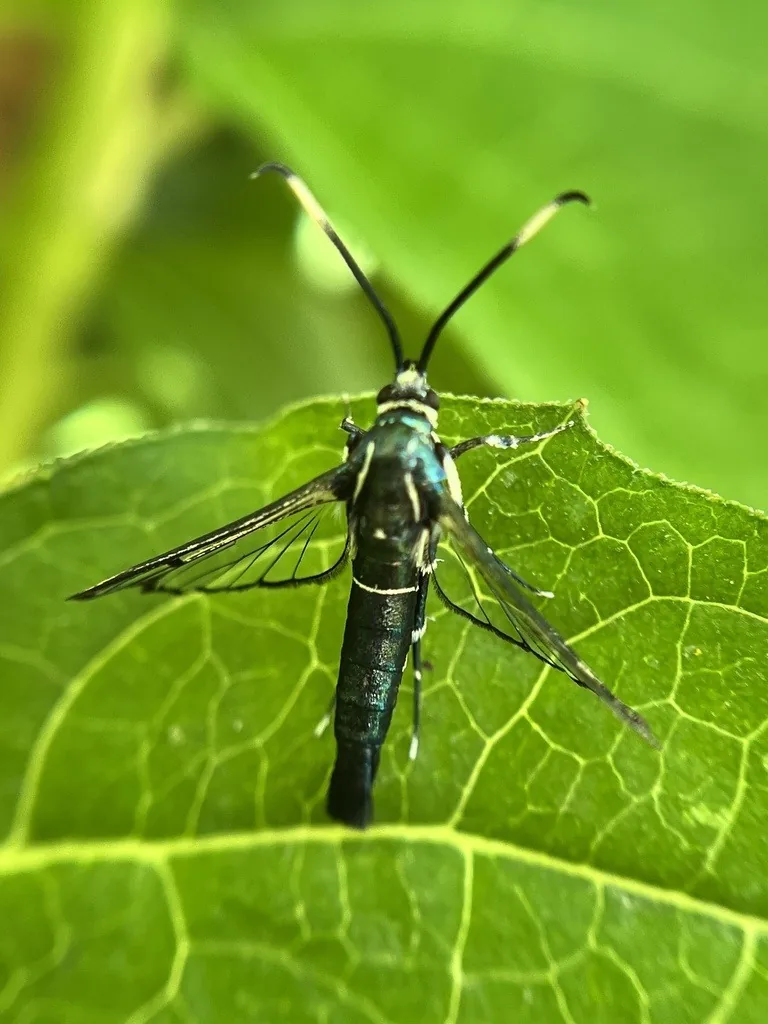
- Adults are day-flying moths that look and fly like wasps: slender, bluish black with yellow markings and clear wings spanning about 3/4 inch. The two species look much alike.[1][2]
- The caterpillars are whitish or pinkish with brownish to red-brown heads and grow to about 5/8 inch long.[1][2]
- Damage sits low on the plant, from below the soil line up to about 18 inches. Look for gnarled, scarred or swollen stems, cracks, sawdust and emergence holes at the base.[1][2]
- Infested shrubs first show wilting, sparse foliage and early fall color; branch dieback and decline follow.[2][1]
Look-alikes
| Look-alike | How to tell them apart |
|---|---|
| Wasps | Viburnum borer adults are moths that mimic wasps in appearance and flight. They have clear wings and slender bluish-black bodies with yellow markings, and they turn up around the base of viburnums in late spring and early summer.[1][2] |
| Viburnum leaf beetle | Also kills viburnums, but by eating the leaves: larvae and adults strip everything but the midrib and major veins, and plants defoliated two or three years in a row may die. Borer damage is at the base of the stems, not on the leaves.[2][1] |
Where it lives
Viburnums are the only known hosts. Wisconsin Extension reports both species on viburnums in Wisconsin, and Cornell University's tree and shrub IPM newsletter lists them among the common insect pests of viburnums.[2][1]
Biology and life cycle
Adults emerge in late spring and early summer, mate, and lay eggs near the base of viburnums, especially near wounds in the bark. Cornell notes that emergence begins near the very end of bloom on bridal wreath spirea.[1][2]
The caterpillars hatch, tunnel into the plant and feed on the bark and the cambium beneath it, working at the base or soil line.[1][2]
There is one generation a year in Wisconsin.[1]
Stressed plants are especially likely to be attacked, while strong, vigorous shrubs are less attractive to borers and more likely to survive.[2][1]
Damage and signs
- Tunneling at the base can girdle stems and kill the shrub. Over time it distorts and swells the main stems and branches, and swellings with callus growth mark old or long-standing injury.[2][1]
- The wounds the borers make can also let plant diseases in.[1]
- Cornell lists wayfaring tree, European and American cranberry-bush, Korean spice viburnum, nannyberry, hybrid leatherleaf viburnum and Sargent's cranberry-bush as susceptible; arrowwood viburnum is reported to be resistant.[2]
Health risk
A plant pest. The wasp-like adults are moths, and neither Wisconsin Extension nor Cornell mentions any risk to people or pets.[1][2]
Control
Prevention
Keep viburnums vigorous with proper pruning and watering, and avoid wounding the bark, since the moths lay eggs near bark wounds and stressed plants are especially susceptible.[1][2]
For new plantings, choose viburnums that borers attack less; arrowwood viburnum is reported to be resistant. Consider removing badly attacked shrubs rather than treating them every year.[2][1]
Biological control
Cornell notes reports of beneficial nematodes applied as a soil drench in late August.[2]
Pesticides
Insecticide works only before the caterpillars get under the bark. Wisconsin suggests a pyrethroid labeled for landscape trees and shrubs, such as bifenthrin, cypermethrin, cyhalothrin or permethrin, applied to the bark of the lower 18 inches when adults are flying and laying eggs; larvae already inside the stems are protected.[1]
Time sprays with pheromone traps that show when adults become active in spring. Without traps, Wisconsin suggests mid-June with a repeat in mid-July for heavy infestations, and Cornell times the first application to the end of bridal wreath spirea bloom, repeating if moths are still flying.[1][2]
Common questions
- Why is my viburnum dying from the bottom up?
- Check the lower 18 inches of the stems. Swollen, cracked or scarred bark with sawdust and emergence holes points to viburnum borers, whose caterpillars tunnel under the bark at the base and can girdle the stems.[1][2]
- When should I spray for viburnum borers?
- When the adult moths are flying and laying eggs, before the young caterpillars bore in. Pheromone traps show when that starts; without them, Wisconsin suggests mid-June and, for heavy infestations, again in mid-July, and Cornell uses the end of bridal wreath spirea bloom as the signal.[1][2]
- Which viburnums resist borers?
- Cornell reports arrowwood viburnum as resistant and lists wayfaring tree, cranberry-bush viburnums, Korean spice viburnum, nannyberry and leatherleaf hybrids among the susceptible ones. Note that arrowwood viburnum is a preferred host of viburnum leaf beetle.[2]
Sources
- University of Wisconsin-Madison Division of Extension, Wisconsin Horticulture, “Viburnum Borer, XHT1046 (P. J. Liesch and P. Pellitteri, revised January 2026).” hort.extension.wisc.edu/articles/viburnum-borer/ (accessed 2026-11-08)
- Cornell University, Plant Pathology and Plant-Microbe Biology Section, “Viburnum Pests, Branching Out IPM Newsletter vol. 23 no. 3 (D. Dailey O'Brien, April 2016).” hdl.handle.net/1813/60600 (accessed 2026-11-08)
- iNaturalist, “Synanthedon viburni taxon page (order and family).” www.inaturalist.org/taxa/232128 (accessed 2026-11-08)