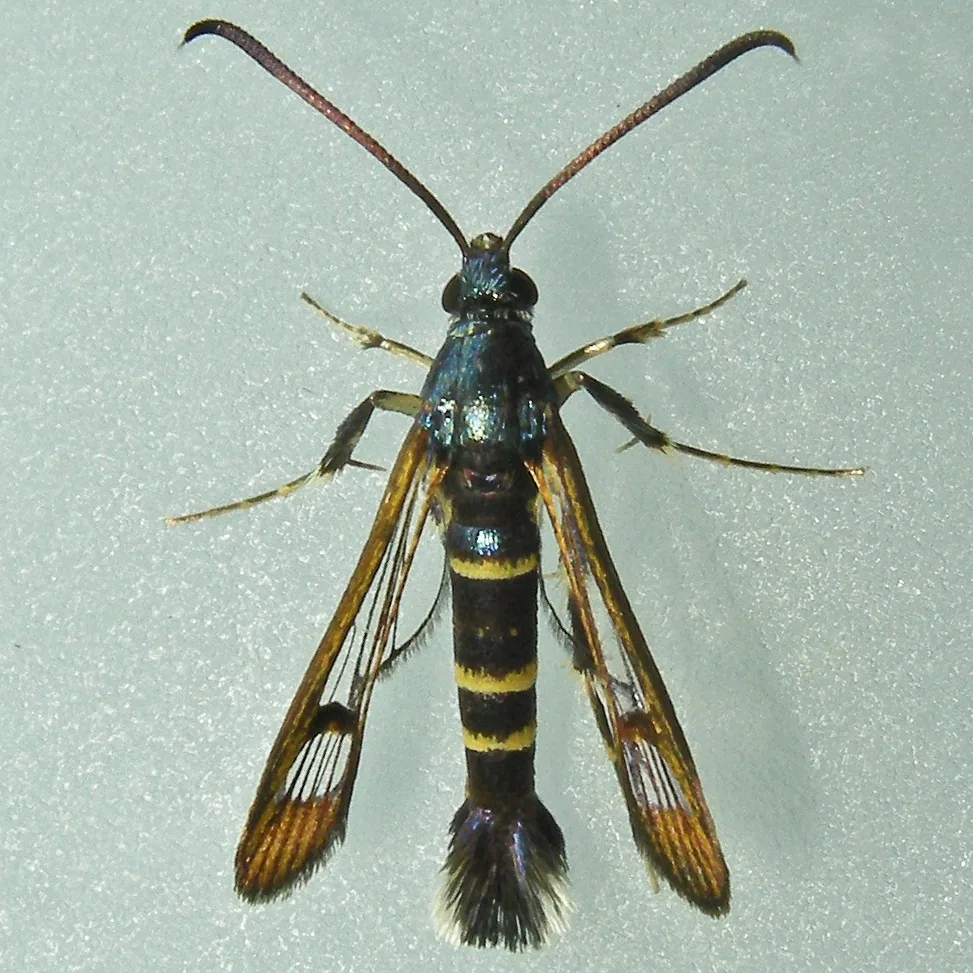
How to identify it
Look-alikes
| Look-alike | How to tell them apart |
|---|---|
| Paper wasps | The adult moth resembles a wasp.[1] |
Where it lives
HGIC covers it on rhododendrons and azaleas in South Carolina.[1]
Biology and life cycle
Females lay eggs on the bark; larvae bore in and make long tunnels within branches.[1]
By late fall larvae enter the sapwood to overwinter.[1]
Damage and signs
- Leaves on infested branches turn off-color and wilt, like drought stress; damage is most noticeable in fall.[1]
Health risk
It feeds on plants; Clemson HGIC mentions no risk to people.[1]
Control
Sanitation
Prune and destroy wilted or infested branches.[1]
Traps and physical control
Cut open wilted branches to look for larvae, and use pheromone traps to detect male moths.[1]
Pesticides
Permethrin can protect trunks and branches from newly hatched borers.[1]
Common questions
Sources
- Clemson Cooperative Extension, Home & Garden Information Center, “Azalea & Rhododendron Insect Pests (HGIC 2051).” hgic.clemson.edu/factsheet/azalea-rhododendron-insect-pests/ (accessed 2026-10-06)
- iNaturalist, “Synanthedon rhododendri taxon page (order and family).” www.inaturalist.org/taxa/417076 (accessed 2026-10-06)