On this page
How to identify it
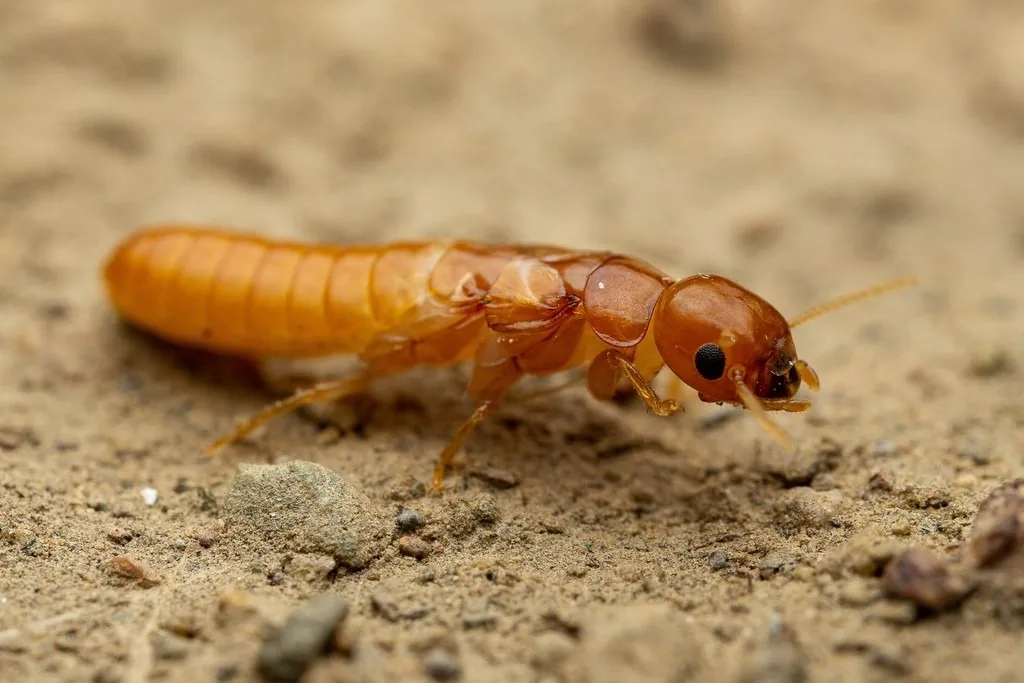
- Swarmers are pale yellow with light wings and intermediate in size, about 1/2 inch with wings; the dark western drywood termite's swarmers are dark brown with smoky-black wings. They fly at dusk, up to 20 flights from June into September, with no link to rain, and in southeastern California they come to lights.[1][2]
- The soldier's giveaway is the antenna: the third segment from the base is elongated and club-like, almost as long as all the remaining segments put together.[1]
- Like other drywood termites it leaves six-sided fecal pellets with longitudinal ridges, pushed out through kick holes under 2 mm across; the little piles below those holes are often the first sign. The pellets' hydrocarbons are species-specific enough that USDA Forest Service chemists could identify M. hubbardi from pellets alone, and it was the one species in their study with no detectable olefins.[1][2][3]
Look-alikes
| Look-alike | How to tell them apart |
|---|---|
| Dark western drywood termite (Incisitermes minor) | The more widespread and probably more destructive western drywood termite, with dark swarmers that fly on bright sunny days from June to August and soldiers with heavy jaws; it replaces M. hubbardi at higher elevations such as Prescott and Flagstaff.[1] |
| Desert subterranean termite (Heterotermes aureus) | A soil-nesting termite whose pale swarmers fly at dusk after monsoon rains and which builds shelter tubes up foundations; it can also swarm to lights in southeastern California.[1][2] |
| Dampwood termites | Larger swarmers that also fly in summer and fall and come to lights, and pellets that are football-shaped without the drywood termite's clear longitudinal ridges.[2] |
Where it lives
True desert regions of Arizona and southern California, mostly below 4,000 feet: from the southeastern California border along the Colorado River Valley through central and southern Arizona, including Phoenix and Tucson, and south down both coasts of the Gulf of California to the tip of Baja and to Colima on the mainland. UC IPM notes it in parts of southeastern California.[1][2]
Biology and life cycle
A drywood termite needs no contact with the soil; the colony lives entirely inside its food, drawing its moisture from the wood, and has no true workers, since the nymphs excavate galleries, tend the eggs and young and feed the king and queen. Colonies are small and slow to develop, usually under 1,000 in UC IPM's general account, though Arizona reports M. hubbardi colonies exceeding 2,000.[1][2]
Laboratory and field experiments show this species tolerates and prefers much drier conditions than the dark western drywood termite. In nature it attacks cottonwoods along canyons and streambeds in the north of its range and saguaro skeletons in the south.[1]
Damage and signs
- Both Arizona drywood termites attack sound dry wood. In the northern part of its range M. hubbardi takes a wide variety of dry sound wood, and in central and southern Arizona it is more commonly found in wooden human-made structures than in its natural habitat, where its damage can be extensive and problematic to structural integrity. The University of Arizona expects it to become an increasing pest as wood-frame homes spread through its range.[1]
- Infestations are hard to find: the termites are seldom seen outside swarming or repair work, and pellets alone cannot tell you whether an infestation is active or how far it extends. Cleaning the pellets away from a kick hole and checking for fresh ones a few days later helps.[2]
Health risk
A wood pest; neither extension source describes any effect on people.[1][2]
Control
Traps and physical control
Heat is the nonchemical whole-structure option, raising all wood to at least 120 F for 33 minutes with the house vacated for hours rather than days, though large beams and heat sinks such as wood on concrete are hard to bring to temperature; heat and microwave devices are also used as spot treatments, and infested boards can simply be removed.[2]
Pesticides
Whole-structure fumigation with sulfuryl fluoride treats every infestation at once, including hidden ones, and kills drywood termites within several days; a monitored fumigation has the highest success rate, and occupants, pets and plants must be out for several days. Localized liquid or dust treatments by licensed applicators work only when the colony is correctly located and the material reaches the termites; home-use products are not effective.[2]
When to call a professional
UC IPM does not recommend do-it-yourself treatment: the products are not available to homeowners, inspection takes experience, and except for removing infested wood the work belongs to a licensed professional. Inspectors look for feeding damage, shed wings, pellets and kick holes; get at least three inspection reports and check the company's license and complaint record.[2]
Common questions
- Pale termites are flying around my porch light at dusk in July. Which termite is it?
- In the low desert it could be the light western drywood termite, which swarms at dusk from June into September regardless of rain, or the desert subterranean termite, which flies at dusk after monsoon rains. A soldier settles it: M. hubbardi's third antennal segment is a long club.[1][2]
- How is it different from the ordinary western drywood termite?
- It is paler, swarms at dusk rather than on sunny days, prefers much drier wood, and lives at low elevations where the dark western drywood termite gives way to it.[1]
- Can I treat the pellets I found with a spray from the store?
- No. UC IPM says home-use products are not effective and the materials that work are restricted to licensed applicators; have the extent of the infestation inspected first.[2]
Sources
- University of Arizona Cooperative Extension, “Arizona Termites of Economic Importance, az1369 (Baker and Marchosky, June 2005).” extension.arizona.edu/sites/extension.arizona.edu/files/pubs/az1369.pdf (accessed 2026-11-10)
- University of California Statewide IPM Program, “Pest Notes: Drywood Termites.” ipm.ucanr.edu/home-and-landscape/drywood-termites/ (accessed 2026-11-10)
- Journal of Chemical Ecology (Springer), “Haverty, Woodrow, Nelson and Grace (USDA Forest Service Pacific Southwest Research Station and University of Hawaii). Identification of termite species by the hydrocarbons in their feces. Journal of Chemical Ecology 31: 2119-2151 (2005), PMID 16132216.” pubmed.ncbi.nlm.nih.gov/16132216/ (accessed 2026-11-10)
- iNaturalist, “Marginitermes hubbardi taxon page (order and family).” www.inaturalist.org/taxa/296460 (accessed 2026-11-10)