The short answer
- Stop all feeding first, by you and by neighbors. Handouts concentrate geese in bigger numbers than the site would naturally support.[9][10][11]
- Scaring and herding geese needs no federal permit, as long as the birds aren't harmed or handled. That covers trained dogs under control, people chasing, scare tape, flags, lasers kept off the birds' eyes, and noisemakers allowed by local law.[3][9][11]
- Change the habitat: let grass grow tall near the water or replace it with shrubs and ground covers, and put a fence, hedge or rock barrier along the shoreline so geese can't walk straight from water to lawn.[9][7][11]
- To stop eggs hatching, register free each year at the USFWS Resident Canada Goose Registration site before touching a nest. Registered landowners, homeowners' associations and local governments may oil eggs with 100% corn oil, puncture or shake them, or destroy the nest. Check your state's rules too.[1][2][3]
- Don't haze nesting geese or families during the summer molt, when they can't fly. Capturing or killing geese outside a hunting season needs federal and state permits, poisons are illegal, and moving geese to another site isn't an option.[7][9][10]
Related profiles
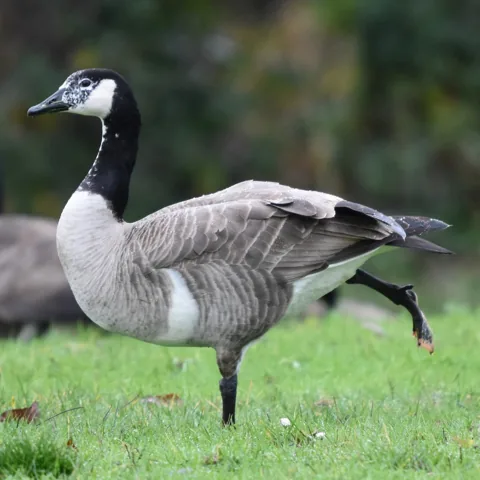 Canada Goose
Branta canadensis
Year-round resident Canada geese have become common in parks, golf courses, office grounds and neighborhoods with ponds and short grass. Problems grow with the flock: bare lawns, droppings on walkways, and nesting birds that attack people who come too close.
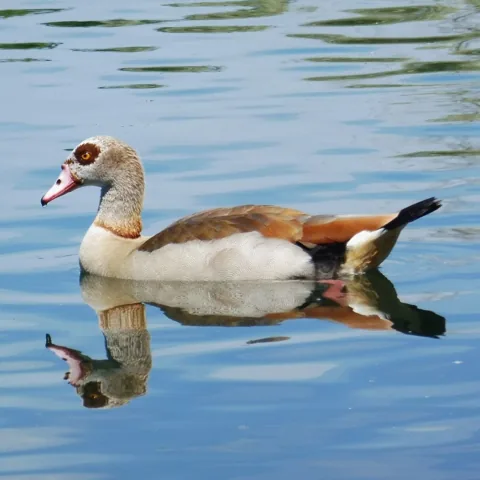 Egyptian Goose
Alopochen aegyptiaca
Egyptian geese are African waterfowl whose U.S. populations began with escaped or released captive birds. The U.S. Fish and Wildlife Service counts established populations only in Florida, Texas, California and Arkansas, where the birds stay mostly in urban and suburban areas.
What the law allows
The Migratory Bird Treaty Act prohibits the take (including killing, capturing, selling, trading and transport) of protected migratory birds without authorization from the U.S. Fish and Wildlife Service. Canada geese, including the year-round resident flocks, are covered, along with their nests and eggs. State laws protect them as well.[4][10][8]
Federal rules exempt scaring: under 50 CFR part 21, no permit is required merely to scare or herd depredating migratory birds, other than endangered or threatened species or bald or golden eagles. New York DEC puts it plainly: federal and state permits aren't needed to harass geese, as long as the birds aren't physically harmed.[3][9]
Clemson Extension adds a limit that matters for dogs: deterrents are allowed without a permit as long as the geese aren't purposefully handled by a person or another animal. Missouri's conservation department says a dog used this way is legally an extension of your hand and must not catch, injure or kill a goose.[11][10]
Shooting geese outside an established hunting season, capturing them, or euthanizing them requires depredation permits. The one major exception for property owners is the nest and egg depredation order described below, which replaces an individual permit with an online registration.[6][7][9]
Local laws apply on top of federal ones. Noise ordinances, fireworks codes and firearm-discharge rules can limit noisemakers and starter pistols, so check with local police before buying them.[9][10]
The same federal framework covers other birds that damage homes. The woodpecker and building-bird guides linked below explain how it applies to those species.[4][5]
Resident geese versus migrants
Federal rules define resident Canada geese as those that nest in the lower 48 states and the District of Columbia, or that live there in April, May, June, July or August. The special control rules apply only to these resident birds.[3][2]
USDA Wildlife Services says migratory Canada geese move between breeding grounds in Canada and wintering areas in the United States but don't nest in the lower 48 states. The geese nesting by your pond and staying through summer are residents.[6]
Resident geese are long-lived. New York DEC says some suburban geese live more than 20 years, and a female may produce more than 50 young in her lifetime; Missouri says a single pair can grow to more than 50 birds in as little as five years. Geese return each spring to where they hatched or nested before, which is why a few birds can become a flock.[9][10]
Step 1: stop the feeding
New York DEC calls ending supplemental feeding the first step in any control program. Fed geese gather in larger numbers than natural habitat would support, foul the most-used lawns and walkways, and are less likely to leave when winter weather arrives. Once feeding stops, some geese disperse.[9]
Bread does the geese no favors. Clemson and Missouri both say it is a poor food for them; Missouri adds that crowding at feeding spots makes geese more aggressive toward people and raises the risk of diseases such as avian botulism and avian cholera.[11][10]
Domestic ducks, geese and mute swans act as decoys that draw wild geese in, so Missouri recommends removing them from problem sites. Signs and no-feeding ordinances help in parks and neighborhoods.[10][9][11]
Step 2: make the lawn and shoreline less inviting
Geese want short, green grass next to open water with a clear view of approaching predators. Breaking any part of that combination makes a site less attractive.[9][7][10]
- Taller grass: New York DEC and ICWDM say to let grass or other plants grow to their full height of 10 to 14 inches around water; most geese eventually stop feeding there. Clemson suggests keeping turf at 8 inches and cutting fertilizer and watering. Missouri recommends no mowing for at least 20 feet back from a pond shoreline.[9][7][11][10]
- Different plants: geese prefer Kentucky bluegrass and are less drawn to fescue, according to New York DEC and ICWDM. Ivy, ferns, pachysandra and junipers are less palatable ground covers. Clemson, writing for the South, recommends centipedegrass and St. Augustinegrass for reseeding where geese aren't wanted.[9][7][11]
- Shoreline buffers: Clemson says a vegetative buffer of tall grasses, shrubs and trees at the water's edge should be at least 24 inches high, 25 feet wide and dense enough that geese can't see through it. Missouri notes giant Canada geese sometimes learn to walk through plant barriers, so fencing may need to be added.[11][10]
- Rocks and steep banks: large stones or steep banks make it harder for geese to walk between water and land. Missouri suggests rocks 4 feet in diameter or more, or a vertical seawall 3 feet above the water.[7][10][11]
- No islands: islands and peninsulas are favorite nesting sites and hold more nesting geese than mainland shores, so avoid creating them when landscaping a pond.[9][7]
- Let the pond freeze: Missouri says aerating ponds is one reason geese stay year-round in the north. Letting the pond freeze pushes them to other water. New York DEC lists fountains and aerators as ineffective and possibly attractive to geese.[10][9]
Step 3: fences and wire grids
Geese usually land on water and walk up onto lawns to feed, so a barrier at the water's edge works well. Fences work best during the summer molt, when geese can't fly and must walk everywhere.[9][7]
Sources give different heights. New York DEC and ICWDM say a goose fence should be at least 30 inches tall and solidly built, with 2 x 4-inch welded wire lasting for years; Clemson says at least 24 inches tall with openings no larger than 3 inches. ICWDM says the fence must completely enclose the site, and Clemson says it should run far enough that geese can't simply walk around the end.[9][7][11]
Cheaper options: snow fencing or erosion-control fabric works as a temporary barrier to molting geese. Two monofilament lines (20-pound test) at 6 and 12 inches above the ground, staked every 6 feet, can work but are less reliable. For electric fencing, ICWDM gives two strands at 8 and 16 inches or three strands at 5, 10 and 15 inches. Missouri says a three-strand electric fence seems effective, especially for private yards, and that electric fences should be well marked with signs and kept out of public-use areas.[9][7][10]
Wire grids over small ponds stop geese from landing. New York DEC and ICWDM describe single strands of 14-gauge wire or 80- to 100-pound monofilament spaced 10 to 15 feet apart and held 12 to 18 inches above the water. Missouri gives lines 20 feet apart and at least 3 feet above the water, best on water less than 150 feet across. Add flagging so birds can see the lines, and a perimeter barrier so geese don't walk in underneath.[9][7][10][11]
ICWDM says grids aren't practical for areas over 1 acre or for water used for swimming, fishing or other recreation.[7]
Step 4: chase them off (hazing)
Hazing works best as prevention, before geese settle in. Missouri says to start in late February or early March, when geese first start looking over a property. Harassment usually won't stop damage once it has started, and geese raised on a site are harder to move.[10][9][7]
Timing limits: don't haze nesting geese, or families during the molt when adults and goslings can't fly. ICWDM says hazing adults without young before the molt can encourage them to leave. New York DEC puts the molt at mid-June to late July, lasting 4 to 5 weeks; USDA and Missouri give mid-June to early July.[7][9][6][10]
- Dogs: New York DEC calls trained dogs among the most effective techniques available, and says geese don't get used to being chased by them. Chasing must be done several times a day for several weeks at first, then on regular patrols. Missouri says any athletic, medium-large dog that reliably obeys commands can work, not just border collies. Keep the dog under close control so it never catches a goose, and don't use it when geese are nesting, molting or have goslings.[9][10][7]
- Lasers: red and green lasers move geese in low light. New York DEC says to shine the beam on the ground or water several yards from the birds and move it slowly toward them, never into a goose's eyes, which can harm the bird and is not legal. ICWDM says to keep the beam below the horizon and away from buildings, people and planes. Lasers don't work on nesting, molting or flightless birds.[9][7][10]
- Visual scare devices: Mylar tape strung along the water's edge, flags or eye-spot balloons on poles 6 feet or taller, and remote-control boats on small ponds. They work best where geese aren't already established and need to be moved often so geese don't get used to them.[9][7][11]
- Noisemakers: screamers, bangers and whistle bombs fired from a starter or flare pistol, and shell crackers fired from a 12-gauge shotgun. Missouri says screamers and bangers may be used without a permit but shell crackers require one, with storage rules from the Bureau of Alcohol, Tobacco, Firearms and Explosives. Geese at busy sites may get used to noise in 1 to 2 weeks, and noise often doesn't work on nesting geese.[10][9][7][11]
- Persistence: chasing on foot or by golf cart, air horns and water sprayers all help when combined with other methods. Missouri's advice is to be more persistent than the geese.[10]
Lawn repellents
EPA has approved anthraquinone and methyl anthranilate as goose repellents on lawns. Geese feed less on treated grass, though they may still walk across it to reach untreated areas.[7][9]
Repellents need repeat applications. Mowing removes them, so reapply after mowing. Missouri says both kinds resist rain once dry; Clemson says methyl anthranilate products are usually reapplied every 4 to 5 days, more often after heavy rain. Follow the label: New York DEC warns that too dilute a mix won't work and too strong a mix can kill grass.[7][10][11][9]
Because of the cost and frequent reapplication, New York DEC and ICWDM say repellents are most practical on small lawns. ICWDM notes that commercial application requires a state-certified pesticide applicator.[9][7]
Stopping eggs from hatching: the USFWS registration
Under the resident Canada goose nest and egg depredation order (50 CFR 21.162, cited as 21.50 in older documents), private landowners, public land managers, homeowners' associations and village, town, municipal and county governments may destroy resident goose nests and eggs on property under their jurisdiction, when needed to resolve or prevent injury to people, property, crops or other interests.[3][2][6]
Before any nest work, the landowner must register online with the Service at the Resident Canada Goose Registration site. Registration is free, has to be renewed every year before nests and eggs are destroyed, and requires listing each employee or agent who will do the work. You must be at least 18 to register.[1][2][3]
A homeowners' association or local government can register common areas or its whole jurisdiction, so members don't each need to register, but it must get the landowner's permission before treating a nest on an individual's property. A landowner may also register and name a wildlife control company as agent; the registration stays in the landowner's name.[2][3]
The order covers the lower 48 states and the District of Columbia, not Alaska, Hawaii, Puerto Rico or the territories. Some states don't take part in the registration program or have extra or stricter requirements, so check your state wildlife agency before registering.[2][1]
Registrants are expected to use nonlethal methods as they see fit to reduce how much nest and egg destruction is needed. The order allows nothing beyond resident goose nests and eggs: no killing geese and no touching other birds' nests.[3][2]
Each year registrants must report how many nests with eggs were destroyed, by month and county, even if they did nothing. The regulation and USDA's 2009 guide give an October 31 deadline; the registration site and its FAQ now say December 31 with a 30-day grace period. Follow the date the site shows when you register. An outstanding report blocks future registrations.[3][6][1][2]
Older guides from USDA (2009), Clemson (2013) and Missouri say registration runs January 1 to June 30 and nest work from March 1 to June 30. The current regulation allows nest and egg work at any time of year, and the registration site says registration is open all year.[6][11][10][3][1]
A goose nest that is still being built and has no eggs counts as inactive under a 2025 USFWS policy memo, and inactive nests can be destroyed without federal authorization as long as nobody keeps the nest or its contents. State rules may still apply.[5][7]
How egg oiling, puncturing and shaking work
Treating eggs and leaving them in the nest usually beats removing them. New York DEC and Missouri say that if the nest is destroyed or the eggs taken, the female may lay again. With treated eggs, she keeps incubating until the eggs would have hatched, then gives up and may move out of the area.[9][10][6]
Timing: USDA Wildlife Services suggests first nest searches around March 10 to 25 in the southern U.S., March 25 to April 10 at mid latitudes, and April 10 to 25 in the north. Treat once the clutch is complete and incubation has started, which warm eggs show. Plan 2 to 3 follow-up visits for missed eggs and new nests; the last is usually in early to mid May.[6][11]
Clutches run 2 to 12 eggs, averaging 5, and incubation lasts 28 days. USDA notes that some people limit treatment to the first 14 days of incubation and use an egg float test to judge age: fresh eggs lie on the bottom of a bucket of water, and eggs start floating near the top at around 14 to 18 days. Clemson reports that humane groups advise not oiling eggs that float.[6][11]
- Oiling: coat each egg in a thin film of 100% food-grade corn oil, by dipping and wiping, wiping with a soaked cloth, or spraying, then return it to the nest. The oil blocks the pores in the shell. Mark each egg on both sides with a permanent marker first. USDA notes some states require a pesticide license for oiling, so check before you start.[6][2][11]
- Puncturing: brace the egg against the ground, push a long thin metal probe such as an awl or ice pick into the pointed end, and swirl the tip inside.[6][11]
- Shaking (addling): shake each egg hard for 5 to 10 minutes and return it to the nest. USDA calls this the most problematic method because it takes so long and it's hard to know when an egg has been shaken enough.[6][11]
- Nest destruction: where a nest is on a rooftop, doorstep, walkway or playground, remove the eggs and nest material and cover the spot with an object such as an overturned garbage can or branches. The pair may renest nearby, so check again.[6]
- Disposal: destroyed eggs and nest material may be left in the field, buried, burned or put in the trash, following local rules. Nothing may be kept, sold or traded. Moving a nest is not allowed and doesn't work: the geese won't accept it in a new spot, and they will just build another nest.[2][6]
Working near a nest without getting hurt
Nesting geese hiss, spread their wings and may run or fly at you, striking with their wings and biting. USDA says the gander standing guard is the bird most likely to attack, and geese used to people are more aggressive than rural geese.[6]
Work in pairs: one person treats the eggs while the other keeps the geese back with slow, steady pressure from a broom, paddle or branch. Leave the geese an escape route. Some experienced workers use a life jacket, boat paddle or trash can lid to fend off attacks. Treating a nest usually takes no more than 5 minutes, and working in the cool early morning reduces stress on the birds.[6]
Treated eggs turn putrid and can burst if knocked together, so don't handle them on later visits. Mark the nest site with flagging to find it again.[6]
If you'd rather leave a nest alone near a door or path, opaque fencing between the nest and foot traffic lets the goose incubate while keeping people safe. New York DEC suggests 48 to 60 inches of fence height to block aggressive birds.[10][9]
What to expect from egg treatment
Egg treatment cuts the number of goslings on a site and makes adults easier to chase off after nesting, since geese without flightless young leave more readily when harassed.[6][9]
It doesn't shrink a flock quickly. New York DEC says it may take 5 to 10 years of treatment before goose numbers change, and works best done across a whole town. Clemson cites population models in which a resident population stayed stable even with 72% of eggs removed, and removing 95% took ten years to bring numbers down to 75% of the original.[9][11][6]
Goslings from untreated nests next door can walk onto your property in May and June along streams and greenways. Coordinating egg treatment with neighbors fixes that over time, and fencing can steer flightless families.[6][9]
Hunting and removal: permits required
Hunting removes some geese and makes the rest warier of noisemakers. Several states hold special seasons to reduce resident geese, most starting in September. Hunters need a state license and a federal Migratory Bird Hunting Stamp, and local laws on discharging firearms apply.[9][7][10]
Capture and removal happens during the molt under federal and state permits, usually by USDA Wildlife Services or the state wildlife agency. Captured geese can be processed and donated to food pantries or charities. Clemson and Missouri say the requesting party pays the costs, and Missouri treats it as a last resort after other substantial efforts have failed.[11][10][9]
Separate federal orders let airports and military airfields control resident geese, and let states authorize control at agricultural facilities or where geese pose a public health threat. For any of these, contact USDA Wildlife Services or your state wildlife agency.[3][2][9]
A fertility-control bait containing nicarbazin reduces hatching when geese eat it through the breeding season. USDA's 2009 guide says it is a restricted-use product that only licensed specialists can buy and use, it needs state approval and a federal depredation permit, some states prohibit fertility control in wildlife, and the baiting itself can draw more birds.[6]
What doesn't work or isn't allowed
Wildlife agencies get asked about these often. Some are illegal and the rest have not held up for resident geese.[9][10]
- Poison: no toxicants are registered for Canada geese, and poisoning them is illegal.[7][10][9]
- Relocation: banded geese moved from New York have come back from as far away as Maine, South Carolina and Oklahoma, and geese moved less than 50 miles may return as soon as they can fly. Clemson notes relocation is not permitted in South Carolina.[9][11]
- Fake swans, owls, alligators, scarecrows and dead-goose decoys: Missouri and New York DEC found them ineffective, or effective only briefly, for resident geese.[10][9]
- Recorded distress calls: not proven for geese, according to New York DEC; ICWDM reports varying results, with geese sometimes just moving across the pond.[9][7]
- Fountains and aerators: not effective and may even attract geese.[9][10]
- Moving a nest with eggs: not allowed under the depredation order, and the geese abandon it.[2][6]
Common questions
- Can I chase Canada geese off my property?
- Yes. No federal permit is needed to scare or herd geese as long as they aren't harmed or handled. Keep dogs under control so they never catch a goose, and don't haze nesting geese or families that can't fly during the summer molt.[3][9][10][7]
- Is it legal to destroy a Canada goose nest?
- Only if you're registered. Landowners, homeowners' associations and local governments in the lower 48 states and DC can register free online with the U.S. Fish and Wildlife Service each year, then destroy or treat resident goose nests and eggs on their property. Check your state's rules as well.[1][2][3]
- What does egg addling mean?
- Treating eggs so they don't hatch, by oiling them with 100% corn oil, puncturing them or shaking them, then putting them back so the goose keeps sitting instead of laying a new clutch. It needs a USFWS registration first.[6][2][9]
- When should I start?
- In late winter, before nesting begins, or as soon as geese show up where they aren't wanted. Hazing works best before geese settle in, and nest searches usually start in March or April depending on latitude.[9][10][6]
- Can I shoot or trap problem geese?
- Not without federal and state permits, except during a legal hunting season with the required licenses and stamps. Capture and removal programs are run under permits, usually through USDA Wildlife Services or the state wildlife agency.[6][9][7]
- Do goose decoys or plastic swans work?
- Generally no. Wildlife agencies in Missouri and New York report that swans, scarecrows and dead-goose decoys don't keep resident geese away, or work only briefly.[10][9]
Photo credits
- Canada Goose: (c) Tser, some rights reserved (CC BY) — via iNaturalist, CC BY 4.0
- Egyptian Goose: (c) Barry Walter, some rights reserved (CC BY) — via iNaturalist, CC BY 4.0
Sources
- U.S. Fish and Wildlife Service, “Resident Canada Goose Registration (RCGR): Resident Canada Goose Nest and Egg Registration Site.” apps.fws.gov/rcgr/ (accessed 2026-11-10)
- U.S. Fish and Wildlife Service, “RCGR FAQ: Resident Canada Goose Nest & Egg Depredation Order.” apps.fws.gov/rcgr/resources/faq (accessed 2026-11-10)
- Electronic Code of Federal Regulations (eCFR), “50 CFR Part 21, Migratory Bird Permits (sections 21.6, 21.100, 21.159, 21.162, 21.165, 21.168).” www.ecfr.gov/current/title-50/chapter-I/subchapter-B/part-21 (accessed 2026-11-10)
- U.S. Fish and Wildlife Service, “Migratory Bird Treaty Act of 1918.” www.fws.gov/law/migratory-bird-treaty-act-1918 (accessed 2026-11-10)
- U.S. Fish and Wildlife Service, “Migratory Bird Permit Memorandum MBPM-2-02: Authorizations to take migratory bird nests and contents (2025).” www.fws.gov/sites/default/files/documents/2025-01/mbpm-2-nest-memorandum-2025.pdf (accessed 2026-11-10)
- USDA APHIS Wildlife Services, “Management of Canada Goose Nesting (August 2009).” www.aphis.usda.gov/sites/default/files/canada_goose.pdf (accessed 2026-11-10). Predates the current regulation: its March 1 to June 30 window and January 1 to June 30 registration period no longer apply.
- Internet Center for Wildlife Damage Management, “Canada Goose Damage Prevention and Control Methods.” icwdm.org/species/birds/canada-geese/canada-goose-damage-prevention-and-control-methods/ (accessed 2026-11-10). Run by university wildlife damage specialists; species modules are based on Prevention and Control of Wildlife Damage (University of Nebraska Cooperative Extension, 1994).
- Internet Center for Wildlife Damage Management, “Canada Geese: Identification and Legal Status.” icwdm.org/species/birds/canada-geese/ (accessed 2026-11-10)
- New York State Department of Environmental Conservation, “When Geese Become a Problem: Managing Nuisance Canada Geese in New York.” dec.ny.gov/sites/default/files/2025-04/geeseproblem.pdf (accessed 2026-11-10)
- Missouri Department of Conservation, “Controlling Conflicts with Urban Canada Geese in Missouri (revised 2018).” mdc.mo.gov/sites/default/files/2022-06/W00081%20Controlling%20Conflicts%20with%20Urban%20Canada%20Geese%20in%20Missouri.pdf (accessed 2026-11-10)
- Clemson Cooperative Extension, Home & Garden Information Center, “HGIC 1854: Resident Canada Geese: Management Options (2013).” hgic.clemson.edu/factsheet/resident-canada-geese-management-options/ (accessed 2026-11-10)