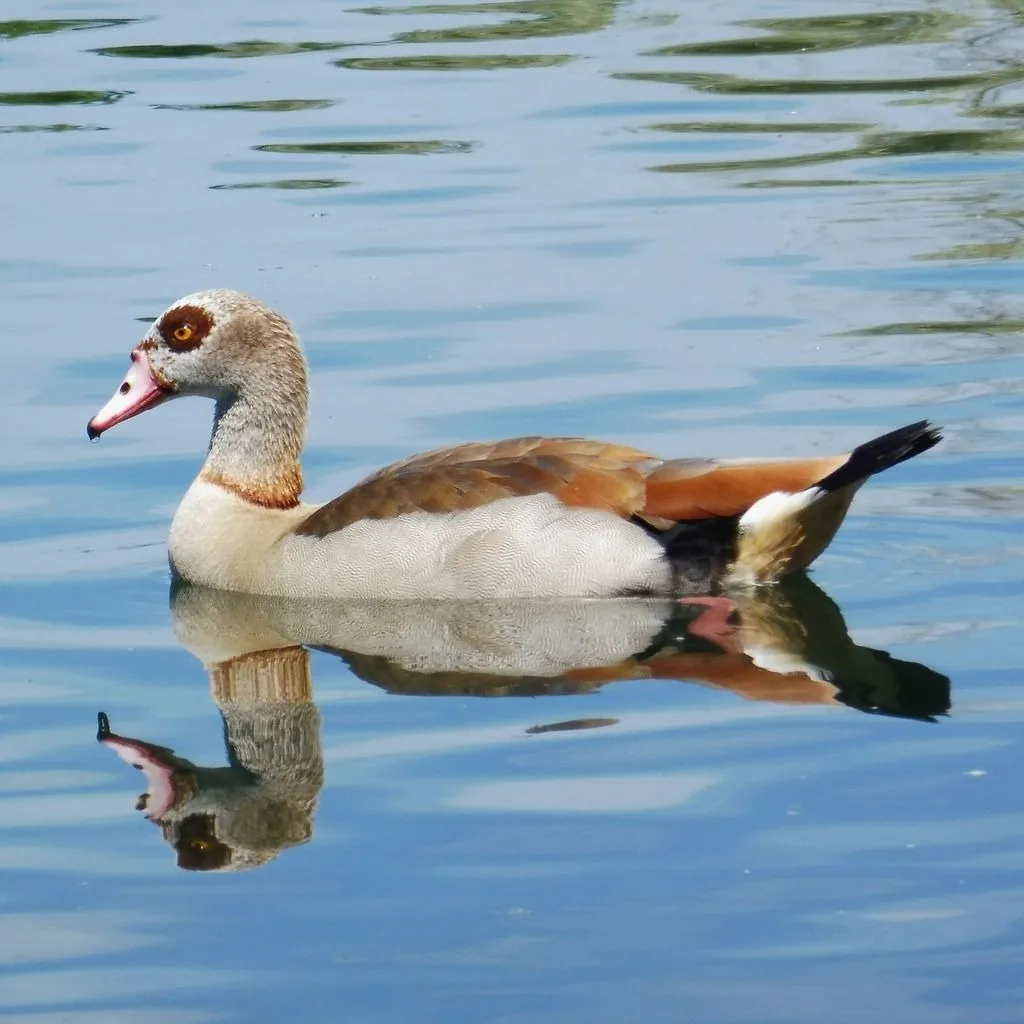
How to identify it
- A reddish-brown mask surrounds a pale orangish eye on a pale beige head.[1][2]
- It has a dark collar, a dark brown patch in the middle of the breast, light gray underparts and a chestnut patch near the black tail.[1][2]
- The bill and legs are pink. Young birds lack the eye mask.[1][2]
- In flight, large white wing patches contrast with otherwise dark wings.[1][2]
- It is larger than a mallard but smaller than a graylag goose, roughly 25 to 29 inches long.[1]
- Despite the name, it is technically a shelduck rather than a true goose, and it often perches and even nests in trees.[2][1]
Look-alikes
| Look-alike | How to tell them apart |
|---|---|
| Canada goose | A Canada goose has a black head and neck with a big white cheek patch instead of a brown eye mask.[6] |
| Muscovy duck | Egyptian geese are larger than Muscovy ducks and have a brown eye patch and pink bill rather than red facial bumps.[2][7] |
Where it lives
Native to Africa south of the Sahara and the Nile Valley. Populations are established and increasing in Florida, especially the southeastern peninsula, with smaller ones in Texas, California and Arkansas.[3][2]
Biology and life cycle
They live in pairs or family groups and graze grass on shore as well as feeding while swimming.[1]
The diet is mainly seeds, grass and algae, with occasional insects, frogs and worms.[2]
Nests are usually on the ground but can be in trees or on top of buildings.[2]
Clutches are large, 5 to 11 eggs, incubated for 28 to 30 days, and the young fledge in about 70 days.[2][3]
Pairs bond strongly, and males become very aggressive during mating and nesting.[2][3]
Damage and signs
- Egyptian geese can cause significant damage in suburban areas such as parks, where grazing damage and heavy droppings are major problems.[2]
- Large groups can damage habitat by grazing and trampling, and their droppings can over-fertilize still ponds.[3]
- Nesting pairs fiercely defend their territory, honking, hissing and chasing intruders away.[2]
- Their aggressive behavior can keep native ducks and coots from setting up territories, and they compete with other birds for nest sites.[3][2]
Health risk
Heavy droppings around buildings and parks increase the chance of spreading disease, and wild Egyptian geese in Africa have carried avian influenza viruses.[2][3]
Control
Traps and physical control
Florida property owners may take nuisance wildlife causing damage with live traps or, where allowed, firearms in daylight. Check every trap at least once every 24 hours.[5]
Nonnative wildlife may not be relocated or released; a live-captured nonnative animal must be humanely euthanized within 24 hours.[5]
When to call a professional
Property owners may authorize a wildlife trapper to remove nuisance animals; the FWC doesn't license trappers but lists them on its website.[5]
Legal status
The U.S. Fish and Wildlife Service lists the Egyptian goose as a nonnative bird that the Migratory Bird Treaty Act does not protect.[4]
In Florida, nuisance wildlife rules still apply: non-target animals must be released on site, and the property owner must give consent.[5]
Firearm discharge may be banned in some cities and residential areas, so check with local law enforcement first.[5]
Never catch Egyptian geese and release them elsewhere; Florida allows nonnative wildlife to be moved only for euthanasia.[5]
Common questions
- Are Egyptian geese protected like Canada geese?
- No. The U.S. Fish and Wildlife Service lists them as nonnative birds outside the Migratory Bird Treaty Act, though state and local rules still apply.[4][5]
- Why are Egyptian geese so aggressive?
- Pairs defend their nest and territory fiercely, especially during mating and nesting, honking, hissing and chasing intruders.[2][3]
- Can I trap Egyptian geese and release them at a lake?
- Not in Florida. Nonnative wildlife may only be transported for euthanasia, not released.[5]
Sources
- Cornell Lab of Ornithology, All About Birds, “Egyptian Goose Identification.” www.allaboutbirds.org/guide/Egyptian_Goose/id (accessed 2026-10-06)
- UF/IFAS Extension Sumter County, “Wildlife & Invasive Species Education (WISE) Species Profile: The Egyptian Goose (Jim E. Davis, updated March 25, 2024).” blogs.ifas.ufl.edu/sumterco/2022/12/28/wildlife-invasive-species-education-wise-species-profile-the-egyptian-goose/ (accessed 2026-10-06)
- U.S. Fish and Wildlife Service, “Egyptian Goose (Alopochen aegyptiaca) Ecological Risk Screening Summary (December 2016; web version April 2, 2018).” www.fws.gov/sites/default/files/documents/Ecological-Risk-Screening-Summary-Egyptian-Goose.pdf (accessed 2026-10-06)
- U.S. Fish and Wildlife Service (Federal Register), “List of Bird Species To Which the Migratory Bird Treaty Act Does Not Apply, 85 FR 21262 (April 16, 2020).” www.govinfo.gov/content/pkg/FR-2020-04-16/html/2020-06782.htm (accessed 2026-10-06). Lists the Egyptian goose (Alopochen aegyptiaca) as a nonnative species the MBTA does not protect.
- Florida Fish and Wildlife Conservation Commission, “FAQs: Nuisance Wildlife.” myfwc.com/conservation/you-conserve/wildlife/faqs-nuisance-wildlife/ (accessed 2026-10-06)
- Internet Center for Wildlife Damage Management, “Canada Geese: Identification.” icwdm.org/species/birds/canada-geese/ (accessed 2026-10-06). Run by university wildlife damage specialists (maintained at the University of Wisconsin-Stevens Point); species modules are based on Prevention and Control of Wildlife Damage (University of Nebraska Cooperative Extension, 1994).
- University of Florida IFAS Extension (EDIS), “Florida's Introduced Birds: Muscovy Duck (Cairina moschata), WEC 254.” journals.flvc.org/edis/article/view/117879 (accessed 2026-10-06). First published March 2009; archival EDIS copy.
- iNaturalist, “Alopochen aegyptiaca taxon page (order and family).” www.inaturalist.org/taxa/72486 (accessed 2026-10-06)