How to identify it
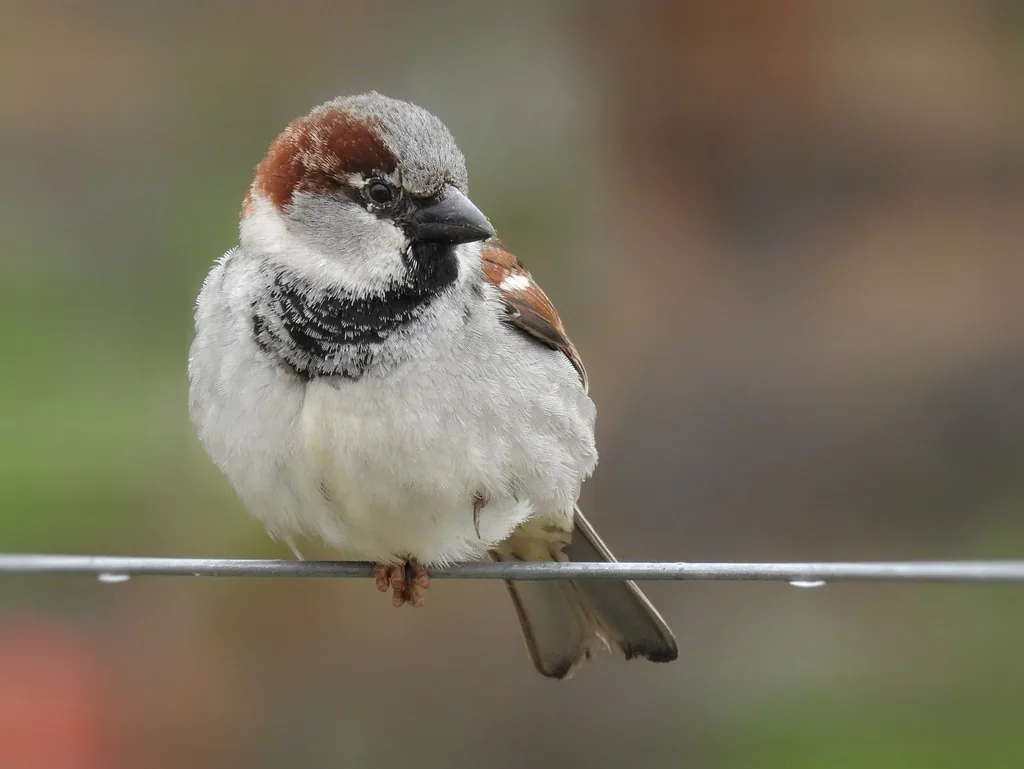
- A brown, chunky bird about 5 to 6-1/2 inches long, weighing less than an ounce, with a streaked brown back and gray breast and belly.[2][3]
- Males have a black bib, white cheeks, a gray crown edged in chestnut and chestnut wing feathers.[3][2]
- Females and young have a plain, dingy-gray breast, a buffy stripe behind the eye and a streaked back.[3]
- The call is a sharp, repeated cheep.[2]
- Nests are untidy, bulky piles of grass, string, paper, feathers and plastic that fill the cavity they are built in.[2][1]
Look-alikes
| Look-alike | How to tell them apart |
|---|---|
| Native sparrows (song, chipping and others) | Female house sparrows are hard to tell from some native sparrows, which are protected and beneficial; males are easy to spot by the black bib, so confirm the species before control.[3][2] |
| European starling | Starlings are larger, about 8 inches, dark and glossy or white-spotted, with long, slender bills; house sparrows are small, streaky brown birds only 5 to 6-1/2 inches long.[2][4] |
Where it lives
First released in Brooklyn, New York, in 1850, house sparrows spread across the continent and now live in human-altered habitats on every continent except Antarctica.[3][1]
Biology and life cycle
They nest from spring through late summer in cavities of houses, barns, signs, bridges and bird boxes, and sometimes in vines on walls.[1][3]
Females lay clutches of about 3 to 9 eggs and can nest up to five times a year, beginning in early April.[2][3]
Eggs hatch in 10 to 14 days and young leave the nest after about 15 days.[3]
House sparrows do not migrate; most adults stay within about a mile and a quarter of the nest site while breeding.[3]
They eat mostly seeds and grain, especially corn, plus insects in warm months, and feed nestlings mostly animal matter.[1][3]
Outside the nesting season, flocks feed on the ground and roost in dense shrubs, vines and on buildings.[1]
Damage and signs
- Bulky, flammable nests tucked into vents, eaves and signs are a potential fire hazard.[3][1]
- Droppings and feathers under roosts create unsanitary, smelly conditions on sidewalks and around buildings.[3][1]
- They eat and contaminate grain and livestock feed, and peck seedlings, buds, fruit and vegetables in gardens.[3][1]
- They drive bluebirds, purple martins and other native birds from nest boxes, destroying eggs and young and sometimes killing adults.[3][2]
- Their nests harbor mites, lice and fleas that can spread to poultry and occasionally bite people.[1][3]
Health risk
House sparrows can carry salmonellosis, psittacosis and various parasites, so wear gloves and protection when removing nests or cleaning droppings.[2][1]
Control
Keep them out
Close all openings larger than 3/4 inch on buildings, and use mesh no bigger than 3/4 inch to cover larger openings.[1][3]
Screen exhaust vents with 1/2-inch mesh, box in gaps under dormers, eaves and porches, and block spaces behind signs and window air conditioners.[2][3]
Remove dense vines and shrubbery used for roosting, or cover plantings you want to keep with plastic mesh or netting.[1][3]
Slope ledges to 45 degrees or more with sheet metal, plexiglass or wood so sparrows can't roost or nest on them.[1][3]
Sanitation
Clean up spilled grain and seed and seal grain bins; in Iowa, less open grain around livestock is a big reason house sparrows are far scarcer than a century ago.[1]
Traps and physical control
Pull nests and eggs from building cavities and nest boxes about every two weeks through the nesting season, bagging the material and wearing gloves.[1][2]
Funnel traps and automatic elevator traps catch house sparrows; move traps around to avoid trap shyness and release native birds unharmed.[1][2]
Protecting bluebird and martin houses
House sparrows quickly take over unattended martin houses; block martin house entrances until martins return in spring.[3]
Remove sparrow nests from nest boxes as soon as they appear and keep removing them, because the birds rebuild quickly.[1][2]
Legal status
House sparrows are non-native and are not protected by the federal Migratory Bird Treaty Act, and Iowa and Nebraska exempt them from state protection.[2][1]
A few states may still require permits or limit control methods, so check state and local rules before shooting or using toxic baits.[3]
Common questions
- How do I stop sparrows from nesting in my vents and eaves?
- Remove the nest, cover exhaust vents with mesh (watching dryer vents for lint buildup), and close gaps over 3/4 inch; keep checking, since sparrows try again.[2][1][3]
- Are house sparrows protected?
- Not federally. They are non-native and exempt from the Migratory Bird Treaty Act, but check state and local rules and be sure it isn't a native sparrow.[2][3]
- Why are sparrows kicking bluebirds out of my nest box?
- House sparrows aggressively compete for nest cavities and often destroy bluebird eggs and young, so remove their nests promptly.[3][2][1]
Sources
- Iowa State University Extension and Outreach, Natural Resource Stewardship, “Nuisance Birds: Damage Management (last reviewed July 1, 2019).” naturalresources.extension.iastate.edu/encyclopedia/nuisance-birds-damage-management (accessed 2026-10-06)
- University of Nebraska-Lincoln Extension, “G2024: Urban Pest Birds: Controlling Damage.” extensionpubs.unl.edu/publication/g2024/html/view (accessed 2026-10-06)
- University of Nebraska-Lincoln Cooperative Extension, USDA-APHIS Animal Damage Control and Great Plains Agricultural Council, “House Sparrows, in Prevention and Control of Wildlife Damage (W. D. Fitzwater, 1994).” digitalcommons.unl.edu/icwdmhandbook/71 (accessed 2026-10-06). 1994 handbook chapter; used here for identification, biology and exclusion details only. Its toxicant listings are outdated.
- University of Illinois Extension, “European Starlings (Invasive Species).” extension.illinois.edu/invasives/european-starlings (accessed 2026-10-06)
- iNaturalist, “Passer domesticus taxon page (order and family).” www.inaturalist.org/taxa/13858 (accessed 2026-10-06)