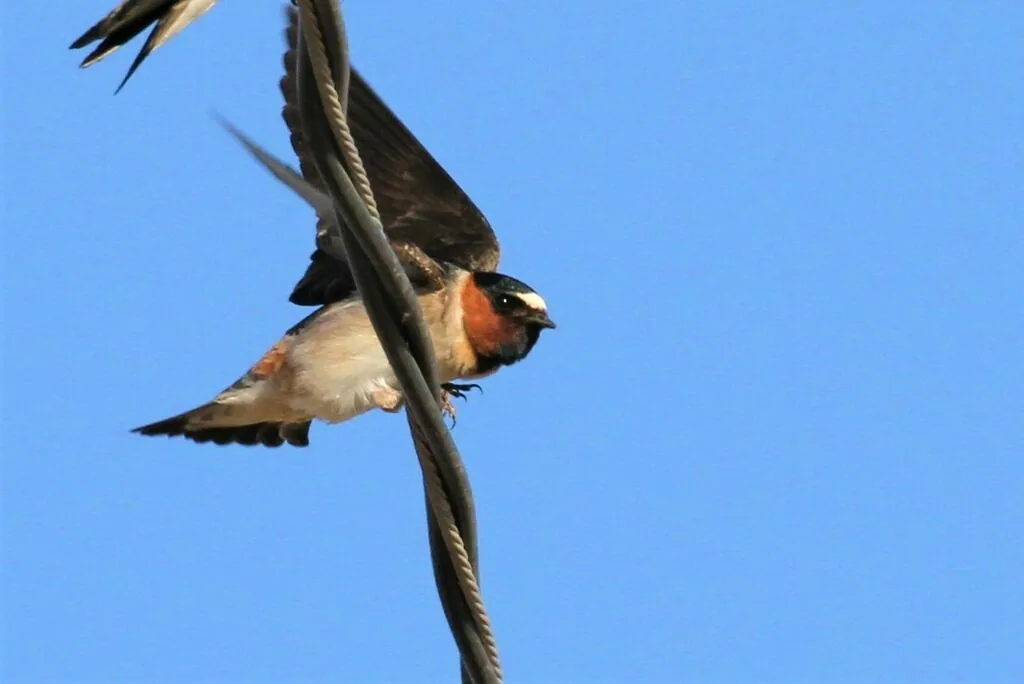
How to identify it
- A small swallow, 5 to 6 inches long, with a square tail rather than a forked one.[1][2]
- Look for a pale orange-brown rump, a white forehead, a dark rust-colored throat, and a steel blue crown and back.[1][2]
- Nests are enclosed, gourd-shaped mud structures with a small entrance, usually built in dense clusters under an overhang.[1][2]
- White droppings rimming a nest entrance are a sign that young birds are inside.[1]
Look-alikes
| Look-alike | How to tell them apart |
|---|---|
| Barn swallow | Has a long, deeply forked tail and builds an open, cup-shaped mud nest mixed with grass and feathers, usually as a single pair rather than a colony.[1] |
| House sparrow | House sparrows sometimes take over empty swallow nests; a taken-over nest has grass, weeds and feathers sticking out of the entrance.[1] |
Where it lives
Cliff swallows winter in South America and migrate north through Central America and Mexico each spring. Colonies need open foraging ground, an overhang, good mud and fresh water, so they gather near ponds, rivers, bridges and overpasses.[1][2]
Biology and life cycle
Colonies near people can hold up to several hundred pairs; in the West, Cornell reports up to 3,700 nests in one spot.[1][2]
Adults tend to return to the same colony each year and are strongly attracted to old nests, which they claim and repair quickly.[1]
Both parents build the nest from 1,000 to 1,400 mud pellets gathered at puddles and ditches up to half a mile away, taking 1 to 2 weeks.[1]
Females lay 3 to 4 eggs, which hatch in 15 or 16 days; the young fledge 20 to 25 days later.[1]
Birds are usually at a colony for up to 100 days and head south by mid-August, with few left by the end of September.[1]
They feed on flying insects such as flies, beetles and mosquitoes, caught in the air.[1][2]
Damage and signs
Health risk
Swallow nests often hold mites and swallow bugs, relatives of bed bugs that will bite people, although humans aren't their usual host. Droppings can also contaminate foodstuffs.[1]
Control
Prevention
Swallows prefer rough surfaces; smooth materials such as sheet metal or a slick coat of paint under the eave can discourage nest attachment.[1]
Hawk, owl or snake models, alarm-call recordings, noisemakers, revolving lights and chemical roost repellents have shown little success.[1]
Keep them out
Netting with 1/2- to 3/4-inch mesh, pulled taut from the outer edge of the eave down to the wall, is the recommended long-term solution.[1]
Put netting up before the birds arrive and cover every suitable part of the building, or the swallows will just move to an unprotected section.[1]
Traps and physical control
Where legal, remove old nests and nests under construction by washing them down or knocking them off with a pole, and clear away every trace of mud.[1]
When to call a professional
There are no toxicants registered for cliff swallows, and shooting, trapping or harming them is not permitted; for permits, contact USDA APHIS Wildlife Services in your state.[1]
What the law allows
All swallows are protected by the Migratory Bird Treaty Act, which makes it illegal to take or possess the birds, their nests or eggs without a permit.[1]
In California, the state treats February 15 to September 1 as swallow nesting season; completed nests can't be touched in that window without a U.S. Fish and Wildlife Service permit.[1]
Outside those dates, nests can be removed without a permit, and exclusion is allowed before birds arrive or while no eggs or young are present.[1]
Permits during nesting are granted only for compelling reasons, such as a colony over a doorway or a food-processing area, and are unlikely if eggs or young are present.[1]
Dates and rules can vary by state, so check with your state wildlife agency before you act.[1]
Common questions
- Can I knock down cliff swallow nests?
- Only when the law allows. Nests with eggs or young are protected, and in California completed nests can't be touched during nesting season without a federal permit.[1]
- When should I put up netting?
- Before the swallows arrive in late winter or early spring, or after they leave in late summer. Netting can't be used on nests with eggs or young without a permit.[1]
- Why do the swallows come back every year?
- Adults return to the same colony and are drawn to old nests and even nest remnants, so remove all the mud and block the site.[1]
Sources
- University of California Statewide IPM Program, “Pest Notes: Cliff Swallows, UC ANR Publication 7482 (T. P. Salmon and W. P. Gorenzel).” ipm.ucanr.edu/home-and-landscape/cliff-swallows/ (accessed 2026-10-06)
- Cornell Lab of Ornithology, “Cliff Swallow Overview (All About Birds).” www.allaboutbirds.org/guide/Cliff_Swallow/overview (accessed 2026-10-06)
- iNaturalist, “Petrochelidon pyrrhonota taxon page (order and family).” www.inaturalist.org/taxa/11858 (accessed 2026-10-06)