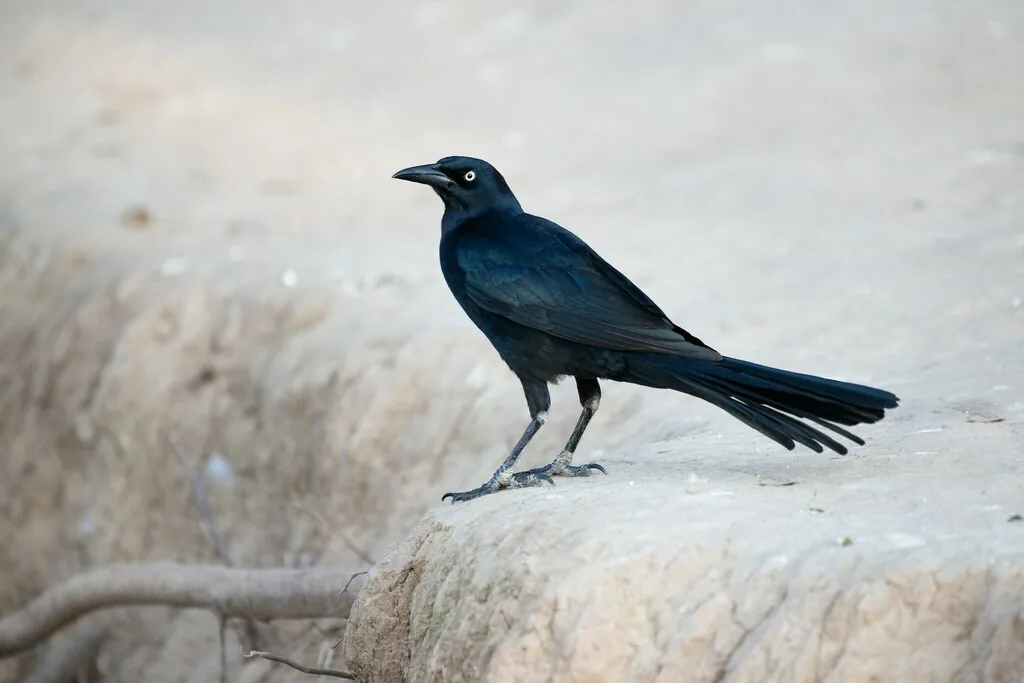
How to identify it
- The largest grackle, with longer wings and an extremely long, keel-shaped tail; the male's tail folds into a V.[1][3]
- Males are about 18 inches long with a 23-inch wingspan, and females are much smaller, about 15 inches long.[1]
- Males are glossy black with purple-blue iridescence, black bills and legs, and, in most areas, piercing yellow eyes.[1][3]
- Females are dark brown above and paler below, with a buff throat and a pale stripe over the eye; young birds look like females with streaked underparts and dark eyes.[3]
- They are loud, social birds that strut and hop across lawns, parks and fields.[3][4]
Look-alikes
| Look-alike | How to tell them apart |
|---|---|
| Common grackle | Smaller than the great-tailed grackle, with a shorter tail; its song is a harsh, toneless hiss.[1] |
| European starling | Also gathers in large, messy flocks but is a short-tailed, robin-sized bird about 8 inches long.[7] |
Where it lives
Native to North America, its range stretches from Louisiana and western Arkansas west through Colorado, Utah, southern Nevada and southern California, and south into Mexico; it is one of the continent's fastest-expanding birds.[1][4]
Biology and life cycle
Grackles nest loosely in colonies, usually raising one clutch of about 3 to 5 eggs a year, sometimes two.[1]
They eat mostly seeds, grain and nuts, but in summer animal foods such as worms, grasshoppers, small fish, mice and other birds' eggs make up a quarter to half of the diet.[1]
Great-tailed and common grackles form large winter roosts, often mixed with other blackbirds; urban roosts can spread over several city blocks.[1]
Roosts are used most from October to April, peaking in October and March.[1]
In southern climates, they pick roost trees and powerlines for protection from predators rather than for warmth.[1]
Damage and signs
- Large roosts in towns are noisy, and the noise can last all night if the area is well lit.[1]
- Droppings pile up on houses, cars and pavement under roost trees, which drives many complaints.[1]
- In south Texas they damage ripening oranges and grapefruit, and they feed on grain crops and at feedlots.[1]
- Great-tailed grackles are among the birds recorded colliding with aircraft.[1]
Health risk
Droppings beneath long-used winter blackbird roosts, including grackle roosts, can support the fungus that causes histoplasmosis. Disturbing soil at these sites can release spores that cause a lung infection if inhaled.[1]
Control
Prevention
Pruning roost trees to open the canopy can push grackles to roost elsewhere, though it works poorly in southern areas where birds pick trees for predator protection.[1][5]
Keep them out
Netting keeps grackles off small trees, gardens or vines with ripening fruit, but it is impractical for large areas.[1]
Traps and physical control
Scare grackles out of a roost with pyrotechnics, distress calls, low-powered lasers or a high-pressure hose, and keep it up for several nights in a row.[1][5]
Combine sight and sound scare devices and move them often so the birds don't get used to them; it often takes five to seven nights or more of steady effort.[5]
Pesticides
Methyl anthranilate repellents are registered for many bird uses, including ripening fruit; they wash off and must be reapplied after rain or irrigation.[1]
When to call a professional
The toxic bait registered for grackles may be used only by USDA APHIS-certified applicators trained in bird control or people under their direct supervision, so it isn't a do-it-yourself option.[1]
Legal status: the depredation order
All grackles are federally protected under the Migratory Bird Treaty Act, but a federal depredation order allows damage control, including lethal take, under set conditions.[1]
Under the current order, private citizens need no federal permit to control grackles that seriously damage crops or livestock feed, cause a health hazard or structural property damage, or threaten protected species.[2]
Each calendar year, nonlethal methods such as netting, flagging, trained raptors, propane cannons and recordings must be tried first before lethal control.[2]
Anyone acting under the order must file an annual report with the U.S. Fish and Wildlife Service and follow all state, tribal and territorial laws, including any required state permit.[2]
Firearm use generally requires nontoxic shot or bullets, and trapped birds can only be euthanized by approved methods.[2]
Moving a roost
Relocating a roost is an attractive alternative to lethal control, and steady disturbance with lasers or water can move it.[1]
Well-established roosts often need continuous, multiple-night efforts before the birds leave.[1]
Trapping usually fails if plenty of food is available outside the traps.[1]
Common questions
- Why do grackles gather in town every evening?
- Great-tailed grackles form large fall and winter roosts in trees and on powerlines; in the South they choose sites for safety from predators rather than warmth.[1]
- Can I shoot or trap grackles?
- Only under the conditions of the federal depredation order, after trying nonlethal methods that year, and in line with state law and any state permit.[2][1]
- Is it safe to clean up grackle droppings?
- Avoid disturbing soil under old roosts, since droppings there can harbor the fungus that causes histoplasmosis.[1]
Sources
- USDA APHIS Wildlife Services, National Wildlife Research Center, “Grackles, Wildlife Damage Management Technical Series (Bodenchuk and Bergman, April 2020).” www.aphis.usda.gov/wildlife_damage/reports/Wildlife%20Damage%20Management%20Technical%20Series/Grackles_WDM%20Technical%20Series_April%202020.pdf (accessed 2026-10-06)
- Electronic Code of Federal Regulations, “50 CFR 21.150, Depredation order for blackbirds, cowbirds, crows, grackles, and magpies (U.S. Fish and Wildlife Service).” www.ecfr.gov/current/title-50/chapter-I/subchapter-B/part-21/subpart-D/section-21.150 (accessed 2026-10-06)
- Cornell Lab of Ornithology, “Great-tailed Grackle Identification (All About Birds).” www.allaboutbirds.org/guide/Great-tailed_Grackle/id (accessed 2026-10-06)
- Cornell Lab of Ornithology, “Great-tailed Grackle Overview (All About Birds).” www.allaboutbirds.org/guide/Great-tailed_Grackle/overview (accessed 2026-10-06)
- New Mexico State University Cooperative Extension, “Guide L-212: Controlling Nuisance Birds in New Mexico.” pubs.nmsu.edu/_l/L212/index.html (accessed 2026-10-06)
- iNaturalist, “Quiscalus mexicanus taxon page (order and family).” www.inaturalist.org/taxa/9607 (accessed 2026-10-06)
- University of Nebraska-Lincoln Extension, “G2024: Urban Pest Birds: Controlling Damage.” extensionpubs.unl.edu/publication/g2024/html/view (accessed 2026-10-06)