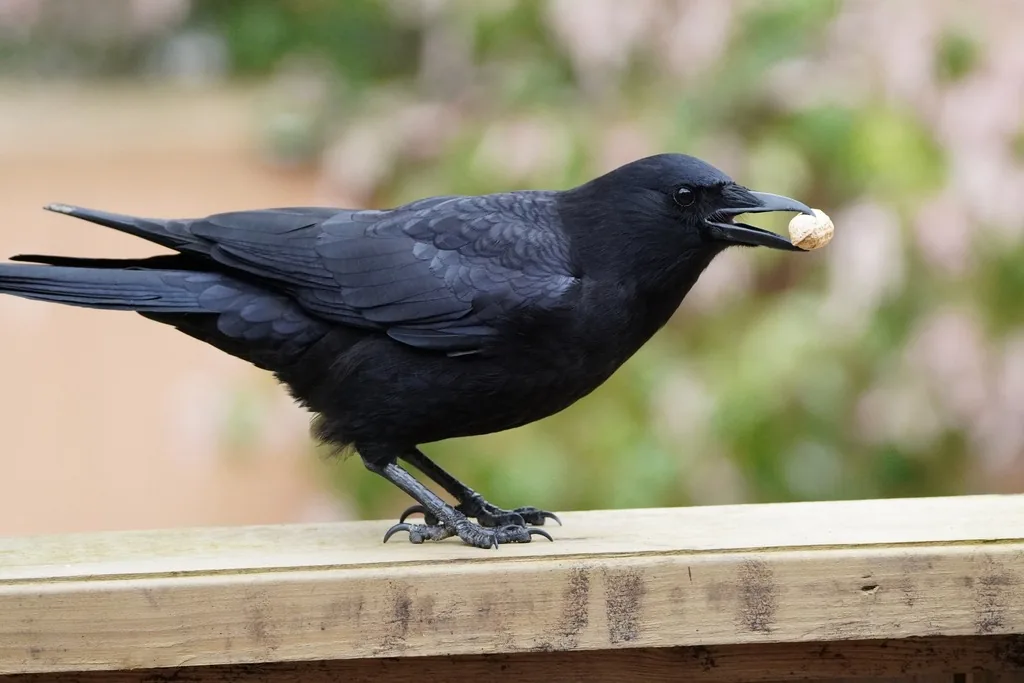
How to identify it
- A large all-black bird, 17 to 21 inches long and about 1 pound; males and females look alike.[1][6]
- Its best-known call is a hoarse "caw, caw," and crows can mimic other birds and animals.[1][6]
- In flight it uses steady, methodical wingbeats with little or no gliding.[1][6]
- Crows are social and noisy, often feeding in groups with a sentinel posted to watch for danger.[1][2]
Look-alikes
| Look-alike | How to tell them apart |
|---|---|
| Common raven | Larger, with a wedge-shaped tail, a different call, and a flight that often includes soaring or gliding.[1] |
| Fish crow | Smaller but looks nearly the same in the field; its call is a short, nasal "ca" or "car," and it lives mainly along the eastern and southeastern coasts.[1] |
| European starling | Starlings also form big winter roosts but are much smaller, about 8 inches long with a short tail.[1][3][7] |
Where it lives
Found across most of North America, from Newfoundland and Manitoba south to Florida and Texas and through most of the West; northern birds migrate south in fall.[1][6]
Biology and life cycle
Crows eat almost anything: insects, grubs, small animals, eggs and nestlings, carrion, garbage, corn and other grain, nuts and fruit.[2][6]
They nest from February to May in the north and earlier in the south, building stick nests 18 to 60 feet up in trees.[2]
A typical clutch is 4 to 6 eggs that hatch in about 18 days, and the young fledge about 30 days later.[2]
Young crows usually don't breed until at least 2 years old, and family groups can include young from several years that help raise new broods.[2][6]
In fall and winter, small flocks gather into roosts that can number from a few hundred to millions, and some have used the same area for over a century.[2][6]
Crows from a roost may fly 6 to 12 miles out each day to feed, and they favor roost trees with heavy canopy in well-lit areas close to food.[2]
Damage and signs
- Large urban roosts are objectionable for the smell of droppings, noise, health concerns and damage to roost trees.[3]
- Crows pull up sprouting corn and feed on ripening corn, peanuts, grain sorghum, sunflowers, pecans, fruit and watermelons.[3]
- They raid the eggs and young of waterfowl and other birds, and in rare cases attack newborn livestock in open fields.[3]
- Flocks near airports can threaten aircraft safety.[3]
Health risk
Soil under roosts of crows, blackbirds and starlings used for years may harbor the fungus that causes histoplasmosis, which people can catch by breathing spores when the soil is disturbed. American crows are also highly susceptible to West Nile virus.[3]
Control
Prevention
Thin up to one-third of the branches of roost trees, or thin trees from dense groves, to reduce perches and open the trees to weather.[4]
Keep them out
Use nets over high-value fruit or vegetable plots, and slip a paper cup or bag over each garden corn ear once the silk turns brown.[4]
Sanitation
Secure trash cans and dumpsters, and remove dead animals promptly so crows can't feed on them.[4]
Traps and physical control
Disperse roosts with recorded crow distress calls, clappers, pyrotechnics or Mylar tape in the trees, playing sounds before the flock settles for the night.[4]
Combine several scare methods and vary their location and timing; crows used to people may ignore them, and ultrasonic devices don't work.[4]
Pesticides
Methyl anthranilate fogs and polybutene tactile repellents can move crows from roosts; no toxicants are registered for crows, and 4-aminopyridine frightening bait is restricted to certified applicators.[4]
When to call a professional
Trapping crows is difficult and regulated; contact your state wildlife agency or USDA APHIS Wildlife Services before trapping or shooting.[4][5]
Legal status
American crows are protected by the Migratory Bird Treaty Act, but a federal depredation order covers them along with blackbirds, cowbirds, grackles and magpies.[1][5]
Under that order, no federal permit is needed to control crows seriously damaging crops or livestock feed, or causing a health hazard or structural damage.[5]
Each year you must first try nonlethal methods such as netting, flagging or recordings before any lethal control.[5]
Anyone acting under the order must file an annual report with the U.S. Fish and Wildlife Service and follow rules on trapping and ammunition.[5]
States may require their own permits, set hunting seasons and restrict methods, and local laws may ban shooting, so check with state wildlife officials first.[1][5]
Common questions
- How do I get rid of a crow roost in my trees?
- Start before the crows settle in for the season: play distress calls at dusk, hang Mylar tape, use noise devices, and thin the roost trees' branches.[4]
- Is it legal to kill crows?
- Crows are federally protected, but a depredation order allows control without a federal permit in specific damage or health-hazard cases, after nonlethal methods, with annual reporting. State and local rules also apply.[5][1]
- Why are crows tearing open my garbage bags?
- Garbage is a main food source for urban crows, so keep trash in secured cans or dumpsters.[2][4]
Sources
- Internet Center for Wildlife Damage Management, “Crows: Identification and Legal Status.” icwdm.org/species/birds/crows/ (accessed 2026-10-06). Run by university wildlife damage specialists (maintained at the University of Wisconsin-Stevens Point); species modules are based on Prevention and Control of Wildlife Damage (University of Nebraska Cooperative Extension, 1994).
- Internet Center for Wildlife Damage Management, “Crow Biology.” icwdm.org/species/birds/crows/crow-biology/ (accessed 2026-10-06). Run by university wildlife damage specialists (maintained at the University of Wisconsin-Stevens Point); species modules are based on Prevention and Control of Wildlife Damage (University of Nebraska Cooperative Extension, 1994).
- Internet Center for Wildlife Damage Management, “Crow Damage Identification.” icwdm.org/species/birds/crows/crow-damage-identification/ (accessed 2026-10-06). Run by university wildlife damage specialists (maintained at the University of Wisconsin-Stevens Point); species modules are based on Prevention and Control of Wildlife Damage (University of Nebraska Cooperative Extension, 1994).
- Internet Center for Wildlife Damage Management, “Crow Damage Prevention and Control Methods.” icwdm.org/species/birds/crows/crow-damage-prevention-and-control-methods/ (accessed 2026-10-06). Run by university wildlife damage specialists (maintained at the University of Wisconsin-Stevens Point); species modules are based on Prevention and Control of Wildlife Damage (University of Nebraska Cooperative Extension, 1994).
- Electronic Code of Federal Regulations, “50 CFR 21.150, Depredation order for blackbirds, cowbirds, crows, grackles, and magpies (U.S. Fish and Wildlife Service).” www.ecfr.gov/current/title-50/chapter-I/subchapter-B/part-21/subpart-D/section-21.150 (accessed 2026-10-06)
- Cornell Lab of Ornithology, “American Crow Overview (All About Birds).” www.allaboutbirds.org/guide/American_Crow/overview (accessed 2026-10-06)
- University of Nebraska-Lincoln Extension, “G2024: Urban Pest Birds: Controlling Damage.” extensionpubs.unl.edu/publication/g2024/html/view (accessed 2026-10-06)
- iNaturalist, “Corvus brachyrhynchos taxon page (order and family).” www.inaturalist.org/taxa/8021 (accessed 2026-10-06)