On this page
How to identify it
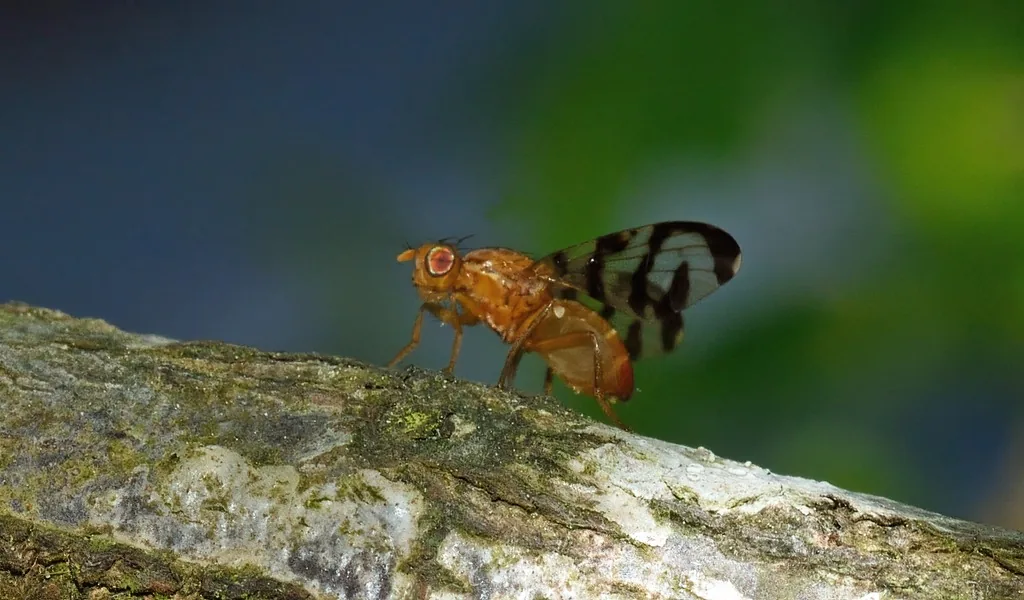
- The adult is a small fly, about 8 millimeters (1/3 inch) long and somewhat smaller than a housefly. It is pale to dark yellow, with bright green eyes and smoky bands across the wings.[1][2]
- The maggots are white and cylindrical, tapering toward the head, and are found inside the berries.[1]
- Infested berries show a small discolored spot where the egg went in, sometimes with a slight brownish tinge, and the elongated whitish egg can be seen just under the skin of dropped fruit.[1][2]
Where it lives
It is widely distributed in western North America, with scattered records from the northeastern United States, and it is not found in Europe.[2]
Biology and life cycle
It attacks red, white and black currants and gooseberries.[2][3]
There is one generation a year. It spends the winter as a brown pupa about the size of a wheat grain, in organic debris or 1 to 3 inches deep in the soil at the base of the plant.[1][2]
In the Pacific Northwest handbook's account the flies start emerging in mid-April and keep coming out for 40 to 45 days; in Alberta adults emerge from about mid-May to early June. Adults feed on flower nectar and aphid honeydew.[1][2]
A female lays one egg under the skin of each developing green berry, rarely two, and keeps laying for up to a month. She can lay up to 165 eggs in her life.[2][3]
Eggs hatch in about a week. The maggot feeds on the seeds inside the berry for about two weeks, eating anywhere from 2 to 9 seeds, and older maggots cut a small breathing hole in the skin. When grown, the maggot leaves the berry, drops to the ground and burrows into the soil to pupate.[2][3][1]
Adults rest on leaves in the center of the bush, out of direct sun, so shaded plants have more flies. They also rest on fence rows, brush and trees next to the planting.[2][1]
Damage and signs
Health risk
These sources treat it only as a fruit pest and do not describe any harm to people.[1][2]
Control
Prevention
Picking late can help avoid maggoty fruit, but it risks sun-scald. The fly favors late-maturing varieties.[2][3]
Keep them out
Cover plants with floating row covers while the adults are emerging. The handbook warns not to use covers on plantings that are already infested.[1]
Sanitation
Remove infested fruit as soon as you see it, and pick up fallen fruit every day. Regular daily collection can gradually reduce the number of flies, though Alberta's longer fact sheet calls daily collection impractical.[1][3][2]
Traps and physical control
Lay a tarp under the bushes to keep maggots from reaching the soil to pupate, or cultivate the soil beneath the bushes to expose pupae to predators.[1][3]
Pesticides
The Pacific Northwest handbook lists no insecticides labeled for home use against this fly. Commercial growers time sprays for when adults are present and active, using registered products such as spinosad, pyrethrins or carbaryl.[1][3]
Monitoring
Start watching for flies in early spring. Yellow sticky traps baited with apple maggot attractant, hung inside the bush at fruit level from green fruit to early harvest, show how many adults are about.[1][3]
As fruit matures, look it over for discolored spots and remove affected berries. Check dropped fruit for whitish eggs just under the skin.[1][2]
Common questions
- Why are my currants turning red and falling off early?
- Currant fruit fly is a likely cause. Berries with an egg or maggot inside usually ripen early and drop, and the Pacific Northwest handbook notes they often turn red first.[2][1]
- Can I spray currant fruit fly in my garden?
- The Pacific Northwest handbook lists no products labeled for home use. Row covers, removing infested and fallen fruit, and a tarp under the bushes are the home-garden options.[1]
Sources
- Pacific Northwest Pest Management Handbooks (Oregon State, Washington State and University of Idaho Extension), “Currant and gooseberry-Currant fruit fly (gooseberry maggot) (Pacific Northwest Insect Management Handbook).” pnwhandbooks.org/insect/small-fruit/currant-gooseberry/currant-gooseberry-currant-fruit-fly-gooseberry-maggot (accessed 2026-11-09)
- Government of Alberta, Agriculture and Forestry, “Insect Pests of Currants and Gooseberries (K. Fry and A. Delidais).” www1.agric.gov.ab.ca/$department/deptdocs.nsf/all/prm2544 (accessed 2026-11-09)
- Government of Alberta, Agriculture and Forestry, “Insect of the Month - Currant Fruit Fly (Hort Snacks, April 2018; R. Spencer).” www1.agric.gov.ab.ca/$department/newslett.nsf/all/snack27577 (accessed 2026-11-09)
- iNaturalist, “Euphranta canadensis taxon page (order and family).” www.inaturalist.org/taxa/543085 (accessed 2026-11-09)