On this page
How to identify it
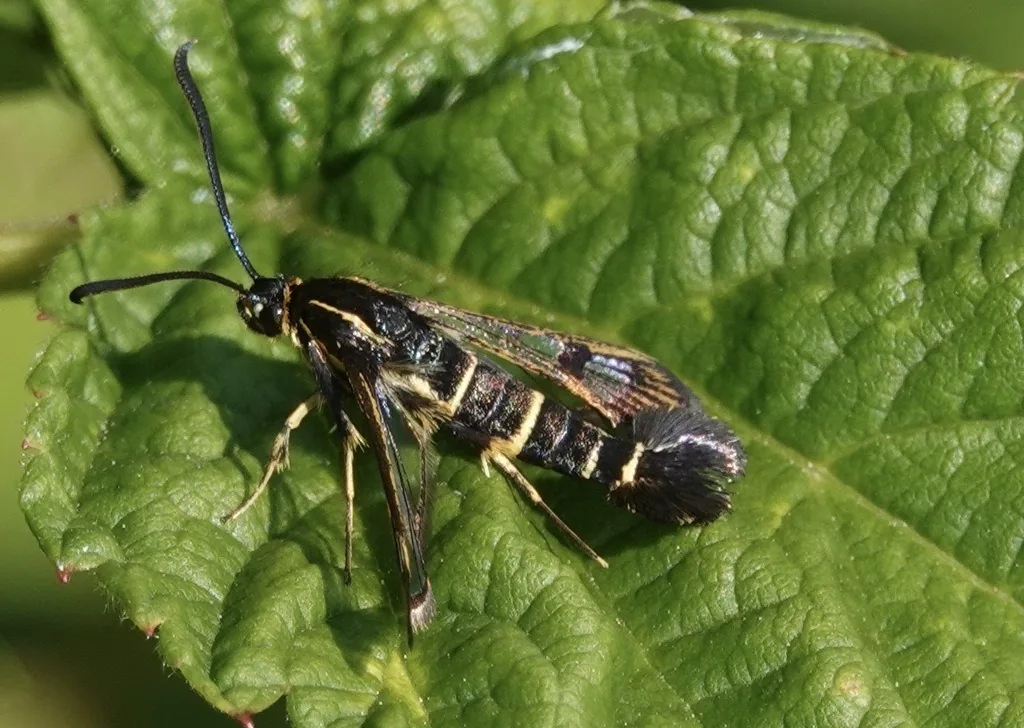
- The adult is a blue-black moth with yellow markings and clear wings, which it usually holds spread out at rest. The wings have scales only on the veins and along the rear edge, where a fringe of long, pale purplish scales borders them, plus a patch of black scales about two-thirds of the way out on each forewing.[1]
- Both sexes have a prominent, shield-like tuft of long scales at the tip of the abdomen; in males it is larger and flatter.[1]
- The larva lives inside the canes, tunneling in the pith. In spring, a hole chewed in the side of a cane and covered with silk marks where it will pupate.[2][1]
- Symptoms on the plant are withering leaves on young shoots and fruit clusters (trusses) that fail to develop.[2]
Where it lives
It is covered as a pest of currants and gooseberries by the Pacific Northwest handbook and by the Government of Alberta, and in New Zealand it has been a long-standing target of mating disruption in black currants.[1][2][3]
Biology and life cycle
It attacks red and black currants and gooseberries, with red currants the most susceptible.[2][1]
Adults emerge in June and July and fly on bright, warm days.[1][2]
Females lay eggs one at a time, usually only one per stem, near a bud, side shoot, node or pruning scar, or under loose bark, on stems one to two years old; Alberta's fact sheet notes that current-year growth is not used.[2][1]
The larva hatches 8 to 10 days later, bores into the pith and feeds until fall. It spends the winter in the cane, nearly full grown, feeds a little more in spring, then chews an exit hole, covers it with silk and pupates inside the cane.[2][1]
Damage and signs
- Tunneling in the pith causes the leaves on young shoots to wither and keeps fruit clusters from developing.[2]
Health risk
These sources treat it only as a pest of currants and gooseberries and do not describe any harm to people.[1][2]
Control
Sanitation
Prune out infested canes and destroy them; this is the main control for home gardeners.[1][2]
Traps and physical control
Sticky traps baited with the female sex pheromone can monitor the moths, and the pheromone is also used for mating disruption. In New Zealand, mating disruption has been used across the black currant industry since about 1990; in trap studies there, yellow or green traps caught more males than red, black, blue or white ones.[2][3]
Biological control
Little is known about its natural enemies, but overwintering larvae are often killed by a parasitic wasp and a fungal disease, which helps hold numbers down.[1]
Pesticides
No insecticides are labeled for home use against it. For commercial growers, the Pacific Northwest handbook stresses that sprays must hit the young larvae while they are exposed, before they enter the woody stem.[1]
Common questions
- Why are some of my currant shoots wilting with no fruit?
- Currant borer larvae tunneling in the pith of the canes cause leaves on young shoots to wither and fruit clusters to fail. The larvae live and feed inside the pith of the canes.[2]
- How do I get rid of currant borers?
- Cut out infested canes and destroy them. Check the canes near the base of the plants in spring, when the larvae are active.[1][2]
Sources
- Pacific Northwest Pest Management Handbooks (Oregon State, Washington State and University of Idaho Extension), “Currant and gooseberry-Currant borer (Pacific Northwest Insect Management Handbook).” pnwhandbooks.org/insect/small-fruit/currant-gooseberry/currant-gooseberry-currant-borer (accessed 2026-11-09)
- Government of Alberta, Agriculture and Forestry, “Insect Pests of Currants and Gooseberries (K. Fry and A. Delidais).” www1.agric.gov.ab.ca/$department/deptdocs.nsf/all/prm2544 (accessed 2026-11-09)
- Journal of Chemical Ecology (via NCBI PubMed), “Optimization of pheromone lure and trap characteristics for currant clearwing, Synanthedon tipuliformis (D. M. Suckling et al.; Journal of Chemical Ecology 31(2), 2005; abstract).” pubmed.ncbi.nlm.nih.gov/15856791/ (accessed 2026-11-09)
- iNaturalist, “Synanthedon tipuliformis taxon page (order and family).” www.inaturalist.org/taxa/232127 (accessed 2026-11-09)