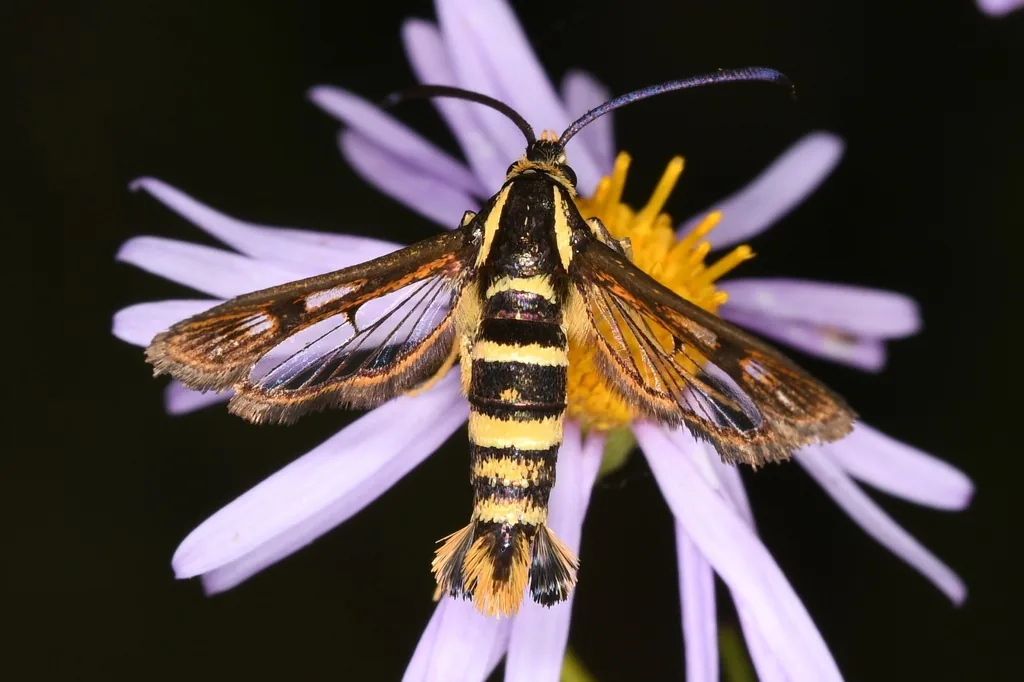
How to identify it
Look-alikes
| Look-alike | How to tell them apart |
|---|---|
| Yellowjackets | The adult moth strongly resembles a yellowjacket, black with yellow markings.[1] |
| Root weevils | Plants hurt by crown moth larvae pull free from their roots easily; root weevil damage doesn't.[1] |
Where it lives
Native to the Pacific Northwest, it has damaged strawberries in the northern Willamette Valley, most severely in Washington County, Oregon.[1]
Biology and life cycle
Larvae overwinter in the crown, become active in April and May, and pupate after a short feeding period.[1]
Adults emerge in late June and July and lay eggs on leaves near the base of plants; young larvae feed on the crown's outside, then bore in.[1]
There's one generation a year, and damage is sporadic.[1]
Damage and signs
- Injured plants are stunted, may redden early and yield poorly; feeding wounds let root diseases in.[1]
Health risk
It feeds on plants; the PNW Insect Management Handbook mentions no risk to people.[1]
Control
Prevention
Don't put new plantings next to infested ones.[1]
Sanitation
Remove and destroy stunted, early-reddening infested plants, which tend to occur in clumps, and replant the gaps.[1]
Traps and physical control
In home gardens, cutting all the old leaves off June-bearers removes eggs and pushes fresh growth.[1]
Pesticides
Chemical control hasn't proven effective and isn't recommended.[1]
Common questions
- Why do my strawberry plants come out of the ground so easily?
- Strawberry crown moth larvae feed in the crown, so damaged tops separate easily from the roots.[1]
- Is the yellowjacket-like insect on my strawberries a wasp?
- It may be a strawberry crown moth, a moth that strongly resembles a yellowjacket.[1]
Sources
- Pacific Northwest Pest Management Handbooks (OSU, WSU, University of Idaho), “Strawberry: Strawberry crown moth (Insect Management Handbook).” pnwhandbooks.org/insect/small-fruit/strawberry/strawberry-strawberry-crown-moth (accessed 2026-10-06)
- iNaturalist, “Synanthedon bibionipennis taxon page (order and family).” www.inaturalist.org/taxa/319098 (accessed 2026-10-06)