On this page
How to identify it
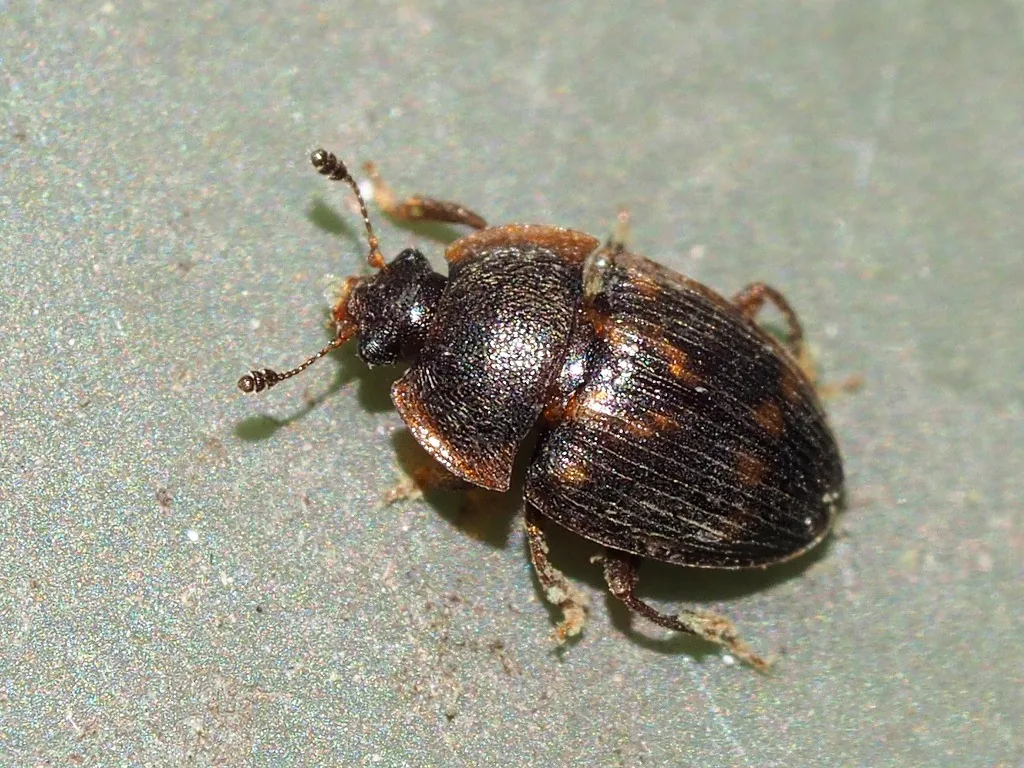
- Adults are oval, brown and slightly mottled, with a lighter X-shaped marking across the wing covers, and only about 1.5 mm (1/16 inch) long.[3][2]
- Like other sap beetles they have knobbed antennae, which set them apart from other small beetles.[1]
- Larvae are off-white with a dark head capsule. NC State describes sap beetle larvae as having three distinct pairs of legs, bristles along the body and two projections at the tip of the abdomen.[3][1]
- Eggs are about 0.75 mm (1/32 inch) long, cream-colored and oblong.[3]
Look-alikes
| Look-alike | How to tell them apart |
|---|---|
| Picnic beetle and other sap beetles | The picnic beetle, another sap beetle found in very overripe berries, is larger and has four orange blotches on its back. NC State names the dusky sap beetle and the fourspotted sap beetle, along with the strawberry sap beetle, among the sap beetles present in North Carolina.[2][1] |
Where it lives
Found throughout the eastern and upper Midwestern United States, and present in North Carolina.[3][1]
Biology and life cycle
Most adults spend the winter outside strawberry fields, in the leaf litter of wooded areas, though some survive in the mulch under blueberry bushes and raspberry canes.[3]
As strawberries ripen in late spring, the overwintered adults move into the planting, attracted to the odor of rotting fruit, and feed on berries until about mid-July. In New York, later generations keep feeding on nearby fruit crops until early September.[3][1]
Adults live for several weeks, and a female can lay 350 or more eggs. Few if any go on the fruit; she places them in soil near the berries, from spring into late summer.[3]
Eggs hatch in 2 to 3 days. Larvae look for fruit touching the ground, reach their third stage within three days and feed three days more, then over the next three days leave the fruit and dig 1 to 2 cm (3/8 to 3/4 inch) into the soil to pupate. Adults emerge in about a week, so egg to adult takes only about three weeks.[3]
Several generations a year are possible, depending on what other fruit crops are nearby. Strawberry is the main host, but the beetle damages raspberry and feeds on blueberry, cherry, apple, melon and sweet corn.[3]
Damage and signs
- Adults and larvae feed on ripe fruit, including berries good enough to sell, but they prefer overripe fruit lying on the ground. Damage ranges from small, easily missed holes to large cavities, often with several beetles in one berry.[3]
- On sound berries the beetles usually get in from underneath, eating a hole straight into the fruit, most often where it rests on soil or mulch. The hole shows once the berry is picked but is not conspicuous unless several beetles have been feeding.[2]
- The beetles spread rot organisms from berry to berry and bring in fungi that make fruit ferment. Any other injury near harvest, from insects or handling, may draw in more sap beetles.[2][1]
- Trouble builds when overripe berries accumulate, as when rain interrupts harvest or pick-your-own customers leave fruit behind. Then adults and larvae can also attack sound, marketable berries.[2][1]
- Larvae left in picked fruit bring customer complaints and have led some fields to stop picking early. In New York the beetle is widely present on farms but usually causes no noticeable damage; the concern is that there is no effective control once an outbreak starts.[3]
Health risk
A fruit pest. NC State, Penn State and NYS IPM describe damage to berries only and mention no risk to people or pets.[1][2][3]
Control
Prevention
Grow cultivars that hold their fruit off the ground, avoid cull piles of other fruit, and where possible put new plantings away from woods and other fruit crops, where the beetles overwinter and feed. NYS IPM cautions that none of these steps gives adequate control alone.[3]
Sanitation
Pick often and remove rotten, overripe, damaged and diseased fruit from the planting. NC State calls this the most important control and says it is often enough on its own to prevent damage.[1][2][3]
Traps and physical control
To check for beetles, sink buckets baited with rotten fruit or whole wheat bread dough into the ground along the edges of the planting. Check them and replace the bait at least weekly, and dispose of old bait away from the field.[1]
Biological control
A parasitic wasp, Microctonus nitidulidis, attacks adult strawberry sap beetles, but it does not appear to give adequate control during outbreaks.[3]
Pesticides
If sanitation is not enough, foliar insecticides are an option; check a current state guide, such as the North Carolina Agricultural Chemicals Manual or the Cornell Pest Management Guidelines, for products. Results vary widely, partly because sprays make poor contact with beetles feeding under the berries, so time applications for adults before egg laying begins, get coverage onto the fruit and not just the leaves, and mind pre-harvest intervals, since the beetles arrive as harvest starts.[1][3]
Common questions
- What are the tiny brown beetles in the holes in my strawberries?
- Brown beetles about 1/16 inch long, with a lighter X-shaped mark across the back, that drop and scurry away when you pick the berry fit the strawberry sap beetle. A larger beetle with four orange blotches is the picnic beetle, another sap beetle.[3][2]
- Is there an organic way to control strawberry sap beetles?
- NC State considers good field sanitation the only effective organically acceptable method at present: keep fruit picked and remove overripe and rotting berries.[1][2]
- Will spraying stop them?
- Not reliably. NYS IPM reports that insecticide results vary widely because sprays have trouble reaching beetles feeding under the fruit, and control gets harder once larvae are inside the berries.[3]
Sources
- NC State Extension, “Sap Beetles in Strawberries (L. Lopez, H. Burrack and A. Toennisson).” content.ces.ncsu.edu/sap-beetles-in-strawberries (accessed 2026-11-08)
- Penn State Extension, “Strawberry Sap Beetle.” extension.psu.edu/strawberry-sap-beetle (accessed 2026-11-08)
- Cornell University, New York State Integrated Pest Management Program, “Strawberry Sap Beetle, Stelidota geminata, berry crops fact sheet (R. Loughner and G. Loeb, 2009).” ecommons.cornell.edu/bitstream/handle/1813/43132/strawberry-sap-beetle-FS-NYSIPM.pdf?sequence=1 (accessed 2026-11-08)
- iNaturalist, “Stelidota geminata taxon page (order and family).” www.inaturalist.org/taxa/231503 (accessed 2026-11-08)