On this page
How to identify it
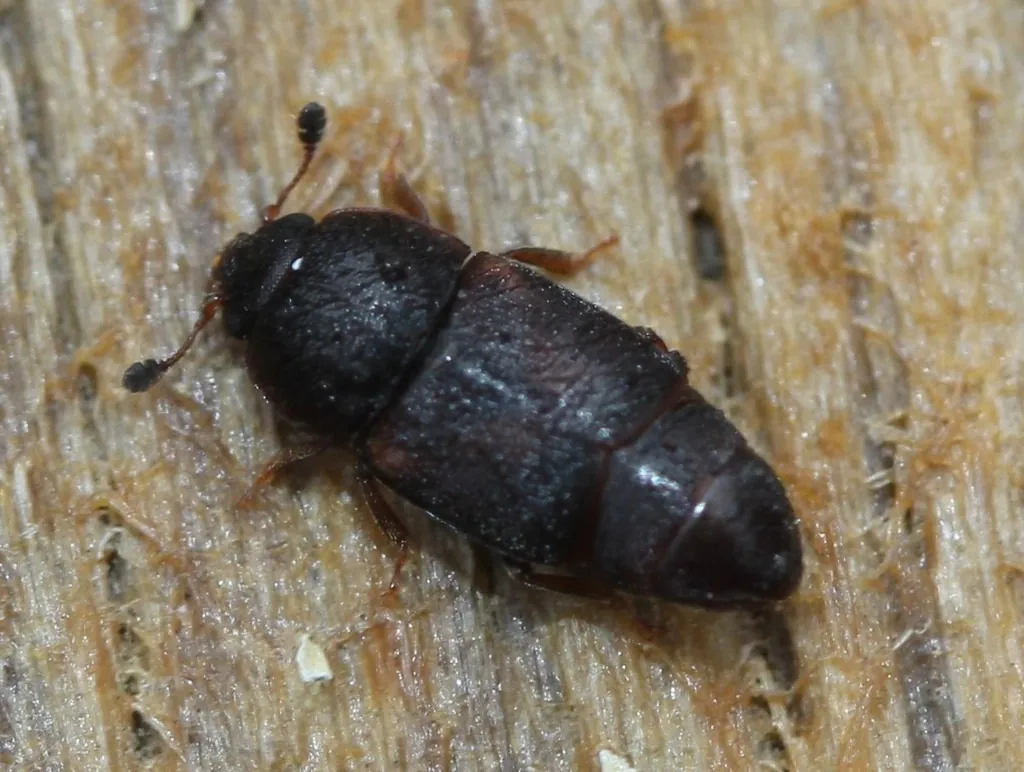
- An all-black sap beetle 3.5 to 4.5 mm long. The four-spotted sap beetle, or picnic beetle, that shares the corn is bigger, 5 to 6 mm, and black with four irregular yellow spots.[1]
- Sap beetles in general are oval to oblong with clubbed or knobbed antennae, and some have short wing covers that leave the tip of the abdomen exposed. Larvae are pale, maggot-like grubs with a brown head, up to about 1/4 inch, pinkish-white or cream, and they move quickly when exposed to light.[2][1]
- Eggs are milky white and look like tiny grains of rice, laid in the silks and at the tip of the ear.[1]
Look-alikes
| Look-alike | How to tell them apart |
|---|---|
| Four-spotted sap beetle, or picnic beetle (Glischrochilus quadrisignatus) | Larger (5 to 6 mm), shiny black with four yellow-orange spots, the other common sap beetle in corn.[1][2] |
| Strawberry sap beetle (Stelidota geminata) | The sap beetle most often found in strawberries rather than corn.[1] |
Where it lives
Virginia Tech puts sap beetles across the eastern United States and as far west as Colorado. The dusky sap beetle is the main species in sweet corn studies from central Illinois, Maryland processing fields and New England farms.[2][3][5][1]
Biology and life cycle
Adults overwinter, often in woods near the previous year's feeding sites, and show up in corn about the time tassels and silk appear. Early sweet corn silk is an attractive feeding and egg-laying site when fruit and other hosts are scarce. Adults move into corn at full tassel to feed on pollen and build up as the ears mature and the silks turn brown; males release an aggregation pheromone that draws both sexes. Full-grown larvae drop to the ground and pupate in the soil. There are two to four generations a year, with larvae peaking in July and adults in late July and August.[1]
Virginia Tech's account of sap beetles generally: adults and pupae overwinter in plant debris or under logs, adults follow the volatiles of damaged or decaying plant matter and lay eggs there, larvae feed about three weeks before pupating in the soil, adults are long-lived and disperse, and the economically important species run two or three generations depending on species and weather.[2]
Sap beetles are drawn to overripe, damaged or fermenting fruit and vegetables, including strawberries, tomatoes, berries and melons as well as corn, and to sap weeping from wounded trees, so farms that grow both fruit and corn tend to have more trouble.[2][1]
Damage and signs
- Larvae burrow into kernels and hollow out the upper half of the ear, making it unmarketable; adults hide between husk layers and feed mainly on pollen and already-damaged kernels. The beetles will enter corn borer tunnels or bird damage, but they are also found in ears with no caterpillar injury, and the problem is often not noticed until adults turn up in harvest bins and larvae in the ears.[1][2]
- Exposed ear tips are the risk factor. In USDA ARS trials in central Illinois, Bt sweet corn cut caterpillar damage by at least 80 percent, yet ears with five or more beetle-damaged kernels were more common in the Bt hybrid in 1998 (13.8 versus 5.5 percent) and equal in 1999, because ears whose husks were flush with the tip or left it exposed took significantly more damage and the Bt hybrid had more exposed tips. In a later three-year study, sap beetle damage was the most common insect damage on Bt sweet corn ears.[3][4]
- In Maryland processing sweet corn, sap beetles (mainly this species) and blemished kernels were the major causes of defective kernels at the cannery even though stink bugs were more abundant in the field, with defective kernels averaging under 1 percent. Virginia Tech notes that sap beetles in field corn can carry plant pathogens and mycotoxin-producing fungi, though control there is seldom warranted.[5][2]
Health risk
A crop pest. The only health-related point in the sources is Virginia Tech's note that sap beetles can move mycotoxin-producing fungi in field corn; neither extension sheet describes any direct effect on people.[2][1]
Control
Prevention
Choose sweet corn varieties with long, tight tip cover; UMass lists Accord, Argent, Avalon, Awesome, Bon Jour, Cuppa-Joe, Easy Money, Fantasia, Ka-Ching, Precious Gem, Prime Plus, Profit, Providence and Renaissance. Ears with exposed tips, especially super sweet and Bt varieties, are the ones that get infested. Control the ear-feeding caterpillars and birds whose damage opens ears to the beetles.[1][3]
Sanitation
Sanitation is the key in every crop: harvest routinely before produce is overripe, remove damaged or overripe fruit and corn, compost properly, and remove, destroy or deeply bury crop residue in fall. Cull piles and decomposing fruit are where populations build.[2][1]
Traps and physical control
Buckets of overripe, fermenting fruit along field borders intercept adults flying in and double as detection traps; empty and destroy the contents every two or three days, because aggregating beetles attract more beetles. USDA ARS found commercial traps and pheromone lures as effective as research versions for monitoring the dusky sap beetle, and faster and less variable than scouting plants.[2][4][3]
Pesticides
Scout at full tassel and early silk. UMass has no scouting threshold but says insecticides may be warranted in fields with a history of at least 10 percent ear damage. Virginia Tech's thresholds for large plantings: inspect 20 primary ears at five spots weekly once silks start wilting and treat at two or more larvae per 100 plants with more than four weeks to harvest, or treat when 5 percent of ears carry adults, eggs or larvae; sprays for corn earworm usually control sap beetles too. For home garden corn, Virginia Tech suggests labeled insecticides on the silks every other day from 10 percent silking until 90 percent of silks have browned.[1][2]
Common questions
- Why are the beetles in my ears when there was no caterpillar damage?
- The dusky sap beetle lays eggs directly in early silk and ear tips, especially on varieties with poor tip cover, so it does not need an earworm hole to get in.[1]
- Will Bt sweet corn stop them?
- No. Bt stops caterpillars, but USDA trials found sap beetle damage as high or higher on Bt ears, which tended to have more exposed tips.[3][4]
- What is the single most useful thing to do?
- Pick a variety with long, tight tip cover and keep overripe or damaged fruit and corn out of the field.[1][2]
Sources
- University of Massachusetts Amherst Extension, “Sap Beetles (Vegetable Program fact sheet, updated July 1, 2021).” www.umass.edu/agriculture-food-environment/vegetable/fact-sheets/sap-beetles (accessed 2026-11-10)
- Virginia Cooperative Extension (Virginia Tech; PDF on VTechWorks), “Sap Beetles (Coleoptera: Nitidulidae), ENTO-157NP (Dellinger and Day, 2015).” vtechworks.lib.vt.edu/bitstreams/81e4e7de-66a4-4175-b701-e053b54b918c/download (accessed 2026-11-10)
- Journal of Economic Entomology (Entomological Society of America), “Dowd (USDA ARS, Peoria). Dusky sap beetles (Coleoptera: Nitidulidae) and other kernel damaging insects in Bt and non-Bt sweet corn in Illinois. Journal of Economic Entomology 93: 1714-1720 (2000), PMID 11142303.” pubmed.ncbi.nlm.nih.gov/11142303/ (accessed 2026-11-10)
- Journal of Economic Entomology (Entomological Society of America), “Dowd (USDA ARS, Peoria). Suitability of commercially available insect traps and pheromones for monitoring dusky sap beetles (Coleoptera: Nitidulidae) and related insects in Bt sweet corn. Journal of Economic Entomology 98: 856-861 (2005), PMID 16022314.” pubmed.ncbi.nlm.nih.gov/16022314/ (accessed 2026-11-10)
- Journal of Economic Entomology (Entomological Society of America), “Dively, Yurchak, Hooks and Farcuh (University of Maryland). Field abundance and spatial patterns of ear-feeding insect pests in relation to levels of defective kernels in processing sweet corn. Journal of Economic Entomology 117: 1977-1982 (2024), PMID 39099228.” pubmed.ncbi.nlm.nih.gov/39099228/ (accessed 2026-11-10)
- iNaturalist, “Caplothorax lugubris taxon page (order and family).” www.inaturalist.org/taxa/1281051 (accessed 2026-11-10)