How to identify it
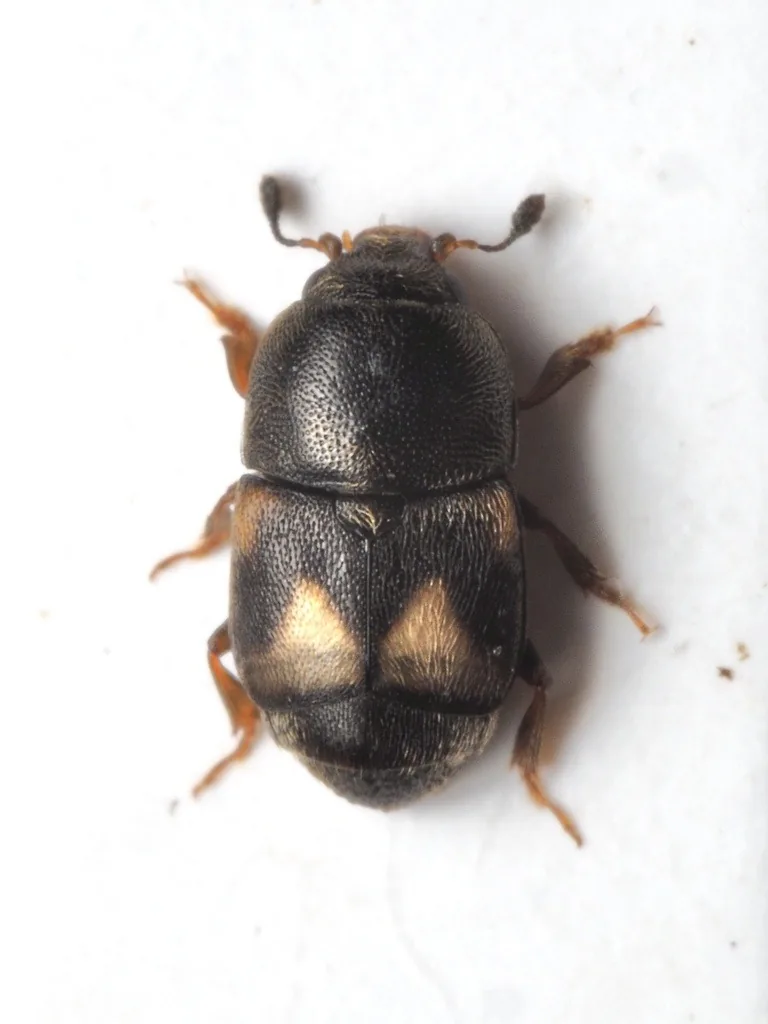
- Adults are oval black beetles about 1/8 inch long, with two large yellow-brown spots on the wing covers that sometimes run together into one large spot.[2][4]
- The wing covers are short, leaving the tip of the abdomen exposed, which marks it as a member of the sap beetle family.[2]
- The antennae are slender except for the last few segments, which form a distinct club.[2][1]
- Larvae are slender and white, about 1/4 inch long, with a light brown head and hardened, hornlike projections at the tail end.[2][1]
Look-alikes
| Look-alike | How to tell them apart |
|---|---|
| Corn sap beetle and other sap beetles | The corn sap beetle is similar in size and shape but lacks the two yellow-brown spots on the wing covers.[2] |
Where it lives
Found worldwide and widespread throughout the United States; it is thought to be native to Asia.[4]
Biology and life cycle
Eggs are laid singly on ripe or fermenting fruit, in the field or in stored products, and hatch in 1 to 4 days.[2]
Larvae finish growing in 4 to 14 days. Outdoors they pupate in the soil; in stored products they pupate inside the food.[2][1]
A generation can take as little as about 12 days in heat and up to 42 days in cool weather, and breeding is continuous in heated buildings.[2]
Adults are drawn to the smell of fermenting fruit and grain, and although reluctant to fly they can travel up to 2 miles in 4 days.[2]
It needs humidity: dry conditions slow larval growth and nearly stop egg laying.[2]
Damage and signs
- It usually attacks overripe or damaged fruit, but it enters ripening figs through the eye and any opening made mechanically or by other insects.[4][1]
- Feeding spreads organisms that cause fruit souring and makes fruit more attractive to vinegar flies and navel orangeworms.[1]
- In storage it can infest dried fruit, corn, cornmeal, wheat, oats, rice, beans, nuts, peanuts, spices, bread, sugar and honey.[2]
Health risk
It is a food-spoilage pest: beetles and larvae contaminate produce and stored foods, and sap beetles carry yeasts, bacteria and fungi, including some that can produce mycotoxins in crops.[2][3]
Control
Prevention
In fig plantings, small-eyed varieties are less affected, and pruning to let sun reach dropped fruit or removing it quickly may reduce problems.[1]
Sanitation
Pick up and destroy fallen fruit and cull piles right away; damaged and overripe produce is where these beetles breed.[1][3]
Clean up grain and food spills promptly, and clean dumpsters regularly so spoiled food doesn't build up.[2]
Traps and physical control
Trap beetles in containers with an inverted-cone top baited with fermenting fruit and water.[1]
When to call a professional
In fruit processing facilities, labeled residual insecticides may be applied, and fumigation may be needed for severe infestations.[2]
Common questions
- What are the tiny black beetles with two orange spots in my fruit bowl or figs?
- Likely dried fruit beetles, small sap beetles that lay eggs on ripe and rotting fruit; throw out the affected fruit and clean up any that has dropped.[2][1]
- Can dried fruit beetles get into pantry foods?
- Yes. Besides dried fruit, they can infest grain products, especially damaged ones, along with nuts, spices, bread, sugar and honey.[2]
Sources
- University of California Statewide IPM Program, “Driedfruit and Sap Beetles (Home and Landscape).” ipm.ucanr.edu/home-and-landscape/driedfruit-and-sap-beetles/ (accessed 2026-10-06)
- Purdue University Extension, Department of Entomology, “Stored Product Pests: Dried Fruit Beetle and Corn Sap Beetle, E-229-W.” www.extension.entm.purdue.edu/publications/E-229/E-229.pdf (accessed 2026-10-06)
- University of Florida, UF/IFAS Extension (EDIS), “Sap Beetles (of Florida), Nitidulidae, IN525 (Featured Creatures).” edis.ifas.ufl.edu/publication/IN525 (accessed 2026-10-06)
- University of Georgia, College of Agricultural and Environmental Sciences, “Carpophilus hemipterus species fact sheet (Carpophiline-ID, version 01.19.2021).” site.caes.uga.edu/carpophiline-id/carpophilus-hemipterus-linnaeus-1758/ (accessed 2026-10-06)
- iNaturalist, “Carpophilus hemipterus taxon page (order and family).” www.inaturalist.org/taxa/216143 (accessed 2026-10-06)