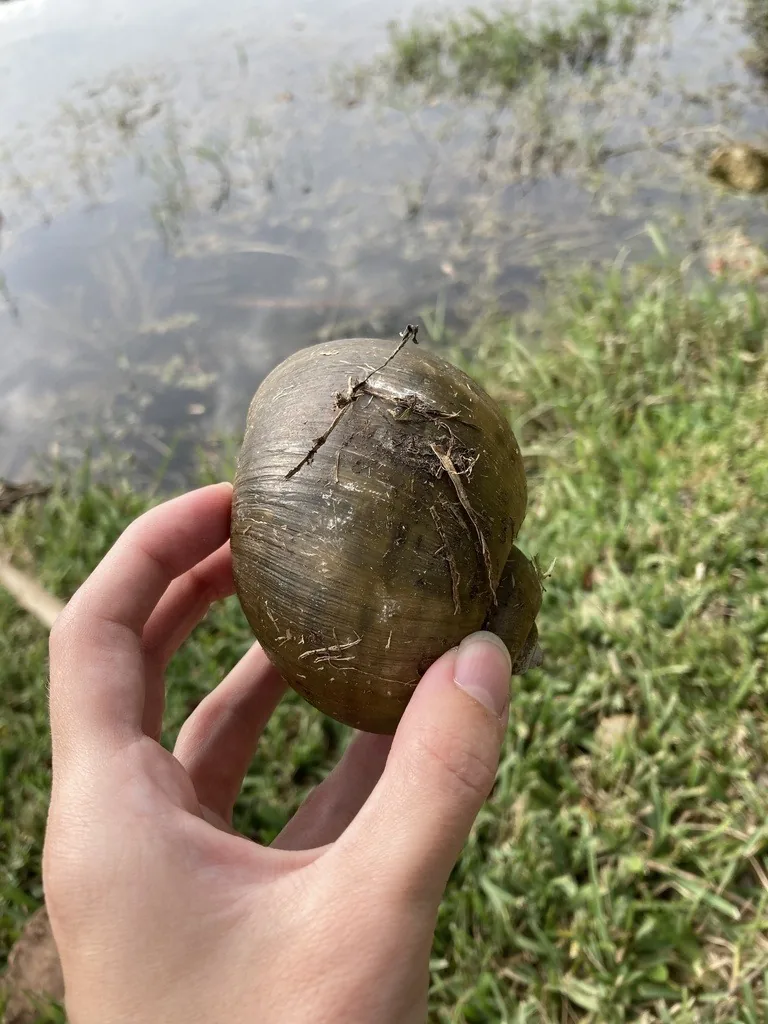
How to identify it
- Shells are large and round, usually around 1.5 inches but up to 4 inches across or more, yellow-brown to brownish black, with or without dark spiral bands.[2][3]
- A hard trapdoor, the operculum, seals the shell opening when the snail pulls inside.[2][3]
- Clusters of bright pink eggs, laid on plant stems, pilings, seawalls or tree trunks just above the water, are usually the first sign.[1][2][3]
- The island and channeled apple snails look nearly identical; only DNA testing confirmed that Texas populations are the island apple snail.[2]
Look-alikes
| Look-alike | How to tell them apart |
|---|---|
| Florida applesnail (native) | A native, beneficial snail with a low, rounded shell tip, about 1.5 to 2.75 inches long, that lays white eggs; it is the main food of the Everglades snail kite.[1] |
| Spike-topped apple snail (mystery snail) | Sold for aquariums; its shell has a more pointed, prominent spire with deep grooves between the whorls.[2][1] |
| Giant African land snail | Lives on land and has a cone-shaped shell tapering to a point, up to nearly 8 inches long.[4] |
| Garden snails and slugs | Land mollusks that chew holes in garden plants at night, while apple snails live in ponds, ditches and other fresh water.[5][2] |
Where it lives
The island apple snail spread through Florida after releases in the 1980s and is now found in Alabama, Georgia, Hawaii, Louisiana, the Carolinas and Texas. The channeled apple snail has been reported from California and Hawaii but not Florida.[1][3]
Biology and life cycle
They live in shallow fresh water, including streams, bayous, ponds, canals and rice fields, and can't tolerate water colder than about 50 degrees F.[2][1]
Females crawl out of the water, often at night, to lay eggs from about March through October in Florida.[1]
A clutch can hold hundreds to more than 2,000 eggs, females may lay again every one to two weeks, and young snails mature in about two to three months.[2][3]
Eggs hatch in one to two weeks, and the young snails drop into the water.[3][2]
In drought they can bury themselves in mud, seal the shell and wait out dry conditions for months.[1][2]
Damage and signs
- Island apple snails eat large amounts of rooted aquatic plants, damaging wetlands and the fish and waterfowl habitat they provide.[1][3][2]
- The channeled apple snail has seriously damaged rice and taro crops in Pacific islands and Southeast Asia, and apple snails are a growing concern for rice growers in the Gulf states.[1][3][2]
- In Texas, burrowing snails have increased levee maintenance for some rice farmers.[2]
Health risk
Apple snails can carry rat lungworm, a parasite people can get by eating raw or undercooked snails or contaminated raw produce; it has been found in apple snails from New Orleans.[2]
Control
Prevention
Never release aquarium snails or plants into ponds, lakes or ditches.[1][3]
Traps and physical control
Hand or mechanical removal of snails and egg masses is the most effective option; TexasInvasives.org advises crushing or removing egg masses rather than scraping them into the water.[1][2]
In Florida, remove only pink egg masses; white egg masses belong to the native Florida applesnail and should be left alone.[1]
Pesticides
No effective chemical recommendation exists for homeowners; copper compounds used over large areas also harm fish, algae and native snails and clams.[1][3]
When to call a professional
Once established they are very hard to eliminate, so report new finds to your state wildlife agency and leave large-scale control to trained professionals.[3]
Shipping and selling apple snails
Since 2006, USDA-APHIS has required permits to import or move freshwater snails between states, and it issues none for Pomacea apple snails except the spike-topped apple snail.[1]
Common questions
- What are the bright pink egg clusters on my seawall or dock?
- They are almost certainly apple snail eggs, laid just above the waterline; in Florida, pink masses come from the invasive island apple snail.[1][2]
- Can I eat apple snails?
- Eating raw or undercooked apple snails can transmit rat lungworm, a parasite that can cause eosinophilic meningitis in severe cases.[2]
Sources
- University of Florida IFAS Extension (EDIS), “Applesnails of Florida, Pomacea spp., Featured Creatures (EDIS publication IN598).” edis.ifas.ufl.edu/publication/IN598 (accessed 2026-10-06)
- TexasInvasives.org, “Apple Snail, Pomacea maculata (Invasives Database species fact sheet).” www.texasinvasives.org/animal_database/detail.php?symbol=15 (accessed 2026-10-06)
- Alabama Cooperative Extension System, “Alabama Aquatic Nuisance Species: Amazonian Apple Snail (September 6, 2018).” www.aces.edu/blog/topics/aquatic-invasive-species/alabama-aquatic-nuisance-species-amazonian-apple-snail/ (accessed 2026-10-06)
- University of Florida IFAS Extension (EDIS), “Giant African Land Snail in Florida, Featured Creatures (EDIS publication IN904).” edis.ifas.ufl.edu/publication/IN904 (accessed 2026-10-06)
- University of California Statewide IPM Program, “Snails and Slugs (Pest Notes, Home and Landscape).” ipm.ucanr.edu/home-and-landscape/snails-and-slugs/ (accessed 2026-10-06)
- iNaturalist, “Pomacea maculata taxon page (order and family).” www.inaturalist.org/taxa/461265 (accessed 2026-10-06)