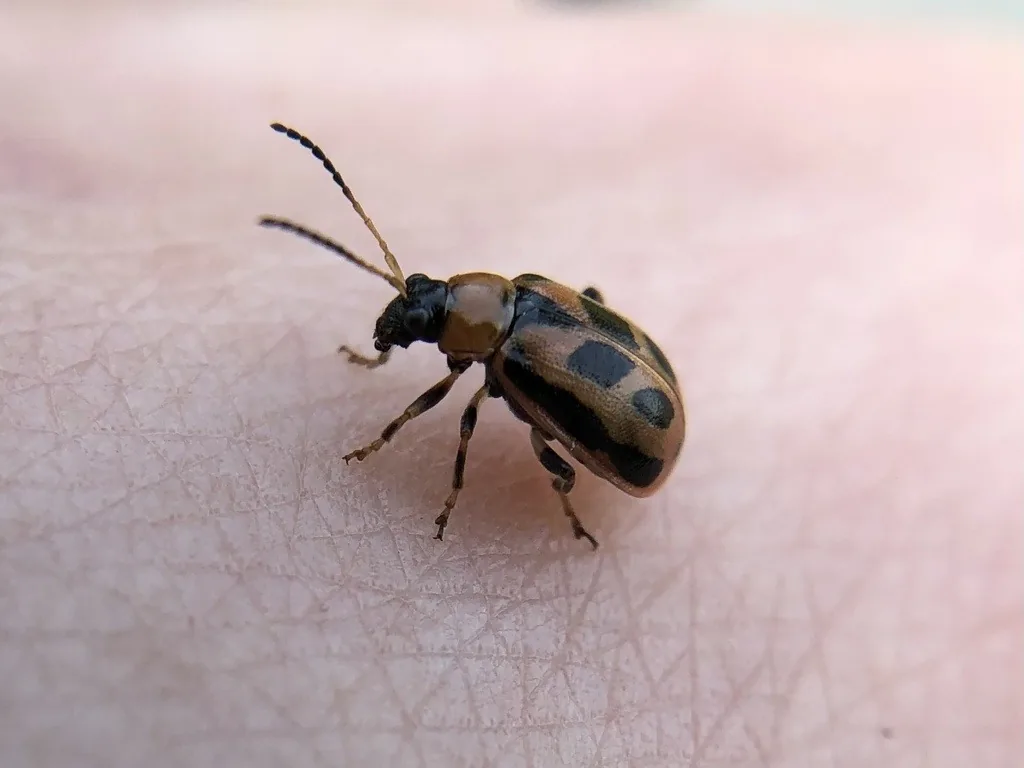
How to identify it
Look-alikes
| Look-alike | How to tell them apart |
|---|---|
| Cucumber beetles | Bean leaf beetles always show the black triangle at the base of the wing covers.[1] |
Where it lives
Minnesota Extension notes it's more common in southern than northern Minnesota; it feeds on snap beans, soybeans, clover, dry beans and related plants.[1]
Biology and life cycle
Adults overwinter in leaf litter and grass clumps and emerge from mid-May to early June.[1]
Females lay clusters of about 12 orange eggs in soil at the base of beans; larvae feed on roots, causing minor damage.[1]
There's usually one generation a year in Minnesota, two in the south of the state.[1]
Damage and signs
- Adults chew round 1/8-inch holes under leaves and can defoliate seedlings; pod feeding is cosmetic.[1]
Health risk
It feeds on plants; Minnesota Extension mentions no risk to people.[1]
Control
Prevention
Delay planting snap beans to early or mid-June in southern Minnesota to avoid spring beetles.[1]
Keep them out
Floating row covers with secured edges keep beetles off.[1]
Sanitation
Clean up leaf litter around the garden to remove overwintering sites.[1]
Traps and physical control
Hold a pail under plants and tap them; beetles drop when disturbed.[1]
Common questions
Sources
- University of Minnesota Extension, “Bean leaf beetles (Yard and garden insects).” extension.umn.edu/garden-and-home/yard-and-garden/yard-and-garden-insects/bean-leaf-beetles (accessed 2026-10-06)
- iNaturalist, “Cerotoma trifurcata taxon page (order and family).” www.inaturalist.org/taxa/216533 (accessed 2026-10-06)