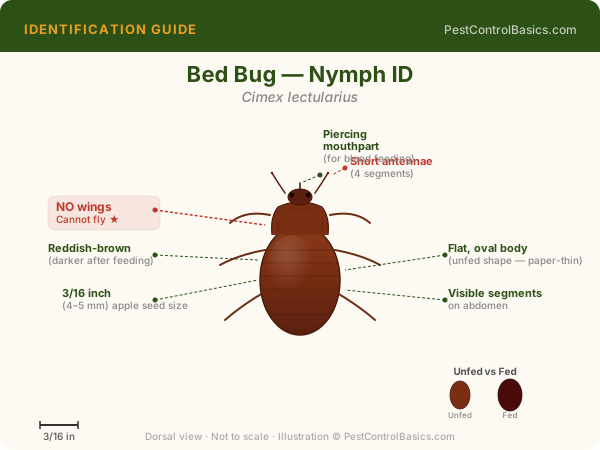
❓ Common Questions About 🛏️ Bed Bug Nymph Identification — All 5 Stages
How do I confirm I actually have this pest (not something similar)?
The most reliable confirmation is a physical specimen — capture one and compare to reference images on this page. For cryptic pests (bed bugs, termites), look for secondary signs: frass, shed skins, mud tubes, or bites with a specific pattern. When uncertain, a professional inspection is faster than months of misidentification.
Can I treat this myself or do I need a professional?
DIY is effective for small, accessible infestations caught early. Professionals are worth the cost when: the infestation is inside wall voids or structural elements, multiple rooms are affected, you have health-risk pests (hantavirus, venomous species), or DIY has already failed twice.
How long until the infestation is completely gone?
Expect 3–8 weeks for most infestations with proper treatment. Insects with dormant life stages (pupae, eggs) extend the timeline because those stages are impervious to most insecticides. Follow-up treatments at 2 and 4 weeks catch each new cohort as they emerge.
What's the most common mistake people make treating this pest?
Treating only the visible pest population while ignoring the harborage site, entry point, or breeding location. Killing adults provides temporary relief but the population rebuilds from hidden egg cases, pupae, or new arrivals through unaddressed entry points.
Bedbug inspection: where to look and what you'll find
Bedbugs harbor within about five feet of where humans sleep, in the smallest cracks available. Inspection priorities: seams and folds of the mattress and box spring (especially the top piping and underside corner protectors), the bed frame joints, headboard back, nightstands, and within five feet of the bed in carpet edges and baseboards. What you're looking for: live bedbugs (reddish-brown, apple-seed shaped when fed, smaller and flatter when unfed), cast skins (translucent, same shape as bugs), eggs (white, smaller than a grain of rice, often in clusters), and fecal staining (dark dots, often around harborage edges, will smear if wiped with a wet cloth). A flashlight and a credit card to pry into seams cover most inspection. Bites alone are not reliable evidence; many people develop bites that look similar from other causes.
How environmental conditions affect treatment efficacy
Pesticide efficacy is highly sensitive to the conditions at application and immediately after. Temperature affects both vapor pressure (volatility) and residual binding — products applied above ~90°F often volatilize before binding to surfaces, while applications below ~50°F can fail to spread properly. Surface porosity changes residual duration: a residual that lasts eight weeks on a sealed concrete slab might last three weeks on bare wood. Rainfall within four hours of an outdoor application typically washes off most surface deposits, though microencapsulated products are more rain-fast. UV exposure degrades many pyrethroids within days to weeks on sunny surfaces, which is why fence-line applications often fail mid-summer. Indoor humidity affects bait acceptance — dry baits perform worse in high humidity as they absorb moisture and lose palatability. Reading conditions correctly explains many otherwise mysterious treatment failures.
Heat treatment for bedbugs: what it can and can't do
Heat treatment raises room or unit temperature to lethal levels (typically 120-140°F sustained) using specialized equipment. Done correctly by a professional, heat penetrates harborage that chemical sprays can't reach and kills bedbugs at all life stages including eggs in a single treatment. Limitations: items can be heat-damaged (electronics, candles, some plastics, certain artwork), heat doesn't provide residual protection so reinfestation isn't prevented, and reaching uniform temperature in voids and stored items takes hours with skilled monitoring. Whole-room heat treatment is often paired with chemical residual at perimeter and harborage to handle reinfestation. Portable bedbug heating units (PackTite and similar) work well for treating suitcases, books, and small items, and are a reasonable DIY tool for handling items that have been in infested environments before bringing them into a clean home.
Apartment bedbug control and the building dimension
In multi-unit housing, individual-unit bedbug treatment without building-level coordination has a poor success rate — bedbugs migrate through wall voids and outlet boxes to adjacent units, so a treated unit is recolonized from an untreated neighbor. Effective treatment requires inspection of adjacent units (above, below, both sides), coordinated treatment if any are also infested, and treatment of common areas if bedbug evidence appears there. Tenants should know their state and local laws on landlord obligations — many jurisdictions require landlord-paid treatment when an infestation is reported, particularly in multi-unit dwellings. Documentation matters: photos of evidence, written reports to building management, and copies of any pest control reports become important if the situation escalates legally. The non-stigmatizing framing helps with cooperation: bedbug infestation is not a result of poor housekeeping, and reporting promptly serves everyone's interest.
When to escalate from DIY to professional
DIY pest control is appropriate for most common household pests when caught early and treated correctly. Escalation to a licensed professional makes sense in specific situations, not just when frustration builds. Wall-void and structural infestations — termites, carpenter ants, rodents nesting inside walls — usually require equipment and access homeowners don't have. Bedbugs at moderate-to-heavy infestation levels almost always require professional treatment; DIY rarely succeeds past the first few isolated bugs. Multi-unit dwellings (apartments, condos) need building-wide coordination that individual unit treatments can't replicate. Health-sensitive households — anaphylaxis risk to stings, immunocompromised individuals, pregnancy, infants — should default to professional because professionals can use the lowest-toxicity option that solves the problem rather than what's available at retail. The financial break-point is roughly when DIY material costs approach one professional visit; below that, DIY is usually fine.
Bed bug encasements and mattress disposal: what to do
Decisions about mattresses and box springs during bed bug treatment often happen under stress and produce expensive mistakes. The two reasonable paths: encase the existing mattress and box spring in bed bug-rated encasements (full-zipper, tested to retain bed bugs), which traps any bugs inside and prevents new harborage, or dispose of and replace, which only makes sense if the mattress is in poor condition anyway. Disposing of a newer mattress and replacing it without treating the room first usually produces a re-infested new mattress within weeks — the bed bugs were in the room, not just the mattress. Encasements should remain on for at least 12 months and ideally permanently; bed bugs inside an encasement can survive months without feeding before dying. When disposing, mattresses should be marked clearly as bed bug-infested (curb-side scavenging is common and spreads infestations) and ideally wrapped or covered for transport. The encasement choice is generally the financially better path and produces equivalent or better results than disposal in most cases.
How structural moisture issues drive pest problems most homeowners miss
A surprising fraction of pest problems are downstream of moisture issues that go uncorrected because they don't produce obvious damage. Subterranean termites require moist soil contact; correcting drainage and downspouts often reduces termite pressure more than any chemical treatment. Carpenter ants nest in damp or previously-damp wood; the colony moves in only after moisture has softened the substrate. Drain flies, fungus gnats, and springtails are all moisture-driven and resolve when the moisture source resolves. Mold mites and booklice indicate humidity that exceeds about 70%, often in unventilated bathrooms or basements. Even rodent activity correlates with moisture: rodents need accessible water and follow water-supply intrusions to bring themselves into structures. The diagnostic question worth asking on any chronic pest problem: is something wet that shouldn't be? Common offenders are clogged gutters, downspouts that drain near the foundation rather than away from it, condensate lines from HVAC systems and water heaters, slow plumbing leaks under sinks, sweating cold-water pipes in unconditioned spaces, and crawlspaces without adequate vapor barriers. Fixing the underlying moisture issue typically yields permanent improvement that chemical treatment alone cannot match.
Bed bug treatment failure: the most common reasons
Bed bug treatments fail at rates that frustrate both homeowners and professionals, and the failures cluster around specific issues that are worth understanding. Insufficient coverage is the most common: bed bugs harbor in dozens to hundreds of microsites in a typical infested room (along mattress seams, in bed frame joints, behind headboards, in nightstand seams, along baseboards, in carpet edges, behind picture frames, in electrical outlets, in the seams of upholstered furniture, under loose wallpaper), and missing any significant fraction leaves a population that rebuilds. Inadequate follow-up is the second issue: bed bug eggs hatch over a 6-10 day window and require re-treatment to address newly-emerged nymphs that residual product may not have killed; one-and-done treatments typically miss this hatch. Pesticide resistance affects pyrethroid-based products in many populations, requiring rotation to non-pyrethroid actives. And reinfestation from untreated adjacent units in multi-unit buildings, untreated luggage from continued travel exposure, or untreated furniture is a major source of apparent treatment failure that's actually re-introduction.
Reading fecal staining: what bed bug evidence actually tells you
Bed bug fecal staining is one of the most reliable indicators of an active or recent infestation, and the location and density of staining gives more information than people typically extract from it. The staining itself is digested blood, which appears as small dark spots on porous surfaces and can smear if rubbed with a damp cloth. Concentrated staining in one specific location — typically along mattress seams, in box spring corners, on bed frames, or behind headboards — indicates established harborage and a population that has been resident long enough to deposit significant waste in one place. Scattered staining across multiple locations suggests either a more mature infestation that has dispersed or recent disruption that drove the population to relocate. Staining in unexpected locations — couches, recliners, baseboards far from sleeping areas — often indicates either secondary harborage sites or recent introduction in those specific locations. Reading the staining pattern at inspection time is more informative than the simple yes/no of detecting bed bugs at all, because it shapes the treatment plan and the prioritization of harborage locations.
Coordinating pest control with renovation and construction work
Renovation work is one of the highest-value moments for pest intervention, and it's also one of the most consistently missed. When walls are open, when slabs are exposed, when crawlspaces are accessible, when sill plates are visible — these are the windows during which exclusion work, soil treatment, perimeter sealing, and harborage elimination can be done at a fraction of their normal cost and with dramatically better completeness. The same caulk-and-foam exclusion job that takes hours of awkward work after the fact can be done in minutes when the wall cavity is open. A pre-construction termite soil treatment is dramatically more effective than any post-construction equivalent, but it has to happen before the slab is poured. Even non-structural renovations like flooring replacement, kitchen rework, or basement finishing create windows during which the home's pest-relevant geometry can be improved. The cost of pulling in a pest professional during the renovation envelope, even just for an inspection and recommendations, is almost always recovered in reduced future treatment costs and avoided structural damage. The conversation to have with general contractors is whether they're willing to coordinate with a pest specialist during the open-wall phase, and most reputable contractors are, particularly on larger jobs where the small additional scheduling complexity is offset by the value-add for the homeowner.
Canine bed bug inspection: what it does and doesn't tell you
Trained dogs can detect bed bug pheromones and have become a common tool in commercial inspection, particularly for hotels, multi-family housing, and large residential properties. Used correctly, a canine inspection is fast, relatively comprehensive, and capable of detecting low-level infestations that visual inspection would miss. The limits matter, though. Canine accuracy depends heavily on handler training and on the specific protocols used during inspection — false positives and false negatives both occur, and the quality of the team varies. A positive canine alert is a strong indication that bed bugs are present somewhere in the inspected area but doesn't pinpoint the exact location with the precision that a visual confirmation would. A negative canine inspection of a single visit is not the same thing as a guarantee that no bed bugs are present, particularly if the inspection happens shortly after a chemical treatment that may have suppressed the pheromone signal. Canine inspection is useful as one input into a decision, not as a sole basis for declaring a property bed bug free, particularly in real estate transactions where the consequences of being wrong are significant.