How to identify it
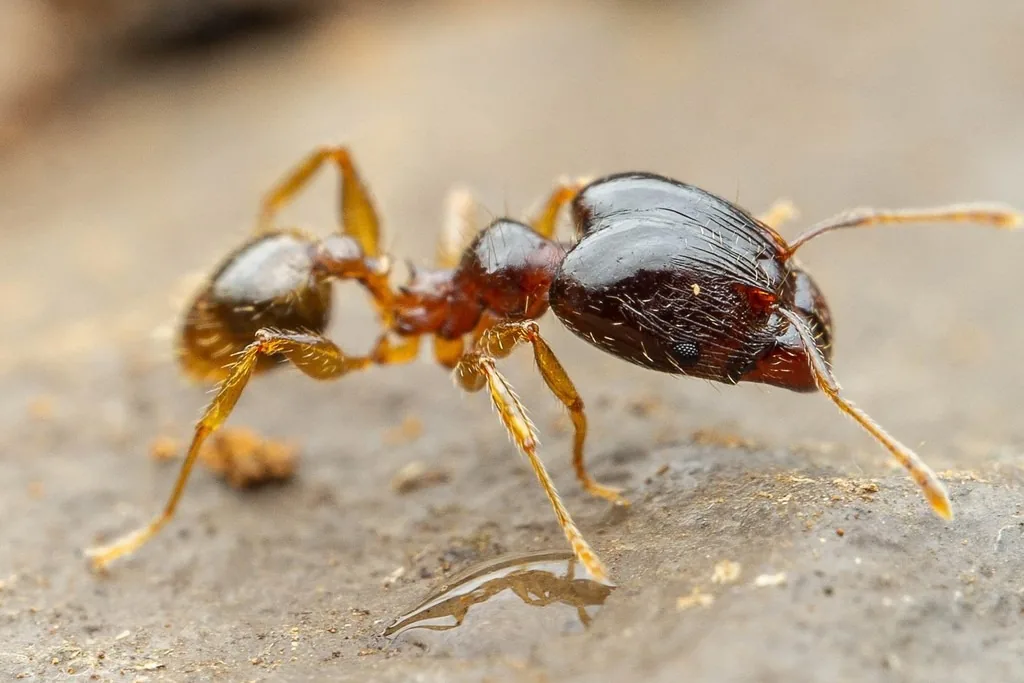
- Workers come in two sizes: minor workers about 2 mm long and reddish brown, and majors 3 to 4 mm with a very large head.[1]
- Majors make up only about 1% of foragers, so look closely at a trail or a disturbed nest to spot them.[1]
- Two nodes at the waist, 12-segmented antennae ending in a 3-segmented club, and two short spines on the thorax.[1][2]
- The major worker's head is bi-lobed, with a groove down the middle.[2]
Look-alikes
| Look-alike | How to tell them apart |
|---|---|
| Red imported fire ant | Fire ant workers come in many sizes and sting aggressively when disturbed; bigheaded ants have two sizes, bite but don't sting, and are slightly smaller, darker and less shiny.[1] |
| Subterranean termites | Bigheaded ants can build debris-covered foraging tubes resembling termite mud tubes, but theirs are much more fragile.[1] |
Where it lives
Pheidole megacephala is an invasive tramp ant of tropical and subtropical regions and is confirmed in many Florida counties. The native Pheidole dentata ranges from Kansas to Virginia and south to Florida.[1][2]
Biology and life cycle
Colonies can have many fertile queens and produce brood year-round in warm climates, sometimes forming nearly continuous supercolonies that crowd out other ants.[1]
In south Florida, winged reproductives fly to mate in winter and spring.[1]
They eat honeydew, dead insects and soil invertebrates, and foragers quickly recruit nestmates to food; indoors the native species takes meats, grease, fruit juice and peanut butter.[1][2]
Nests are in lawns, flowerbeds and disturbed soil, under bricks, slabs and flower pots, and along foundations, walkways and water pipes.[1]
Damage and signs
Health risk
Bigheaded ants don't sting and usually bite only when the nest is disturbed; even then, the bite is not painful.[1]
Control
Prevention
Find where colonies are located first, then treat them directly; use baits where nests can't be reached.[2]
Pesticides
Baits held up longer than sprays in a UF trial: two baits gave control for about four weeks versus about two weeks for residual sprays.[1]
Treat lawns, flowerbeds and soil along walkways, not just the house perimeter; one-time treatments are of very limited value against this prolific ant.[1]
Ants entering a building can be baited with sweet liquid ant baits, and colonies in wall voids treated with a dust labeled for that use.[1][2]
When to call a professional
Control is difficult because colonies are numerous and usually spread across property lines; professional programs need to cover lawns, flowerbeds, trees and walkways, not just the foundation.[1]
Common questions
- What are the little piles of sand along my driveway?
- In Florida, they are often from bigheaded ants digging beneath walkways and driveways and pushing loose soil to the surface.[1]
- Do bigheaded ants sting?
- No. They may bite if the nest is disturbed, but the bite is not painful.[1]
- Are there native bigheaded ants?
- Yes. Pheidole dentata is a native species and the most common Pheidole in the southern states; it lives mostly outdoors.[2]
Sources
- University of Florida, IFAS Extension, “Bigheaded Ant, Pheidole megacephala (Publication IN712).” ask.ifas.ufl.edu/publication/IN712 (accessed 2026-10-06)
- Texas A&M AgriLife Extension, Urban and Structural Entomology, “Big-Headed Ant.” urbanentomology.tamu.edu/urban-pests/ants/big_headed/ (accessed 2026-10-06)
- iNaturalist, “Pheidole megacephala taxon page (order and family).” www.inaturalist.org/taxa/199356 (accessed 2026-10-06)