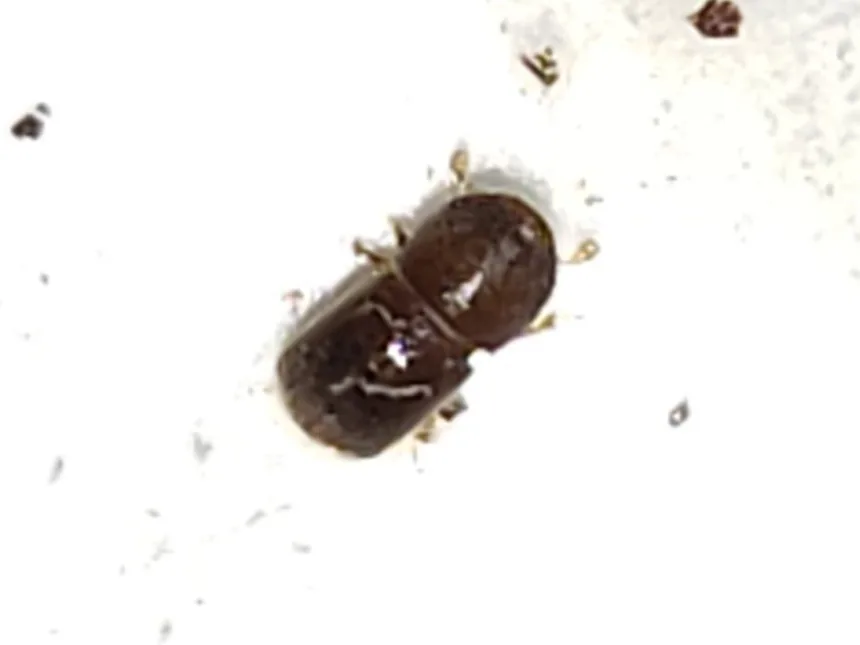
How to identify it
Look-alikes
| Look-alike | How to tell them apart |
|---|---|
| Granulate ambrosia beetle | A related Xylosandrus that attacks larger branches and stems, 3/4 to 3 inches across.[1] |
Where it lives
First collected in the U.S. at Fort Lauderdale in 1941, it now ranges along the Southeastern Coastal Plain.[1]
Biology and life cycle
Over 224 plant species in 62 families are susceptible.[1]
Damage and signs
- It infests small twigs of hosts such as maples, pecan and beautyberry.[1]
Health risk
It attacks plants; UF/IFAS mentions no risk to people.[1]
Control
Prevention
Promote tree vigor to help recovery.[1]
Traps and physical control
Prune and destroy infested twigs.[1]
Common questions
Sources
- University of Florida IFAS Extension (Featured Creatures), “Black Twig Borer, Xylosandrus compactus (EENY-311).” edis.ifas.ufl.edu/publication/IN577 (accessed 2026-10-06)
- iNaturalist, “Xylosandrus compactus taxon page (order and family).” www.inaturalist.org/taxa/450007 (accessed 2026-10-06)