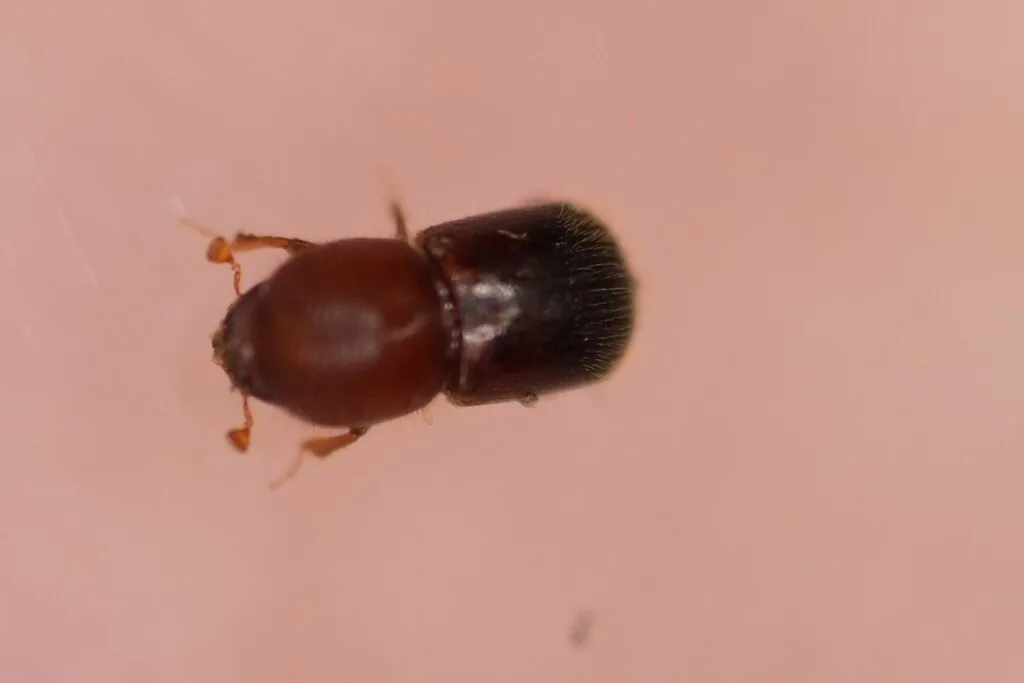
How to identify it
- Females are about 2.1 to 2.9 mm long, stout, smooth and cylindrical, and usually dark reddish brown.[1]
- Males are smaller, about 1.5 mm, hunch-backed and flightless; they rarely leave the gallery, so the females are the ones you see.[1][2]
- The surest sign is frass tubes: fragile, toothpick-like strands of sawdust sticking out of tiny holes in the bark.[1][2]
- Entrance holes are about 2 mm across, roughly the width of pencil lead, and attacks are usually below shoulder height.[1][2]
Look-alikes
| Look-alike | How to tell them apart |
|---|---|
| Pine bark beetles | Bark beetles feed on the living inner bark (phloem), while ambrosia beetles feed on fungus they grow in their tunnels; the granulate ambrosia beetle doesn't attack conifers such as pines.[1] |
| Native ambrosia beetles | Native species are usually secondary pests of stressed, dying or dead trees; the granulate ambrosia beetle can also attack healthy hosts.[1] |
Where it lives
First found in the U.S. in peach trees near Charleston, South Carolina, in 1974; it has since spread across the eastern U.S. to at least 29 states.[1][2]
Biology and life cycle
Females bore galleries into the wood and plant spores of a symbiotic ambrosia fungus, which both adults and larvae eat; they don't eat the wood itself.[1][2]
Eggs, larvae and pupae develop together inside the galleries, and only adults leave the tree.[2]
Young females mate with their brothers inside the gallery or reproduce without mating, then fly off to attack new plants.[1][2]
Activity peaks in spring, with large flights possible as early as mid-February in Georgia; the Southeast likely sees two generations a year.[2][1]
Damage has been reported in more than 100 woody plants, including dogwood, redbud, maple, ornamental cherry, crape myrtle, pecan, peach, fig, magnolia, sweetgum and azalea.[1][2]
Damage and signs
- The fungus it introduces disrupts the plant's vascular system, causing wilting and branch dieback.[1]
- Heavily infested trees may be stunted, leaf out late in spring and drop leaves early.[1][2]
- Attacks on nursery stock or newly transplanted trees are often fatal, while larger trees usually survive unless they face another stress.[2][1]
- Holes also let in secondary disease organisms such as Fusarium, which add to the decline.[1]
Health risk
The harm is to trees and shrubs: attacks can cost ornamental plants and nursery stock their appearance and value.[1]
Control
Prevention
Keep plants healthy: choose species suited to the site, plant correctly and give good care, since stressed and newly planted trees are most vulnerable.[1]
Time protection with traps: alcohol-baited traps or ethanol-filled hardwood bolts show when beetles are flying; rubbing alcohol doesn't work as bait.[2][1]
Sanitation
Remove and destroy heavily infested plants to limit spread; infested nursery trees can become breeding sites.[1][2]
Pesticides
Preventive pyrethroid sprays such as permethrin or bifenthrin can stop females from boring in, but must go on before attack and be repeated while beetles are active.[1][2]
Once beetles are inside, insecticides and fungicides help little, because the beetles don't eat wood and are protected deep in the tree.[1][2]
Common questions
- What are the sawdust toothpicks on my young tree?
- Strings of sawdust pushed out of tiny holes are a classic sign of ambrosia beetles such as the granulate ambrosia beetle; they break off easily in wind or rain.[1][2]
- Can ambrosia beetles in firewood infest my house?
- No. Ambrosia and bark beetles that emerge from firewood or new lumber are forest insects and can't reinfest the wood in a finished structure.[3]
Sources
- Clemson Cooperative Extension, Home & Garden Information Center, “Granulate Ambrosia Beetle (Xylosandrus crassiusculus), HGIC 2516 (November 20, 2023).” hgic.clemson.edu/factsheet/granulate-ambrosia-beetle-xylosandrus-crassiusculus/ (accessed 2026-10-06)
- University of Georgia Cooperative Extension, “Granulate Ambrosia Beetle (Xylosandrus crassiusculus) (Landscape Pest Management: Nursery Pests).” extension.uga.edu/programs-services/landscape-pest-management/Nursery-pests/granulate-ambrosia-beetle.html (accessed 2026-10-06)
- University of California Statewide IPM Program, “Pest Notes: Wood-Boring Beetles in Homes, Publication 7418.” ipm.ucanr.edu/home-and-landscape/wood-boring-beetles-in-homes/ (accessed 2026-10-06)
- iNaturalist, “Xylosandrus crassiusculus taxon page (order and family).” www.inaturalist.org/taxa/233854 (accessed 2026-10-06)