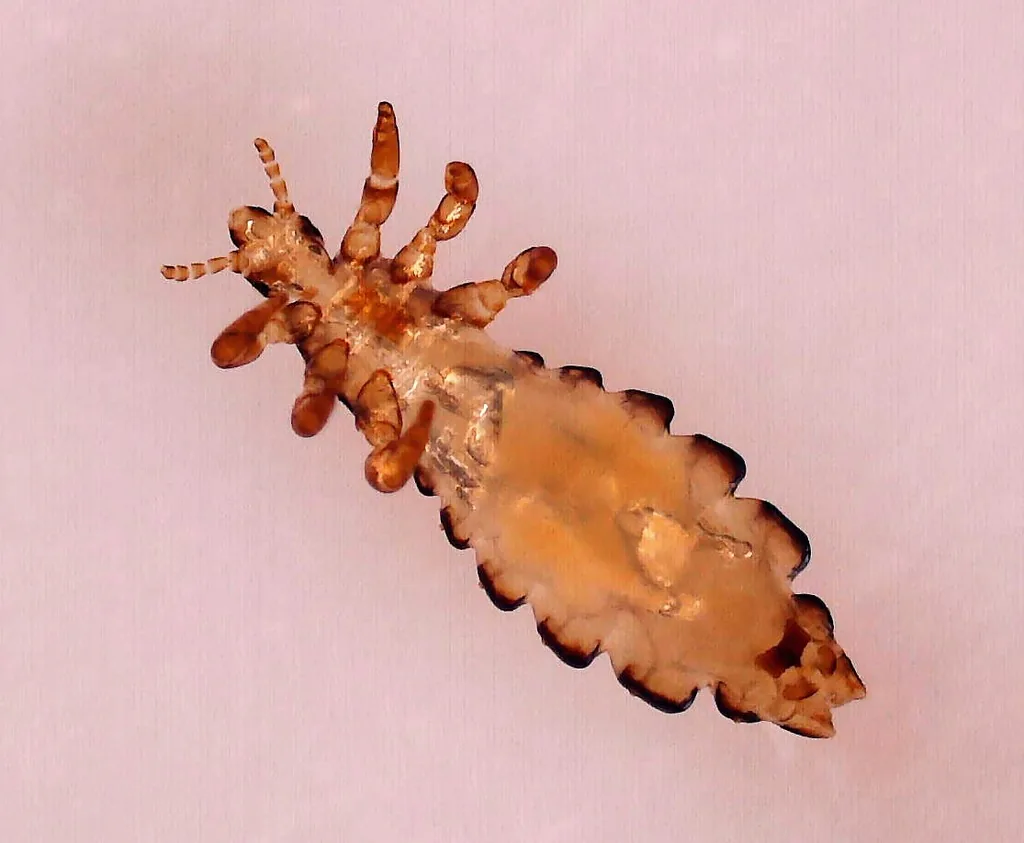
How to identify it
- Adults are about 2.3 to 3.6 millimeters long, roughly the size of a sesame seed, tan to grayish-white, with six legs.[1]
- Eggs, called nits, are tiny and easy to mistake for dandruff; they are laid in clothing and bedding rather than on the skin.[1]
- Newly hatched nymphs are about the size of a pinhead.[1]
Look-alikes
Where it lives
Body lice occur worldwide but are concentrated where people live in crowded conditions without regular access to bathing and clean clothes.[1]
Biology and life cycle
Nits hatch in about 6 to 9 days, and the nymphs grow into adults in about a week.[1]
A female can lay up to eight nits a day.[1]
Adults need to feed on blood several times a day and die within 1 to 2 days if they can't feed.[1]
Damage and signs
- Infestations mostly affect people without regular access to bathing and clean clothing, such as people experiencing homelessness, refugees and disaster survivors.[1]
Health risk
Body lice can spread epidemic typhus, Bartonella quintana infection and epidemic relapsing fever; bites cause intense itching and rash, and long-term infestations thicken and darken the skin.[1][3]
Control
Prevention
Avoid sharing clothing, bedding and other personal items.[1]
Sanitation
Bathe regularly and change into clean clothes at least once a week; better hygiene is the main treatment for body lice.[1]
Machine-wash infested clothing and bedding in water at least 130 degrees Fahrenheit, then dry them on high heat.[1]
Dry-clean items that can't be washed, or seal them in a plastic bag for two weeks.[1]
Pesticides
Lice-killing medicines exist but usually aren't needed when hygiene and laundering are kept up; insecticide dusting is sometimes used to control disease outbreaks.[1]
How body lice spread
They spread through direct contact with a person who has body lice, or through infested clothing, bedding or linens.[1]
Epidemic typhus, also called louse-borne typhus, spreads to people through contact with infected body lice.[3]
Pets do not spread human lice.[1]
Common questions
- What water temperature kills body lice?
- The CDC advises washing infested items in water at least 130 degrees Fahrenheit and drying them on the hot cycle.[1]
- Can I get body lice from my dog or cat?
- No. Pets don't spread human lice.[1]
- Do I need medicine for body lice?
- Usually not. Regular bathing, clean clothes and hot-water laundering of clothing and bedding are normally enough.[1]
Sources
- U.S. Centers for Disease Control and Prevention, “About Body Lice (updated June 24, 2024).” www.cdc.gov/lice/about/body-lice.html (accessed 2026-10-06)
- U.S. Centers for Disease Control and Prevention, “About Head Lice.” www.cdc.gov/lice/about/head-lice.html (accessed 2026-10-06)
- U.S. Centers for Disease Control and Prevention, “Typhus Fevers Basics (updated December 11, 2025).” www.cdc.gov/typhus/about/index.html (accessed 2026-10-06)
- iNaturalist, “Pediculus humanus humanus taxon page (order and family).” www.inaturalist.org/taxa/411752 (accessed 2026-10-06)