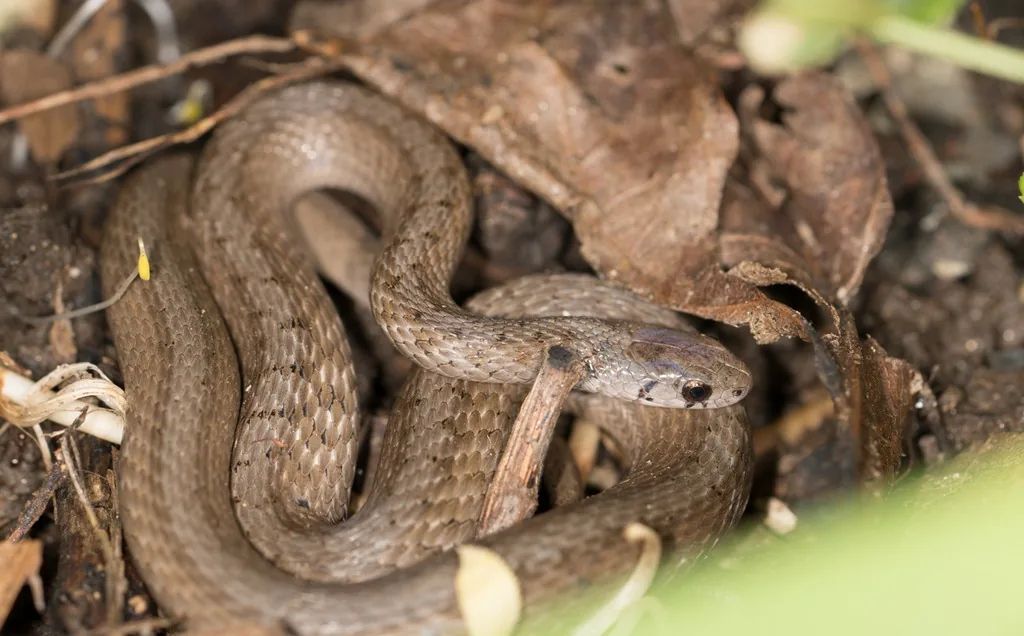
How to identify it
- A small, slender snake, usually 9 to 13 inches long as an adult and rarely up to about 20 inches.[1][2]
- Gray-brown to reddish brown, usually with a paler stripe down the back bordered by two rows of small dark spots that may be linked across the back.[1][2][3]
- The head is dark on top, with a dark mark below each eye and on each side of the neck.[1][2][3]
- The scales are keeled, each with a raised ridge, and the belly is cream, tan, pinkish or gray, often with tiny black dots along the edges.[1][3][4]
- Young brownsnakes are darker overall, with a pale band or collar across the back of the head.[1][3][4]
Look-alikes
| Look-alike | How to tell them apart |
|---|---|
| Copperhead (young) | Brownsnakes are often killed by mistake for copperheads, but copperheads have bold hourglass-shaped crossbands and young ones have a bright yellow tail tip.[4] |
| Garter snakes | Missouri lists the plains gartersnake as a similar species; the brownsnake's tan back stripe is bordered by two rows of small brown spots, usually joined by a narrow line.[2] |
| Red-bellied snake | The closely related red-bellied snake is a bit smaller and has a bright red or orange belly; it is more common in forests, while brownsnakes favor disturbed ground.[3][4] |
| Earthsnakes | Earthsnakes look similar but lack the brownsnake's spots on the back and head.[4] |
Where it lives
Found across the eastern United States and into adjacent Canada, including statewide in Missouri, but absent from high mountain elevations. In extreme southern Georgia and Florida it is replaced by the closely related Florida brownsnake.[4][3][2][1]
Biology and life cycle
Brownsnakes live in woods, wetlands and grasslands but thrive in developed areas, including yards, parks, cemeteries and vacant city lots.[3][2][4]
They hide under logs, rocks, boards, leaf litter and other debris and are rarely noticed until yard work or heavy rain uncovers them.[1][2][3]
Their diet is mostly slugs and earthworms, plus snails and soft-bodied insects; one Missouri study found 75 percent slugs.[2][1][4]
They are active from about March to November and may move at night in hot weather.[3][2]
They spend winter below the frost line in rodent burrows, rock crevices or under buildings, often sharing dens with garter snakes and other species.[3]
Females give birth to live young, about 3 to 41 per litter, from mid-July through early fall; newborns are only about 4 inches long.[2][3][1]
Damage and signs
Health risk
Brownsnakes are harmless to people and pets and rarely if ever bite. When handled they flatten the head and body and release a foul-smelling musk.[1][2][3]
Control
Prevention
The best approach is to leave a brownsnake alone and let it move on; Connecticut wildlife officials strongly discourage killing snakes.[3]
Keep them out
Seal foundation cracks and keep basement windows closed or screened; sealing small gaps as you would for mice also keeps snakes out.[3][6]
Sanitation
To make a yard less inviting, keep grass short, trim shrubs off the ground, and remove brush piles, rock piles, boards and other debris that give cover.[3][6]
Pesticides
No toxicants are registered for snakes, and research on snake repellents is lacking or inconsistent.[6]
Common questions
- Is the little brown snake in my garden venomous?
- If it is a DeKay's brownsnake, no. It is nonvenomous, rarely bites, and is not dangerous to people or pets.[1][2][3]
- Is it a baby copperhead?
- Probably not. Young copperheads have bold hourglass bands and a bright yellow tail tip, while brownsnakes have small rows of spots and no yellow tail.[4]
- Why do I keep finding brownsnakes after it rains?
- They usually stay hidden under cover, but heavy rain and yard work flush them out, and they often cross trails and roads in spring and fall.[1][2]
Sources
- Florida Museum of Natural History, University of Florida, “Dekay's Brownsnake (Florida Snake ID Guide).” www.floridamuseum.ufl.edu/florida-snake-id/snake/dekays-brownsnake/ (accessed 2026-10-06)
- Missouri Department of Conservation, “Dekay's Brownsnake (Field Guide).” mdc.mo.gov/discover-nature/field-guide/dekays-brownsnake (accessed 2026-10-06)
- Connecticut Department of Energy and Environmental Protection, “Dekay's Brownsnake (Wildlife Fact Sheet, updated August 2022).” portal.ct.gov/deep/wildlife/fact-sheets/dekays-brownsnake (accessed 2026-10-06)
- Savannah River Ecology Laboratory, University of Georgia, “Brown Snake (Storeria dekayi).” srelherp.uga.edu/snakes/brown-snake/ (accessed 2026-10-06). University of Georgia research unit's herpetology guide to snakes of the Southeast.
- Internet Center for Wildlife Damage Management, “Snake Damage Identification.” icwdm.org/species/reptiles/snakes/snake-damage-identification/ (accessed 2026-10-06). Run by university wildlife damage specialists (maintained at the University of Wisconsin-Stevens Point); species modules are based on Prevention and Control of Wildlife Damage (University of Nebraska Cooperative Extension, 1994).
- Internet Center for Wildlife Damage Management, “Snake Damage Prevention and Control Methods.” icwdm.org/species/reptiles/snakes/snake-damage-prevention-and-control-methods/ (accessed 2026-10-06). Run by university wildlife damage specialists (maintained at the University of Wisconsin-Stevens Point); species modules are based on Prevention and Control of Wildlife Damage (University of Nebraska Cooperative Extension, 1994).
- iNaturalist, “Storeria dekayi taxon page (order and family).” www.inaturalist.org/taxa/28562 (accessed 2026-10-06)