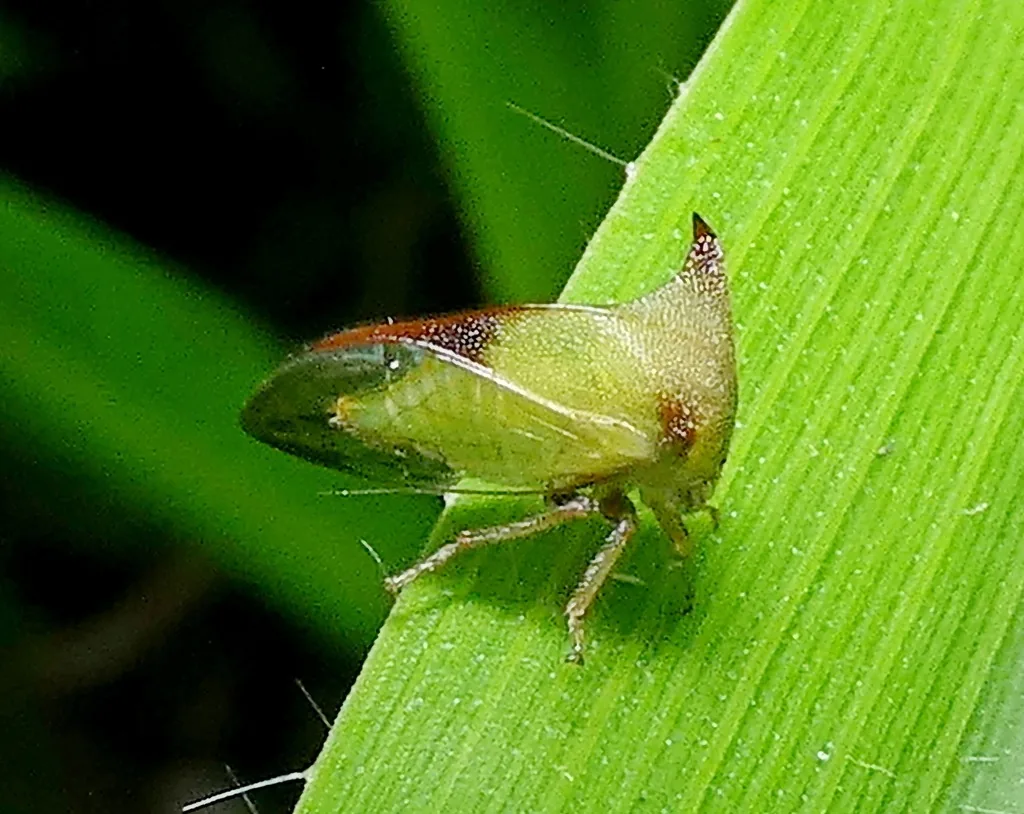
How to identify it
- Adults are brown or green, 2/5 inch long or less, and triangular from above.[1]
- An enlarged hood behind the head covers the front half of the body, setting treehoppers apart from true bugs.[1]
- Nymphs are reddish brown with many spines on the back, often in groups on stems, and both stages jump readily.[1]
Look-alikes
| Look-alike | How to tell them apart |
|---|---|
| Leafhoppers and cicadas | They share rows of spines on the hind legs, but only treehoppers have the large hood over the body.[1] |
Where it lives
At least 40 treehopper species live in California; buffalo treehoppers feed on many herbaceous and woody plants.[1]
Biology and life cycle
Eggs overwinter in slits females cut in the upper side of twigs.[1]
Nymphs hatch in spring and drop to feed on herbaceous plants nearby.[1]
Adults appear in summer and fall and lay the overwintering eggs; there's one generation a year.[1]
Damage and signs
Health risk
They feed on plant sap; UC IPM describes no risk to people.[1]
Control
Prevention
Generally no control is needed to protect plant health.[1]
Sanitation
Removing herbaceous weeds lowers nymph survival and future egg-laying damage.[1]
Traps and physical control
On small plants, a forceful spray of water knocks them off.[1]
Pesticides
If twig damage was heavy the season before, dormant-season horticultural oil can kill overwintering eggs.[1]
Common questions
Sources
- University of California Statewide IPM Program, “Buffalo Treehopper (Pests in Gardens and Landscapes).” ipm.ucanr.edu/PMG/GARDEN/VEGES/PESTS/buftrehop.html (accessed 2026-10-06)
- iNaturalist, “Ceresa taxon page (order and family).” www.inaturalist.org/taxa/120886 (accessed 2026-10-06)