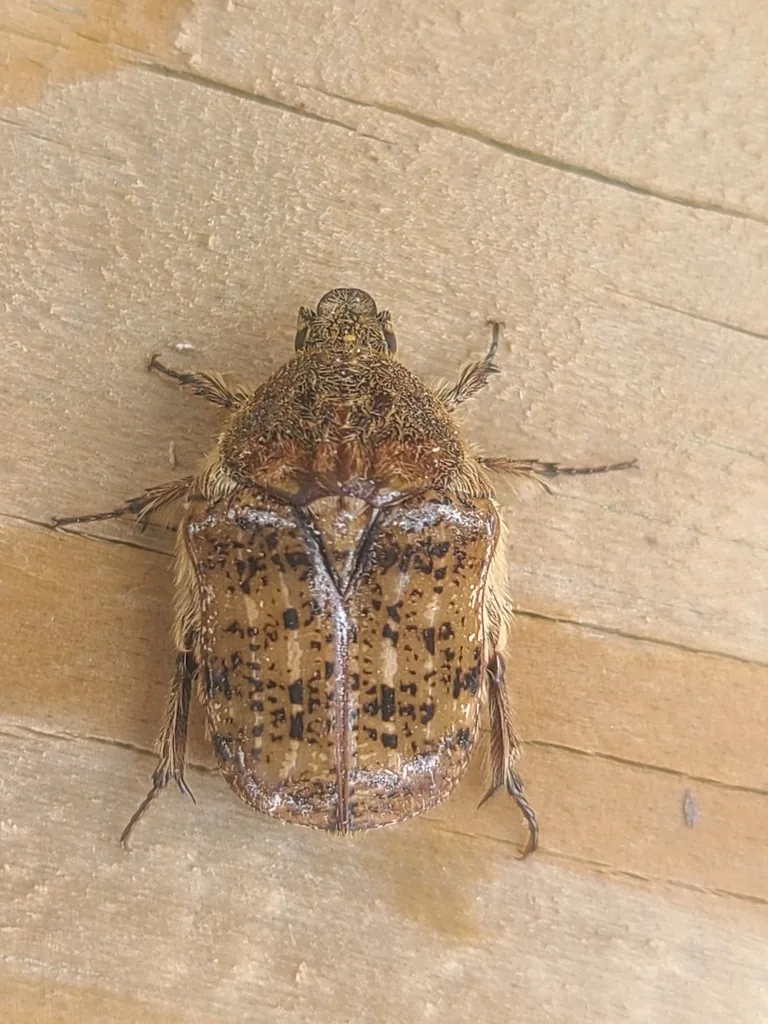
How to identify it
- Adults are about 1/2 to 0.6 inch long, with yellowish-brown or cinnamon wing covers marked with irregular rows of small black spots.[1][2]
- The head, thorax and underside are densely hairy, and the beetles make a noticeable buzzing sound in flight.[1][2]
- Handled adults may give off a pungent, chlorine-like defensive odor; the larvae are white grubs that resemble June beetle grubs.[1]
Look-alikes
| Look-alike | How to tell them apart |
|---|---|
| June beetle | Related, but June beetles appear mostly from May to June, while bumble flower beetles show up from late July until the first hard frost.[2] |
Where it lives
Utah State and South Dakota State Extension both report it; Utah State says it seldom needs control there.[1][2]
Biology and life cycle
Eggs are laid in soil rich in organic matter or in compost on the first warm days of spring, and larvae feed on organic matter and rotting fruits and vegetables.[1]
Larvae mature in June to July and pupate 2 to 5 inches deep; in Utah, adults are active from mid August through September before overwintering.[1]
There is one generation a year.[1]
Damage and signs
- The grubs feed only on organic matter and are beneficial in compost.[1]
- Adults are attracted to sweet or fermenting liquids and ripening crops, and occasionally feed on corn kernels at the silk stage and on fruit.[1][2]
- SDSU notes they are often blamed for damaged tomatoes and apples but feed on produce that was already damaged.[2]
Health risk
Control
Sanitation
Harvest promptly and remove damaged produce, blemished apples and dropped fruit throughout the season.[1][2]
Remove decaying organic matter, such as compost piles, from near the affected crop.[1]
Traps and physical control
Pick adult beetles off plants and drop them into a bucket of soapy water.[1][2]
Common questions
- What is the hairy buzzing beetle on my tomatoes?
- Likely a bumble flower beetle, which appears in late summer and is drawn to ripe or damaged produce.[1][2]
- Are bumble flower beetles harmful?
- Rarely; they mostly feed on fruit that is already damaged, and their grubs eat only organic matter.[1][2]
- How is it different from a June beetle?
- Timing: June beetles appear in May and June, bumble flower beetles from late July until frost.[2]
Sources
- Utah State University Extension, “Bumble Flower Beetle.” extension.usu.edu/planthealth/ipm/notes_ag/veg-bumble-flower-beetle.php (accessed 2026-10-15)
- South Dakota State University Extension, “Bumble Flower Beetles Are Here (September 14, 2021).” extension.sdstate.edu/bumble-flower-beetles-are-here (accessed 2026-10-15)
- iNaturalist, “Euphoria inda taxon page (order and family).” www.inaturalist.org/taxa/219776 (accessed 2026-10-06)