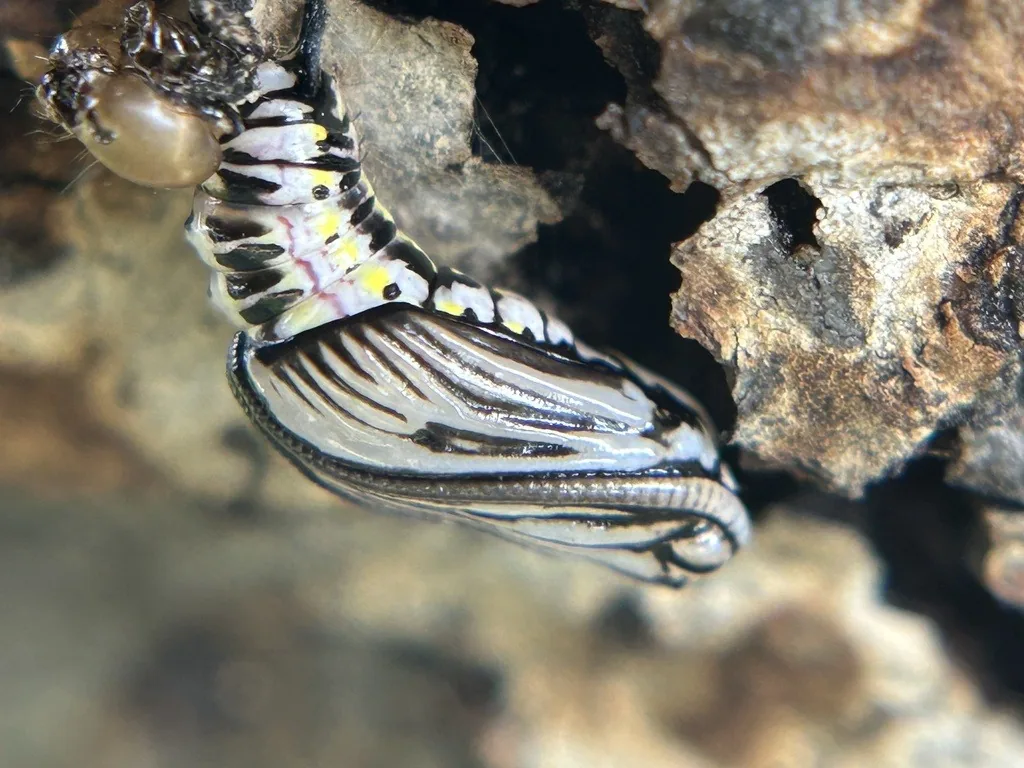
How to identify it
- Older caterpillars are commonly dark with prominent lengthwise yellow or olive stripes and a large brown head, about 1 inch long.[1]
- Young caterpillars are small and yellowish green with dark side stripes.[1]
- Adults are tan to gray or silvery moths with prominent wing veins and about a 1-1/4 inch wingspread.[1]
- Pupae are white to pinkish with black marks, hanging from limbs, trunks or nearby objects.[1]
Look-alikes
| Look-alike | How to tell them apart |
|---|---|
| Tussock moth and tent caterpillars | These also feed on oaks but are quite hairy; oakworms are relatively smooth.[1] |
Where it lives
It ranges along the coast and coastal mountains of California; damage is most common on coast live oak around San Francisco and Monterey bays.[1]
Biology and life cycle
Fall eggs hatch within weeks, and caterpillars overwinter on evergreen oak leaves, pupating in May or early June.[1]
Moths emerge in June and July, and a summer generation feeds July through September; a third generation can occur in warm areas.[1]
Damage and signs
Health risk
It feeds on oaks; UC IPM mentions no risk to people.[1]
Control
Prevention
Treatment usually isn't recommended; healthy oaks generally tolerate extensive defoliation.[1]
Biological control
Predators, parasites and natural disease outbreaks sometimes kill enough oakworms to control them.[1]
Common questions
Sources
- University of California Statewide IPM Program, “Pest Notes: California Oakworm (Publication 7422).” ipm.ucanr.edu/PMG/PESTNOTES/pn7422.html (accessed 2026-10-06)
- iNaturalist, “Phryganidia californica taxon page (order and family).” www.inaturalist.org/taxa/83958 (accessed 2026-10-06)