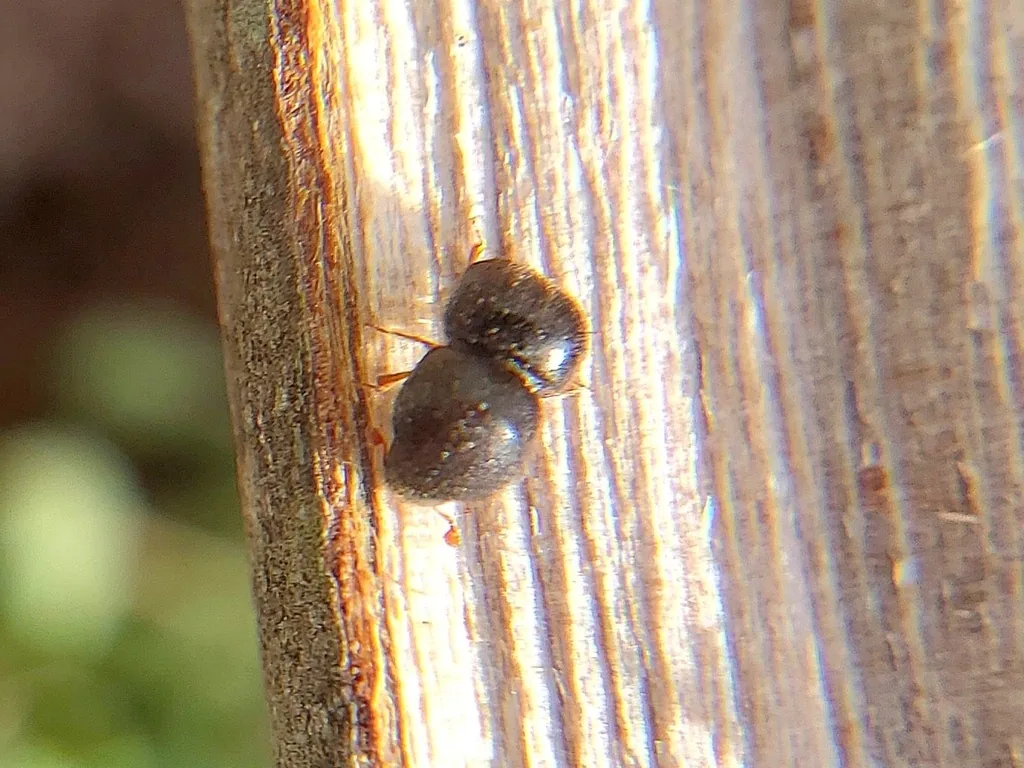
How to identify it
- Adults are robust, dark brown beetles 2.6 to 3.9 mm long, the largest ambrosia beetles in North America.[1]
- The body is cylindrical, and the rear looks cut off at an angle, so the abdomen is shorter than the head and thorax.[1]
- Entry and exit holes are about 2 mm (5/64 inch) across, large for an ambrosia beetle.[1]
Look-alikes
| Look-alike | How to tell them apart |
|---|---|
| Other ambrosia beetles | Camphor shoot borer holes are relatively large, about 2 mm, and a split stem shows a T- or cross-shaped gallery running with the grain.[1] |
Where it lives
Native to Asia, it was found in Mississippi in 1999 and has spread through the eastern US, reaching southern Pennsylvania by 2013.[1]
Biology and life cycle
Females carry a fungus into the wood, and the beetles feed on the fungus rather than the tree itself.[1]
It attacks many hardwood trees, shrubs and vines, with sweetgum a preferred host, but only plants that are stressed, weakened or dying.[1]
Ethanol from stressed plants helps draw the beetles in; drought, flooding, poor drainage, herbicide injury and transplant shock all raise the risk.[1]
They colonize stems 2.5 to 3.8 cm (about 1 to 1.5 inches) thick, never under 1.2 cm or over 5 cm, at least 0.5 m (about 1.6 feet) above the ground.[1]
Only females fly to new hosts; males mate with their sisters inside the gallery and never leave it.[1]
In Pennsylvania, adults have been collected from May into early October.[1]
Damage and signs
- Attacks cause wilting leaves and branch dieback, and a colonized trunk can die above the attack, sometimes killing the whole tree.[1]
- Gasoline with up to 10 percent ethanol fools them into attacking plastic gas cans, tanks and fuel lines, sometimes by the hundreds.[1]
- Enough beetles can bore through a container to ruin it, and Penn State warns that bored boat fuel lines can leak and leave a boater stranded.[1]
Health risk
It attacks plants and plastic fuel containers; Penn State Extension mentions no risk to people.[1]
Control
Prevention
The best prevention is unstressed plants: species suited to the site, no herbicide drift near hardwoods, and transplanting outside peak flight.[1]
Kaolin clay on trunks has been suggested, since the white coating keeps beetles from recognizing trees as hosts.[1]
Sanitation
Pruning out infested branches or removing infested plants lowers local numbers, though these strong fliers can reinfest from nearby.[1]
Pesticides
No insecticide has been tested against it; imidacloprid, bifenthrin and permethrin cut attacks by some other ambrosia beetles, so they may or may not help.[1]
Common questions
Sources
- Penn State Extension, “Camphor Shoot Borer (Cnestus mutilatus).” extension.psu.edu/camphor-shoot-borer-cnestus-mutilatus (accessed 2026-10-06)
- iNaturalist, “Cnestus mutilatus taxon page (order and family).” www.inaturalist.org/taxa/493583 (accessed 2026-10-06)