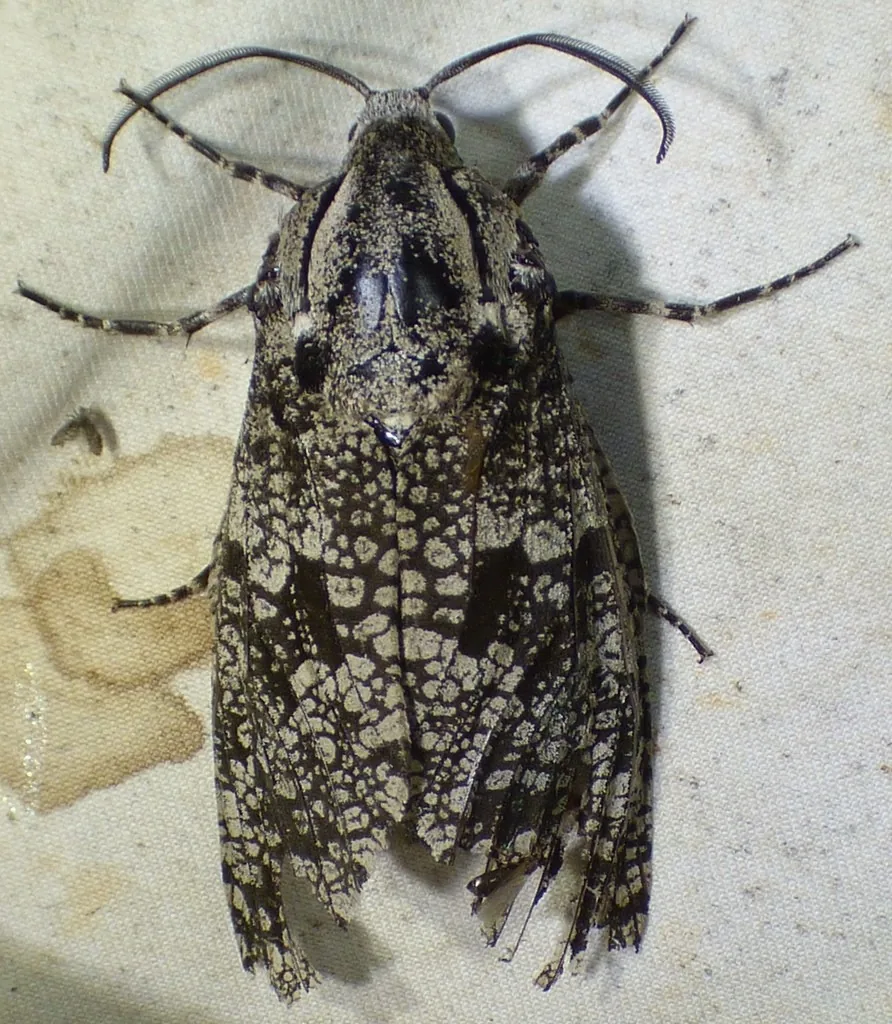
How to identify it
- Early signs are dark sap spots on the trunk, then frass and sawdust pushed out of gallery openings.[1]
- Mature larvae are 2 to 3 inches long, greenish white with a dark brown head.[1]
- Adults are robust moths with about a 3-inch wingspan and mottled black-and-gray forewings; males have orange hind wings.[1]
- In older infestations, pupal cases stick about two-thirds out of the bark.[1]
Look-alikes
| Look-alike | How to tell them apart |
|---|---|
| Clearwing borers | Clearwing pupal cases are about 3/4 inch; carpenterworm cases are usually over 1-1/2 inches.[2] |
Where it lives
Hosts include apricot, ash, birch, cottonwood, American elm, black locust, maple, oak, pear and willow; trees near streams and rivers are more susceptible.[1]
Biology and life cycle
Females lay 3 to 6 eggs in sticky masses in bark cracks or near existing galleries, often on the tree they came from.[1]
Larvae bore into sapwood and later heartwood; galleries reach about 1/2 inch wide and 6 to 10 inches long.[1]
Development takes 2 to 4 years in California, and moths emerge mostly May through July.[1]
Damage and signs
Health risk
The caterpillars live inside trees; the hazard UC IPM describes is falling limbs, not the insect itself.[1]
Control
Prevention
Keep trees vigorous with proper watering and care, and protect them from wounds.[1]
Traps and physical control
Probe galleries with a long wire, then mark them and check weekly for fresh frass.[1]
Biological control
A single treatment with Steinernema feltiae or S. carpocapsae nematodes can be very effective.[1]
When to call a professional
Have an arborist inspect heavily infested trees; badly tunneled limbs may need removal.[1]
Common questions
Sources
- University of California Statewide IPM Program, “Pest Notes: Carpenterworm (Publication 74105).” ipm.ucanr.edu/PMG/PESTNOTES/pn74105.html (accessed 2026-10-06)
- University of California Statewide IPM Program, “Pest Notes: Clearwing Moths (Publication 7477).” ipm.ucanr.edu/PMG/PESTNOTES/pn7477.html (accessed 2026-10-06)
- iNaturalist, “Prionoxystus robiniae taxon page (order and family).” www.inaturalist.org/taxa/126293 (accessed 2026-10-06)