❓ Common Questions About 🦗 Cat Flea
How do I confirm I actually have this pest (not something similar)?
The most reliable confirmation is a physical specimen — capture one and compare to reference images on this page. For cryptic pests (bed bugs, termites), look for secondary signs: frass, shed skins, mud tubes, or bites with a specific pattern. When uncertain, a professional inspection is faster than months of misidentification.
Can I treat this myself or do I need a professional?
DIY is effective for small, accessible infestations caught early. Professionals are worth the cost when: the infestation is inside wall voids or structural elements, multiple rooms are affected, you have health-risk pests (hantavirus, venomous species), or DIY has already failed twice.
How long until the infestation is completely gone?
Expect 3–8 weeks for most infestations with proper treatment. Insects with dormant life stages (pupae, eggs) extend the timeline because those stages are impervious to most insecticides. Follow-up treatments at 2 and 4 weeks catch each new cohort as they emerge.
What's the most common mistake people make treating this pest?
Treating only the visible pest population while ignoring the harborage site, entry point, or breeding location. Killing adults provides temporary relief but the population rebuilds from hidden egg cases, pupae, or new arrivals through unaddressed entry points.
Outdoor flea sources and yard treatment
Fleas brought in by pets often originate from yard reservoirs — shaded, humid areas where pets rest are the main concentration points. Yard treatment focuses on these resting areas rather than broadcast lawn treatment: under decks, around foundation plantings, in shaded grass under trees, and near pet bedding or doghouses if present. Insect growth regulators added to yard treatment improve durability. Wild animal hosts (feral cats, raccoons, opossums, squirrels) can sustain yard flea populations even with treatment — exclusion under decks and outbuildings reduces these reservoirs. In light infestations, yard treatment may not be necessary at all; in heavy or persistent infestations, it's often the missing piece that explains why interior-only treatment hasn't worked.
How environmental conditions affect treatment efficacy
Pesticide efficacy is highly sensitive to the conditions at application and immediately after. Temperature affects both vapor pressure (volatility) and residual binding — products applied above ~90°F often volatilize before binding to surfaces, while applications below ~50°F can fail to spread properly. Surface porosity changes residual duration: a residual that lasts eight weeks on a sealed concrete slab might last three weeks on bare wood. Rainfall within four hours of an outdoor application typically washes off most surface deposits, though microencapsulated products are more rain-fast. UV exposure degrades many pyrethroids within days to weeks on sunny surfaces, which is why fence-line applications often fail mid-summer. Indoor humidity affects bait acceptance — dry baits perform worse in high humidity as they absorb moisture and lose palatability. Reading conditions correctly explains many otherwise mysterious treatment failures.
Choosing pet flea prevention products
Pet flea prevention has improved substantially in the last decade. Modern oral products (typically isoxazoline class — afoxolaner, fluralaner, sarolaner, lotilaner) provide rapid kill and monthly to quarterly dosing, with strong veterinary support for safety in the general dog and cat population. Topical products work but have more variability in application reliability and bathing washes them off. Flea collars vary widely in efficacy; the prescription Seresto collar has reasonable evidence support, many over-the-counter collars have minimal effect. Veterinary consultation is appropriate before choosing because some products are species-specific (dog products on cats can be dangerous) and breed sensitivities exist (collies and related breeds with MDR1 mutation). The improved products mean that on-pet prevention is now the most reliable element of flea control; environmental treatment is the supporting element rather than the lead.
When professional flea treatment is justified
DIY flea treatment handles most household situations when done thoroughly. Professional treatment is reasonable when: the infestation is in a property with extensive carpet and upholstery where DIY vacuuming and IGR application is impractical; treatment hasn't reduced flea pressure after a full cycle (six weeks of consistent treatment); the household has had multiple flea outbreaks despite consistent pet prevention; or the property includes outdoor structures (sheds, crawlspaces, under-deck areas) that need treatment but are hard to access. Professional treatment typically combines on-pet prevention coordination, interior IGR plus adulticide application, exterior targeted treatment of resting zones, and a follow-up at three weeks. Costs are usually moderate and the time savings versus thorough DIY treatment are significant.
How resistance develops and how to slow it down
Pesticide resistance is now common enough across major pest categories — cockroaches, bedbugs, mosquitoes, certain ant species, some flies — that treatment recommendations have shifted to account for it. Resistance develops through repeated exposure to a single active ingredient class; the surviving population reproduces, and over generations the population shifts toward resistance. Slowing resistance development requires rotating active ingredient classes (not just brands), using full label rates rather than reduced rates, and avoiding routine prophylactic spraying when it isn't needed. The EPA mode-of-action (MoA) classification on product labels helps with rotation: alternating between products in different MoA classes is more effective than alternating brand names within the same class. For homeowners, the practical translation is: don't use the same product month after month; if you're spraying regularly, rotate among at least two unrelated chemistries; and don't spray when monitoring suggests no active population.
Yard flea reduction and the role of microhabitat
Yard flea problems concentrate in specific microhabitats and respond well to targeted treatment of those zones rather than broadcast yard spraying. Flea larvae require shaded, humid, organic-debris-rich environments to develop; they don't survive in mowed sunny grass. The actual breeding zones in a typical yard are: shaded areas under decks and porches (where pets rest), the perimeter of crawlspace access points (where wildlife shelter), along fence lines and dense shrubs (where shade and debris accumulate), under outdoor furniture where pets lie, and beneath low spruce or evergreen branches in landscaped areas. Targeted treatment of these microhabitats with appropriate IGR plus adulticide products produces much better results than spraying the entire lawn. Sunny exposed lawn areas don't support flea development and don't need treatment. Limiting wildlife access (sealing under deck and crawlspace openings, removing feeders that concentrate animals near the home, securing trash) reduces ongoing introduction of new fleas from wildlife sources.
The cost of doing nothing: implicit pest tolerance and its hidden expenses
Pest control discussions usually frame the costs of treatment without quantifying the costs of non-treatment, but the latter are often larger and almost always less visible. Cockroach allergens add measurable healthcare costs in homes with asthma. Rodent activity in attics damages insulation (reducing R-value and adding seasonal heating and cooling costs) and creates fire risk through wire chewing that doesn't show up until something fails. Termite damage in unmonitored properties produces structural repair bills in the five-figure range, often discovered during unrelated renovation. Stored-product pests destroy food inventory at rates that aren't tracked because items are discarded individually rather than tallied. The cumulative cost of doing nothing isn't a single line item but a sum of small chronic losses across years. The framing that helps: pest control isn't a luxury expense layered onto a working baseline; it's a maintenance expense that competes with the slow accumulating cost of allowing a problem to continue. Households running the comparison honestly almost always find that modest preventive spending is the cheaper path.
Flea infestation in homes without pets: more common than expected
Flea infestations in homes without current pets surprise residents but follow a predictable pattern. The most common scenario is a home with a recently-deceased or recently-rehomed pet; flea pupae can remain dormant in carpets for months and emerge en masse when vibration and CO2 from human movement signals their environment is again occupied. Less commonly, wildlife under or near the home — feral cats, raccoons, opossums, or squirrels — produces an outdoor flea population that migrates inside. Even less commonly, fleas hitchhike on humans returning from visits to infested homes or properties. Treatment in pet-free homes focuses on the environment exclusively: IGR application to carpets and upholstery, repeated vacuuming over several weeks to capture emerging adults and stimulate dormant pupae, and addressing any wildlife harborage under or near the structure. Without a current host to feed on, adult fleas have shorter lifespans, but the unfed adults will actively seek humans for blood meals, producing bites that are often the first sign of the infestation.
Indoor flea life cycle: exploiting timing for treatment success
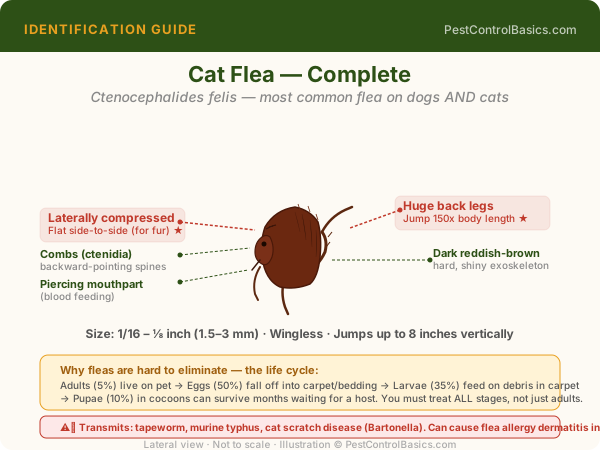
The cat flea, which is the species behind nearly all household flea infestations regardless of which animal it's feeding on, has a four-stage life cycle that runs roughly two to four weeks under household conditions. Adults emerge from pupae in the carpet, feed on a host, mate, and lay eggs that fall off the host into the carpet, where they hatch into larvae that develop into pupae over one to two weeks. The pupal stage is critical for treatment planning because pupae are largely impervious to most insecticides — the cocoon protects the developing flea inside. This is why a single insecticide treatment of a flea infestation almost always fails: it kills adults and larvae but leaves the pupae intact, and over the following two to four weeks those pupae emerge as new adults. Effective flea programs anticipate this by combining initial knockdown treatment with insect growth regulators that disrupt the cycle, vacuuming aggressively to remove eggs and stimulate pupal emergence, and planning follow-up treatment timed to the predicted emergence window. The cycle is what makes flea control take longer than most homeowners expect; understanding it removes the temptation to declare premature success.
Pest control warranties: reading the fine print before signing
Pest control warranties are not standardized, and the differences between contracts that look superficially similar can be enormous. Termite warranties in particular vary across at least three significant dimensions: whether they cover retreatment only or also include damage repair, whether the damage coverage is capped or unlimited, and whether the warranty is transferable to subsequent owners. A retreatment-only warranty on a property with significant termite pressure is much weaker than a damage-inclusive warranty, and the difference matters most precisely in the situations where the warranty is most likely to be needed. General pest control service agreements often have similar gradations — some include unlimited callbacks during the service period, some include a fixed number, and some charge for any visit outside the regular schedule. Before signing, the question to ask is not whether the contract has a warranty, but exactly what the warranty covers, what triggers a callback at no charge, and what the renewal terms are. Companies rarely volunteer this clearly; reading the document carefully and asking specific questions is on the homeowner.
Environmental treatment timing tied to pet treatment
Flea control fails routinely when the pet and the environment are treated on uncoordinated schedules, and the failure mode is predictable. If the pet receives effective flea prevention but the environment isn't treated, eggs continue to drop off the pet — or off transient adults that find the pet briefly — and a baseline infestation persists in the carpet. If the environment is treated but the pet has untreated flea reservoir, every cycle re-seeds the environment. The right sequence is essentially simultaneous: aggressive vacuuming and indoor insecticide treatment combined with starting the pet on a fast-acting flea preventive on the same day, with both maintained for at least eight to twelve weeks to span the full life cycle. Veterinary preventives are dramatically more effective than over-the-counter products for the pet side of this, and the cost difference is small enough that the substitution rarely makes economic sense. Households that follow this sequence resolve flea problems on a predictable timeline; households that treat the pet and environment as independent problems generally don't.