How to identify it
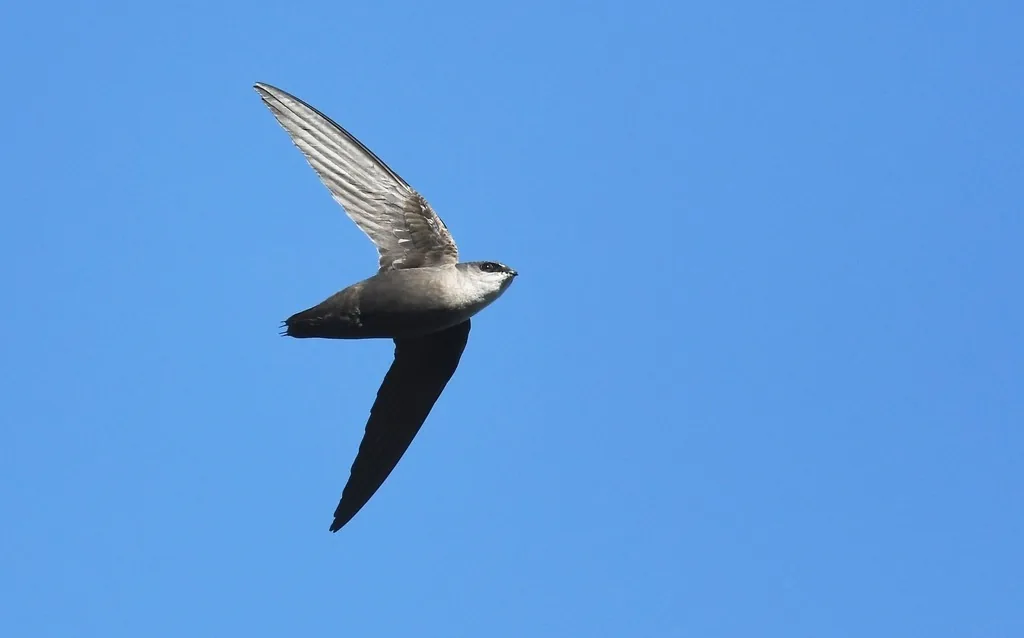
- A small gray-brown bird, about 5 1/4 inches long, with a whitish throat and a short, square-tipped tail.[1][3]
- In flight it looks like a flying cigar with long, narrow, curved wings beating quickly and stiffly.[1][3]
- It never perches on branches; it clings only to vertical surfaces inside chimneys, hollow trees and similar dark spaces.[1][2][3]
- Its call is a rapid series of loud chips or twittering, and nestlings make a loud chattering inside the chimney.[1][3]
Look-alikes
| Look-alike | How to tell them apart |
|---|---|
| Swallows, including cliff swallows | Swallows have more triangular wings with a distinct bend and fly with fluid strokes; swift wings form a crescent and beat shallowly and stiffly.[1] |
Where it lives
Chimney swifts spend the summer across eastern North America and migrate to South America for the winter, leaving Missouri in October.[3][1]
Biology and life cycle
They originally nested in hollow trees and cliff faces, but most now depend on chimneys, old buildings and similar structures.[1][3][2]
The nest is a small cup of twigs glued together and to the chimney wall with sticky saliva.[1][3]
Only one pair nests in a chimney, though the young make it sound like more.[1][3]
Females lay 3 to 5 eggs; incubation lasts about 15 to 20 days, and young fledge 15 to 20 days after hatching.[1]
In fall, hundreds of migrating swifts may circle a large chimney at dusk before dropping in to roost for the night.[1]
They eat flying insects, including mosquitoes and other biting flies, caught on the wing.[1][3]
Damage and signs
Health risk
North Carolina's wildlife agency lists no safety concerns from chimney swifts, but recommends gloves when handling any animal.[2]
Control
Prevention
Wait it out: once the young are calling, they will fledge within a few weeks and the noise will stop.[2]
Keep them out
After the swifts have left for the season, cap the top of the chimney to keep birds out in the future.[2]
Never cap a chimney with an active nest, because shutting out the adults will cause the young to die.[2]
Sanitation
Have the chimney cleaned each year for safety, but not while swifts are nesting, from May through August.[1]
When to call a professional
Removing swifts or an active nest always requires a federal permit, obtained with help from USDA Wildlife Services through the U.S. Fish and Wildlife Service, and states may require their own permit.[2]
Legal status
Chimney swifts are a federally protected migratory bird under the Migratory Bird Treaty Act.[2]
Without a federal permit, it is illegal to take, possess, transport or relocate them, and active nests with eggs or nestlings can't be removed.[2]
Their numbers have declined steeply as chimneys are capped or lined with metal that swifts can't cling to, and some people build swift towers to help them.[1][3]
If a young swift falls into the fireplace
Young swifts can climb and preen before their feathers grow in, so leave a fallen nestling alone for 24 hours before calling a licensed wildlife rehabilitator.[2]
Licensed rehabilitators can take sick or injured swifts.[2]
Common questions
- Can I get the birds out of my chimney now?
- Not if they are nesting. Chimney swifts and their active nests are federally protected, so wait until the young fledge and the birds leave.[2]
- When can I cap my chimney?
- Outside the nesting season, after the swifts have left. In Missouri they leave for South America in October.[2][1]
- What is the chattering noise in my chimney?
- If you hear loud, chattering calls in summer, it's likely chimney swift nestlings, which become noisy at about two weeks old.[2][1]
Sources
- Missouri Department of Conservation, “Chimney Swift (Field Guide).” mdc.mo.gov/discover-nature/field-guide/chimney-swift (accessed 2026-10-06)
- North Carolina Wildlife Resources Commission, “Chimney Swifts (wildlife damage control guidance).” ncwildlife.gov/media/2294/download (accessed 2026-10-06)
- Cornell Lab of Ornithology, “Chimney Swift Overview (All About Birds).” www.allaboutbirds.org/guide/Chimney_Swift/overview (accessed 2026-10-06)
- iNaturalist, “Chaetura pelagica taxon page (order and family).” www.inaturalist.org/taxa/6571 (accessed 2026-10-06)