🛏️ Bed Bug Look-Alikes — What's Really Biting You at Night
Multiple possible sources · Multiple orders
The biggest mistake after finding nighttime bites is automatically assuming bed bugs. Here are the 6 most common causes of 'mystery nighttime bites' — and how to determine which you have.
Bed BugIdentificationLook-alikeBiteNightDiagnostic
🛏️
Risk Level
Identification Guide
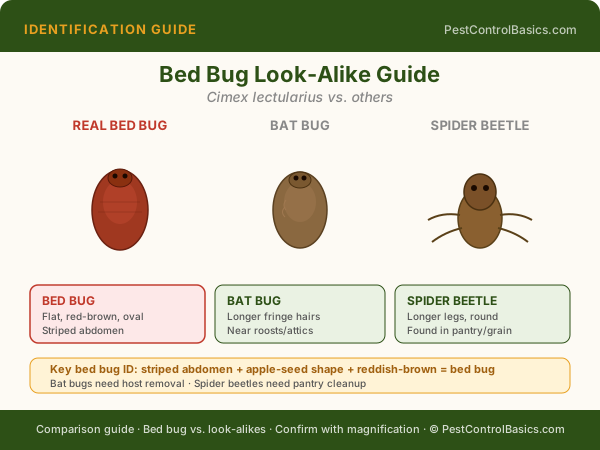
📐 FIELD GUIDE ILLUSTRATION
Original illustration by PestControlBasics.com. Use anatomical labels above to confirm your identification. For photo references, see the identification section below.
🔬
PestControlBasics Editorial Team
Reviewed by Derek Giordano · Updated 2026
🔍 Identification
Bat Bug (Cimex adjunctus): Identical to bed bug; lives in bat colonies in attics; bites humans when bats leave in fall. ID: requires microscopy — slightly longer hairs on thorax fringe than bed bug. If you have bats, assume bat bugs.
Swallow Bug: Nests with cliff swallows; bites humans when birds migrate. Same ID challenge as bat bug.
Bird Mites: From bird nests near structure; tiny, 8-legged; very itchy; no pest visible on mattress.
Yellow Sac Spider bites: Occur in bed when sleeping rolls onto spider; painful; single bite.
Fleas: Ankles and lower legs primarily; pet present.
Dermatitis from bedding: No pest at all — reaction to laundry detergent, dust mite allergy, or new fabric.
🧬 Biology & Behavior
Each has distinct biology. Bat bugs only occur with bats present (attic, chimney). Bird mites only occur after bird nest abandonment. Fleas require an animal host. True bed bugs are completely independent of wildlife — they depend solely on humans.
⚠️ Damage & Health Risk
Varies completely by species: bat bugs need bat exclusion; bird mites need nest removal; fleas need pet treatment; bed bugs need the full bed bug protocol.
🔧 DIY Treatment
The diagnostic step: professional inspection or placing bed bug monitors (glue cards under bed feet) for 2 weeks. Finding actual insects on the monitor is the only reliable confirmation.
👷 When to Call a Pro
Pest control professional with experience in all these species — or an entomologist — can provide definitive identification from a specimen. This is one situation where getting the ID right saves significant time and money.
❓ FAQ
How do I know if it's actually bed bugs and not something else?
Place bed bug climb-up interceptors under each bed leg for 2 weeks. If bed bugs are present, they'll be caught in the interceptors while climbing toward you or falling away. Absence of insects after 2 weeks strongly suggests the bites have another cause.
What do bat bug bites look like vs. bed bug bites?
Bat bug and bed bug bites are clinically identical — the bite reactions are the same. The only way to differentiate is finding the pest itself: bat bugs are found near bat roosting areas (attic, chimney), not in the bedroom. Bed bugs are found at the bed.
DG
Derek Giordano
Certified Pest Control Operator · Former Business Owner
Derek ran his own pest control company in Florida for several years, servicing thousands of regular customers. All content is based on hands-on field experience and current EPA & university extension guidelines.
Prevention strategies that actually reduce Bed Bug Look-Alikes — What's Really Biting You at Night pressure
Most pest pressure traces back to one or two environmental conditions that are easier to fix than the infestation itself is to spray. For Bed Bug Look-Alikes — What's Really Biting You at Night, the highest-leverage changes typically involve moisture management, food access, and exclusion at structural entry points. Reducing standing water within 20 feet of the foundation eliminates more pest problems than any single chemical application, and the effect persists year over year rather than requiring a rebuy every quarter.
Exclusion work is unglamorous but durable. A common entry-point audit covers door sweeps, weep holes, utility penetrations, dryer vents, soffit gaps, and the base of siding. Most homes have between five and fifteen openings larger than the minimum required for the target pest to enter, and sealing even half of them measurably reduces indoor sightings within one season. Stainless steel mesh, copper wool, and exterior-grade sealant cover most situations; expanding foam alone is not sufficient because rodents and some insects chew through it.
Storage practices matter too. Pantry pests, fabric pests, and overwintering insects all exploit cardboard, paper, and natural-fiber storage in basements and garages. Switching to sealed plastic bins for seasonal storage removes a significant amount of harborage that is otherwise impossible to spray effectively.
When to escalate Bed Bug Look-Alikes — What's Really Biting You at Night control beyond DIY
Most Bed Bug Look-Alikes — What's Really Biting You at Night situations are within the range of a careful homeowner, but a handful of scenarios genuinely warrant a licensed applicator. Multi-unit buildings are at the top of that list — shared walls, plumbing, and ductwork mean a localized treatment in one unit often just relocates the population to a neighbor. Any infestation that involves wall voids, attic insulation, or sub-slab plumbing is also harder to reach with consumer products and benefits from professional equipment and labeled product concentrations.
Health-sensitive situations are the second escalation trigger. Pregnancy, infants, immunocompromised residents, and pets with known sensitivities all narrow the available product list considerably. A licensed professional can apply restricted-use products and reduced-risk reformulations that achieve control with lower household exposure than over-the-counter alternatives. The cost difference is usually less than two seasons of DIY spending once the time investment is factored in.
The third escalation point is recurrence. If the same pest returns within six weeks of an apparently successful treatment, the source is usually structural or environmental rather than chemical, and a professional inspection often finds the cause faster than a second round of self-treatment.
Confirming a Bed Bug Look-Alikes — What's Really Biting You at Night infestation in the field
Misidentification is the most common reason home treatment fails for Bed Bug Look-Alikes — What's Really Biting You at Night. Look-alike species often respond to completely different active ingredients, so a 30-second confirmation step before any spraying or baiting saves the most time over a season. The practical workflow begins with where you found the specimen — kitchen, bathroom, garden, attic — because habitat narrows the candidate list faster than morphology alone.
Specific cues for Bed Bug Look-Alikes — What's Really Biting You at Night include body proportions, leg count, antenna shape, and any wing structure if present. Adults are usually the easiest stage to identify, but most real-world infestations show juveniles or evidence (frass, shed skins, webbing, damage patterns) more often than adults themselves. Photograph the specimen against a ruler or coin for scale, then compare against a regional reference rather than a global one — range maps from state Extension services beat generic online identification sites.
When two species look genuinely similar, the deciding factor is often where they congregate at dusk versus dawn, or whether they leave a visible trail. A test of three common DIY treatments — one bait, one residual spray, one mechanical barrier — applied in different areas can also confirm identity by which works.
Why timing changes everything with Bed Bug Look-Alikes — What's Really Biting You at Night
The same product applied two weeks apart can produce a complete kill or near-zero effect depending on where the Bed Bug Look-Alikes — What's Really Biting You at Night population sits in its life cycle. Egg-stage pests are nearly immune to contact sprays, so a perfectly applied treatment during a major hatch event will leave the next generation completely unaffected. The professional standard is two applications spaced 10 to 14 days apart for most household pests — the first kills the active adults, the second catches anything that emerges from eggs in the interim.
Temperature also drives treatment success. Most residual sprays lose efficacy above 90°F or below 50°F, and pyrethroid products in particular can repel rather than kill when applied during high heat. The best window is early morning when surface temperatures are still moderate and target pests are moving but not yet at peak activity. Indoor treatment is less weather-dependent but still benefits from being applied when household air movement is low — running ceiling fans during application redistributes droplets away from the intended surface.
Seasonal pressure for Bed Bug Look-Alikes — What's Really Biting You at Night usually has two or three predictable peaks per year. A treatment calendar built around those peaks costs less and works better than reactive spraying after a problem is already established.
Published: Jan 1, 2025 · Updated: Apr 7, 2026
Heat treatment for bed bugs: what it does and doesn't do
Whole-room or whole-structure heat treatment — raising indoor temperature to roughly 120-130°F for several hours — kills bed bugs at all life stages including eggs, which is the major advantage over chemical treatment. Heat does not leave residual protection: a room treated successfully with heat will be reinfested immediately if a new bed bug walks in from an adjacent unit or arrives on returning luggage. Heat treatment also has practical limitations: heat-sensitive items (electronics, photographs, candles, some plastics, instruments, certain medications) need to be removed before treatment, and getting all areas of a room to lethal temperature simultaneously requires equipment and technique that consumer space heaters can't replicate. Professional heat treatment costs more than chemical treatment but produces faster knockdown with no chemical residue. The reasonable use case is severe infestations where rapid elimination matters more than residual protection, treatments in chemically-sensitive environments (homes with infants, allergies, or chemical sensitivities), or as a complement to chemical treatment that addresses both immediate population and reinfestation risk.
When professional treatment is genuinely worth the cost
Professional pest control isn't always the right answer, but several specific situations genuinely justify the cost over DIY treatment. Severe bed bug infestations rarely yield to homeowner treatment because the required combination of vacuuming, encasements, structural treatment, and follow-up monitoring exceeds what most homeowners execute consistently. Subterranean termite treatment requires equipment (subslab injection) and product (commercial-grade termiticide quantities) not accessible to consumers, and inspection findings often dictate specific treatment that homeowners can't do safely. Roof and attic rodent problems benefit from professional exclusion that addresses access points consumers don't find. Mosquito reduction programs using barrier treatments and breeding-site management produce substantially better results than consumer foggers and yard sprays. Persistent cockroach problems in multi-unit buildings need coordination consumers can't provide. The pattern: professional treatment justifies itself when scale, access, regulatory product restrictions, or coordination requirements exceed what DIY can practically accomplish. Routine ant trails, occasional wasp nests, fruit fly outbreaks, and the like remain reasonable DIY targets where the cost-benefit math favors handling it yourself with the right products and information.
Bed bug encasements and mattress disposal: what to do
Decisions about mattresses and box springs during bed bug treatment often happen under stress and produce expensive mistakes. The two reasonable paths: encase the existing mattress and box spring in bed bug-rated encasements (full-zipper, tested to retain bed bugs), which traps any bugs inside and prevents new harborage, or dispose of and replace, which only makes sense if the mattress is in poor condition anyway. Disposing of a newer mattress and replacing it without treating the room first usually produces a re-infested new mattress within weeks — the bed bugs were in the room, not just the mattress. Encasements should remain on for at least 12 months and ideally permanently; bed bugs inside an encasement can survive months without feeding before dying. When disposing, mattresses should be marked clearly as bed bug-infested (curb-side scavenging is common and spreads infestations) and ideally wrapped or covered for transport. The encasement choice is generally the financially better path and produces equivalent or better results than disposal in most cases.
Canine bed bug inspection: what it does and doesn't tell you
Trained dogs can detect bed bug pheromones and have become a common tool in commercial inspection, particularly for hotels, multi-family housing, and large residential properties. Used correctly, a canine inspection is fast, relatively comprehensive, and capable of detecting low-level infestations that visual inspection would miss. The limits matter, though. Canine accuracy depends heavily on handler training and on the specific protocols used during inspection — false positives and false negatives both occur, and the quality of the team varies. A positive canine alert is a strong indication that bed bugs are present somewhere in the inspected area but doesn't pinpoint the exact location with the precision that a visual confirmation would. A negative canine inspection of a single visit is not the same thing as a guarantee that no bed bugs are present, particularly if the inspection happens shortly after a chemical treatment that may have suppressed the pheromone signal. Canine inspection is useful as one input into a decision, not as a sole basis for declaring a property bed bug free, particularly in real estate transactions where the consequences of being wrong are significant.
Why product instructions are often suboptimal in practice
Pesticide labels are legal documents written to satisfy regulatory requirements, not field guides written to maximize success in a specific home. The instructions cover the broadest reasonable use case, which means they're rarely tuned for the specific construction type, climate, or pest pressure you're dealing with. A label might call for application every six weeks because that's what the registration data supports across a wide range of conditions, but the actual reapplication interval that matches the residual life of the active ingredient in your specific application context could be shorter or longer. This is not an invitation to ignore label directions — doing so is illegal and frequently dangerous — but it does mean that following the label is the floor, not the ceiling, of good practice. Knowledgeable users overlay the label with conditions-aware judgment: shorter re-treatment intervals during heavy rain or high humidity, denser application in known harborage, and supplementary monitoring after treatment to verify that the work actually performed as expected. The label tells you what's permitted; experience tells you what's optimal within that envelope.
Reading fecal staining: what bed bug evidence actually tells you
Bed bug fecal staining is one of the most reliable indicators of an active or recent infestation, and the location and density of staining gives more information than people typically extract from it. The staining itself is digested blood, which appears as small dark spots on porous surfaces and can smear if rubbed with a damp cloth. Concentrated staining in one specific location — typically along mattress seams, in box spring corners, on bed frames, or behind headboards — indicates established harborage and a population that has been resident long enough to deposit significant waste in one place. Scattered staining across multiple locations suggests either a more mature infestation that has dispersed or recent disruption that drove the population to relocate. Staining in unexpected locations — couches, recliners, baseboards far from sleeping areas — often indicates either secondary harborage sites or recent introduction in those specific locations. Reading the staining pattern at inspection time is more informative than the simple yes/no of detecting bed bugs at all, because it shapes the treatment plan and the prioritization of harborage locations.
🗺️ US Distribution — What Bites at Night? 6 Pests Confused with
Common Occasional Not Present
States Present
49
Occasional
2
Primary Region
Continental US
📊 Source: University extension services, USDA, CDC vector data, and published entomological surveys.