HomePest LibraryCrickets • Drain Flies • Millipedes
Nuisance Pest Guides

Crickets, Drain Flies & Millipedes

Three of the most common nuisance calls pest pros receive. Moisture, light, and habitat are the common threads — and the solutions are mostly free once you know the root cause.

📐 FIELD GUIDE ILLUSTRATION
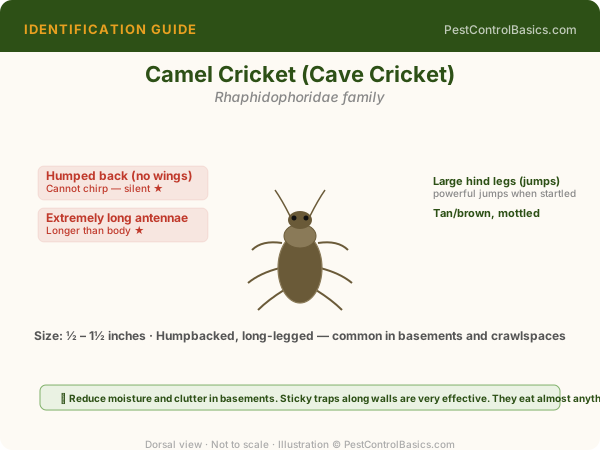
Crickets, Drain Flies & Millipedes identification illustration with labeled anatomical features — PestControlBasics.com

Original illustration by PestControlBasics.com. Use anatomical labels above to confirm your identification. For photo references, see the identification section below.

🦠
Nocturnal ChirperAttracted to White LightEasy DIY
House Cricket
Acheta domesticus & Gryllus species
The chirping at 2am is a male advertising for a mate. Crickets are drawn to exterior lights, enter through ground-level gaps, and establish in moist basements. Switch to yellow LEDs, spray the perimeter, and run a dehumidifier — problem solved.

Why They're In Your Home

House crickets and field crickets are primarily outdoor insects. Indoor infestations are driven by three factors: white exterior lighting that attracts them at night, ground-level entry points, and moist basements that let them survive and breed inside. In late summer populations peak and they start seeking warmth — the same pressure driving stink bugs inside.

💡 The Light Switch Solution

Exterior white lights are the single biggest cricket attractor. Replacing porch lights with yellow LED bulbs (2700K) or motion-activated lights can reduce indoor cricket pressure by 60–80% with no chemical treatment at all. This is step one.

Control Protocol

1
Switch to Yellow LEDs
Replace white porch bulbs with 2700K LEDs. Move lights away from entry points.
2
Perimeter Spray
Bifenthrin along foundation, around doors, over adjacent mulch. Apply early evening.
3
Dehumidify Basement
Below 50% RH. Fix plumbing drips. Dry basements won't sustain cricket populations.
✓ Glue board trapsPlaced along basement walls reveal hotspots and capture large numbers
✓ Seal door gapsGarage door weatherstripping is a primary cricket entry — replace if compressed
✗ Don't ignore humidityCrickets reproduce in moist basements — drying it out is the permanent fix
✓ Boric acid dustAlong basement wall-floor joints kills crickets that groom and ingest it
House Cricket — Quick Ref
Size3/4–1 inch
ActiveNight only
SoundMales chirp — mating call
Attracted ToWhite light, moisture, warmth
Bites?Rarely — minor
Best controlLight + perimeter + low RH
Not sure? AI ID →
🪳
Breed in Drain BiofilmEnzymatic Cleaner — Not Bleach7-Day Fix
Drain Flies
Psychoda species — Moth Flies
Small, fuzzy, slow-moving. They breed exclusively in organic biofilm inside drain pipes — soap scum, hair, and bacteria. Spraying adults kills today's batch while tomorrow's larvae hatch in the drain. You must clean the biofilm with an enzymatic cleaner, not bleach.

The Breeding Site Is Always the Drain

Drain flies lay eggs in gelatinous organic biofilm coating drain pipes. This builds in any infrequently used drain: floor drains in basements, laundry room drains, bathroom drains used rarely, and the overflow hole near the top of bathroom sinks. Spraying them with insecticide leaves the breeding site intact — new adults emerge from larvae within days.

🔍 Tape Test — Find the Source Drain

Place clear tape (sticky side down) over suspect drains before bed. If drain flies are breeding there, you'll find adults stuck to the tape by morning. Test every drain in the home, including floor drains and HVAC condensate lines. Identify all breeding drains before treating.

Treatment — What Works and What Doesn't

What works: Enzymatic drain cleaner (Invade Bio Drain, Green Gobbler). These contain bacteria and enzymes that digest the biofilm drain flies breed in. Pour down each affected drain, let sit overnight, repeat 5–7 nights.

What doesn't work: Bleach. It kills on contact but doesn't dissolve or remove biofilm — it washes past without cleaning. Drain fly breeding resumes within days.

Physical scrubbing first: Use a flexible drain brush to break up the P-trap buildup before applying enzymatic cleaner. Physical disruption plus enzymatic treatment resolves most infestations in 1–2 weeks.

The overflow drain: The small hole near the top of bathroom sink basins connects to the main drain and is rarely cleaned. Treat it specifically — it's one of the most-missed breeding sites.

Floor drains: Pour 1 gallon of water down infrequently used floor drains weekly to maintain the P-trap water seal and block drain fly access from the sewer.

Drain Fly — Quick Ref
Size1/8 inch — tiny
AppearanceFuzzy, moth-like, dark gray
Breeds InDrain pipe organic biofilm
Bleach works?No — use enzymatic cleaner
vs. Fruit FlyFuzzy body; red eyes = fruit fly
Timeline5–14 days to resolve
Dangerous?No — nuisance only
🐛
Mass Rain InvasionHarmless — Dies Indoors in 48hrsRemove Mulch First
Millipedes
Narceus americanus & related species — Order Diplopoda
After heavy rain, millipedes migrate en masse from saturated soil into structures — sometimes by the hundreds. They're harmless, die quickly indoors, and the invasion is temporary. Remove the mulch buffer from the foundation, improve drainage, and perimeter treat before rain.

Why They Invade — The Rain Trigger

Millipedes eat decaying organic matter in moist soil and mulch. When soil becomes waterlogged after heavy rain, they migrate upward and outward seeking drier ground — toward your foundation. They die within 24–48 hours indoors because low humidity kills them. The invasion is self-limiting, but the outdoor population remains and will repeat with each heavy rain until habitat is reduced.

💡 Millipede vs. Centipede

Both have many legs. Key differences: millipedes have 2 pairs of legs per body segment and move slowly — they curl into a ball when threatened. Centipedes have 1 pair per segment, move very fast, and can bite. The fast one darting across your bathroom floor is a centipede (beneficial predator). The slow curling one is a millipede (harmless detritivore).

Control Strategy

1
Remove Mulch Buffer
Pull mulch 6–12 inches from foundation. Replace that zone with gravel. Eliminates primary harborage adjacent to entry points.
2
Improve Drainage
Grade soil away from foundation. Extend downspouts. Reduce soil saturation that triggers migration.
3
Perimeter Treatment
Bifenthrin granules or spray along foundation band. Apply before predicted heavy rain for best timing.

Indoor millipedes: Sweep or vacuum — they die quickly anyway. No indoor chemical treatment needed. Some large species secrete a mild defensive chemical when threatened (hydrogen cyanide compounds) — wash hands after handling, keep away from eyes.

✓ Long-Term Fix

The 18-inch foundation clearance zone — either bare soil or gravel instead of mulch — is the single most effective long-term millipede (and earwig) prevention measure. It also helps with carpenter ants, boxelder bugs, and stink bugs. One change reduces pressure from multiple pest species simultaneously.

Millipedes — Quick Ref
Legs2 pairs per body segment
MovementSlow — curls when threatened
Bites?No — completely harmless
TriggerSaturated soil after heavy rain
Lives indoors?No — dies within 48 hours
Primary driverMoist mulch at foundation
SolutionMulch removal + drainage fix
DG
Derek Giordano
Certified Pest Control Operator · Former Business Owner
Derek ran his own pest control company in Florida for several years, servicing thousands of regular customers. All content is based on hands-on field experience and current EPA & university extension guidelines.

Related Resources

📚 Full Pest Library🧪 DIY vs. Pro Quiz💰 Cost Guide🌿 IPM Guide🔍 Find a Pro
🔮
Reviewed by Derek GiordanoContent on PestControlBasics.com is developed with input from certified pest management professionals and cross-referenced against EPA, CDC, and university extension guidance. Last reviewed: April 2026.
📚 Sources: EPA Termite Guide · NPMA Termite Info
Published: Jan 1, 2025 · Updated: Apr 7, 2026

Building a pest management calendar for residential properties

Most pest management problems become much easier to handle with a simple seasonal calendar mapping the high-leverage interventions to their optimal windows. A representative annual calendar for temperate-climate residential properties: February through March, conduct exterior exclusion audit and address gaps before spring pressure begins; March through April, schedule outdoor preventive treatment if appropriate (foundation perimeter, mosquito source reduction setup), inspect for early wasp nest construction; May through July, mosquito source reduction maintenance (weekly standing water check), tick prevention if regionally relevant; August through October, fall rodent exclusion check, schedule pest control inspection if on annual service, address overwintering pest entry points (occasional invaders); November through January, indoor monitoring (sticky traps for pantry pests and incidental species), assess prior year's pressure to plan next year's focus. A calendar entry per month, taking 15-30 minutes most months, produces dramatically better outcomes than reactive treatment after problems become visible.

Pest control and indoor air quality: the overlap most people miss

Many pest problems are also air quality problems, and treating one without considering the other produces partial results. Cockroach allergens are a documented asthma trigger, with proteins from droppings and shed cuticles persisting in dust for months after the live population is eliminated. Rodent urine and dander carry allergens that contribute to childhood asthma development. Stored-product pests in pantries can contribute to allergic reactions and food contamination. Mold associated with rodent or insect infestations adds a separate respiratory burden. The implication for control programs: post-treatment cleanup of dust, droppings, and contaminated insulation produces measurable indoor air quality gains beyond just removing live pests. HEPA-filtered vacuums (not standard household vacuums, which can re-aerosolize fine particles) are the right tool for cleanup. This matters most in homes with asthma sufferers, young children, or anyone with respiratory sensitivity.

The role of local cooperative extension in pest decisions

State cooperative extension services — university-based educational and advisory programs in every state — are dramatically underused resources for residential pest decisions. Most state extensions employ entomologists who answer homeowner questions free of charge through county offices, online query forms, or scheduled call hours. The information available is specific to the state's pest pressure, climate, and recommended practices, and is typically much more locally accurate than national resources. Extension publications cover identification, life cycle, treatment options, and specific product recommendations for state conditions; the publications are peer-reviewed by university scientists and updated periodically based on current research. For any pest situation where identification is uncertain or treatment options are unclear, a clear photograph submitted to the state extension produces an identification, a brief biological explanation, and one or more treatment options within typically a few days. The benefit beyond any single inquiry is building familiarity with the local resource — extension contacts become a reference for future situations and produce better decisions than aggregated online advice.

The cost of doing nothing: implicit pest tolerance and its hidden expenses

Pest control discussions usually frame the costs of treatment without quantifying the costs of non-treatment, but the latter are often larger and almost always less visible. Cockroach allergens add measurable healthcare costs in homes with asthma. Rodent activity in attics damages insulation (reducing R-value and adding seasonal heating and cooling costs) and creates fire risk through wire chewing that doesn't show up until something fails. Termite damage in unmonitored properties produces structural repair bills in the five-figure range, often discovered during unrelated renovation. Stored-product pests destroy food inventory at rates that aren't tracked because items are discarded individually rather than tallied. The cumulative cost of doing nothing isn't a single line item but a sum of small chronic losses across years. The framing that helps: pest control isn't a luxury expense layered onto a working baseline; it's a maintenance expense that competes with the slow accumulating cost of allowing a problem to continue. Households running the comparison honestly almost always find that modest preventive spending is the cheaper path.

Integrated pest management for households: the practical hierarchy

Integrated pest management (IPM) is a structured approach to pest control developed for agricultural and commercial settings that translates well to residential use. The hierarchy: prevention first (sanitation, exclusion, habitat modification to make conditions unfavorable for pests), monitoring second (sticky monitors, visual inspection, identifying pests at low population before infestation establishes), targeted intervention third (using the least disruptive effective method against an identified pest in an identified location), and broad chemical treatment last (when targeted approaches have failed or aren't feasible). The hierarchy matters because higher-level interventions are durable and address root causes, while lower-level chemical interventions address symptoms and require repeat application. Most residential pest control reverses this hierarchy — chemical treatment first, sometimes prevention later — and produces the predictable consequence of recurring problems. Households that adopt the IPM hierarchy (often without using the term) generally describe spending less time and money on pest issues over years even though specific incidents might take more thought to address than spray-and-forget approaches.

Pest control and HOA dynamics: where they overlap

Homeowners' associations vary widely in how they engage with pest control, and the variations create practical issues that affect individual treatment decisions. Some HOAs maintain common-area pest treatment programs that handle perimeter spraying, mosquito treatment, or rodent monitoring on shared property; others leave all pest control to individual homeowners. Some have rules about treatment products or notification requirements; others don't. Some include treatment in the HOA fee structure; others bill separately. For homeowners in HOA communities dealing with persistent pest pressure, understanding what the HOA does and doesn't do is the first step in figuring out what additional individual action is needed. For HOAs without coordinated programs in areas with significant pressure, organizing a neighborhood-level treatment plan often produces dramatically better results than individual treatment efforts that don't coordinate timing or coverage. The conversations are sometimes politically awkward in HOA contexts, but the underlying problem — that some pests are neighborhood-scale and unit-level treatment can't address them — is structural rather than personal. Bringing the issue to an HOA meeting with concrete proposals tends to produce more constructive responses than complaint-style framing.

When neighborhood-level coordination matters for treatment

Some pests are house-scale problems and some are neighborhood-scale problems, and treating a neighborhood-scale problem as if it were house-scale leads to a familiar frustration: treatment works, then activity returns within weeks because the source was never inside your property. German cockroach problems in multi-unit buildings are the canonical example — treating one unit while the rest of the building is untreated produces temporary relief at best. Rodent infestations frequently span multiple adjacent properties, especially row houses, condo complexes, and dense suburban developments with shared boundary fencing or shared utility easements. Mosquito problems are obviously neighborhood-scale because adult mosquitoes don't respect property lines. The practical implication is that for these pests, isolated treatment is not just incomplete but in some cases economically wasteful. Coordinating with neighbors, talking to HOA or property management about whole-building or whole-block treatment, and identifying the actual sources rather than the symptom locations is what produces durable results. This is uncomfortable work in some neighborhoods, but no amount of treatment intensity in a single unit substitutes for it.

Understanding pest forecast reports and what they signal

Pest forecast reports — issued by some state agricultural agencies, cooperative extension services, and commercial pest control companies — are an underutilized resource for homeowners who want to anticipate rather than react to seasonal pest activity. These reports typically combine historical pest data, current weather conditions, and growing degree day calculations to predict when specific pests will emerge or peak in specific regions. A tick forecast for an upcoming spring season, a mosquito pressure forecast after a wet winter, a termite swarm prediction for a specific week in the Southeast — these aren't speculation but reasonably calibrated predictions based on biological timing. For homeowners, the value is in scheduling preventive treatment and personal protection to match the predicted high-pressure windows rather than reacting after problems have established. Subscribing to a regional pest newsletter from a cooperative extension service or state agriculture department is free or low cost and produces these forecasts during relevant seasons. The information is dramatically more actionable than generic pest control content because it's calibrated to your specific region and current conditions.

🗺️ US Distribution — Crickets, Drain Flies & Millipedes

image/svg+xml
Common Occasional Not Present
States Present
49
Occasional
2
Primary Region
Continental US
📊 Source: University extension services, USDA, CDC vector data, and published entomological surveys.