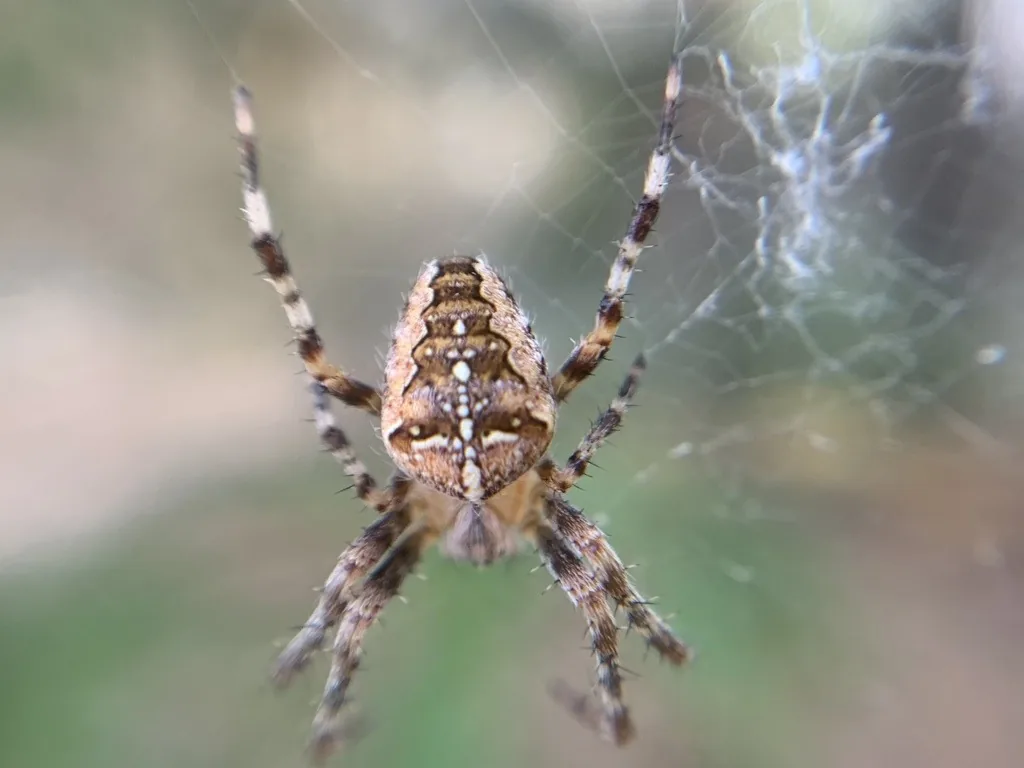
How to identify it
- Adult females are 6.5 to 20 mm long and males 5.5 to 13 mm; smaller, younger spiders are darker and adult females lighter.[1]
- The abdomen is yellow to brown with two wavy lengthwise lines and white or yellow spots; four long spots near the front form a cross.[1]
- The front body section has three dark lengthwise bands.[1]
Look-alikes
| Look-alike | How to tell them apart |
|---|---|
| Banded garden spider | Has the same three dark bands on the front body section, but its abdomen is banded silver, yellow and black.[1][2] |
Where it lives
Probably introduced from Europe, it's known from Pennsylvania north through New England and Canada and south into Washington and Oregon.[1]
Biology and life cycle
Adults are found from late summer through autumn.[1]
In late September females leave their webs to lay 300 to 900 eggs in a yellow silk cocoon under dead bark or in cracks and crevices.[1]
It's commonly found on or next to buildings with exterior lighting, including lighted stairwells in rural areas.[1]
Damage and signs
Health risk
Verified bites caused pain, swelling and redness, and in some people anxiety, nausea, headache and muscle cramps lasting two days to three weeks.[1]
Control
Prevention
Outdoor lights attract insects and, in turn, spiders; keep fixtures off walls and away from windows and doorways where possible.[3]
Traps and physical control
Sweep, hose or vacuum webs and spiders off buildings regularly.[3]
Pesticides
UC IPM advises against spraying spiders outdoors in general, since insecticides don't give long-term control.[3]
Common questions
- Why are there big orb webs around my porch light every fall?
- Cross orbweavers are commonly found on buildings with exterior lighting from late summer through autumn.[1]
- Is a cross orbweaver bite dangerous?
- Verified bites caused pain, swelling and redness, sometimes with nausea or headache lasting days to weeks.[1]
Sources
- Penn State Extension, “Cross Orbweaver Spider.” extension.psu.edu/cross-orbweaver-spider (accessed 2026-10-06)
- Penn State Extension, “Banded Garden Spider.” extension.psu.edu/banded-garden-spider (accessed 2026-10-06)
- University of California Statewide IPM Program, “Spiders (Pest Notes, Home and Landscape).” ipm.ucanr.edu/home-and-landscape/spiders/ (accessed 2026-10-06)
- iNaturalist, “Araneus diadematus taxon page (order and family).” www.inaturalist.org/taxa/52628 (accessed 2026-10-06)