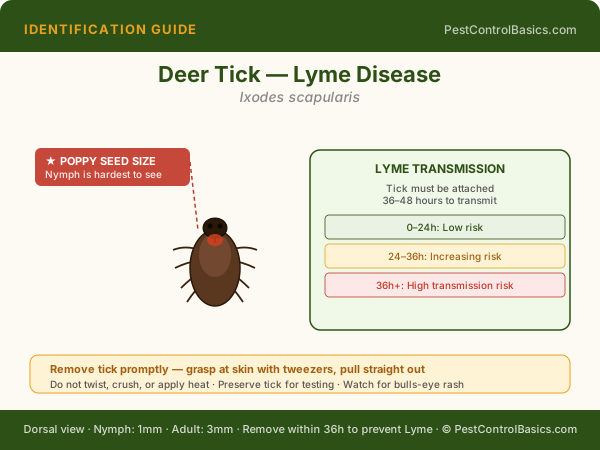
The 36-48 hour Lyme transmission window makes daily tick checks extraordinarily effective at preventing Lyme disease. Here's the biology behind the rule.
Original illustration by PestControlBasics.com. Use anatomical labels above to confirm your identification. For photo references, see the identification section below.
🔬
PestControlBasics Editorial Team
Reviewed by Derek Giordano · Updated 2026
🔍 Identification
Why 36-48 hours? Borrelia burgdorferi (the Lyme bacterium) is in the tick's midgut at the time of attachment. As the tick feeds, the bacteria begin migrating toward the salivary glands — this migration requires time (approximately 24-36 hours at minimum). Before migration is complete, even if the tick bites, minimal spirochetes are in the salivary glands to transmit. After 36-48 hours of feeding, the migration is complete and transmission becomes likely.
🧬 Biology & Behavior
Critical caveats: This is a population-level generalization, not an absolute — some transmission before 24 hours has been documented. Powassan virus (also tick-transmitted) can transmit within minutes of attachment. Nymph ticks (the primary Lyme transmission stage at 1-2mm) are nearly impossible to feel during feeding, making the time-of-attachment unknown for most discovered ticks. This is why check frequency matters more than any spray program for personal Lyme prevention.
⚠️ Damage & Health Risk
Lyme disease (476,000 cases/year in US); anaplasmosis; babesiosis; Powassan virus (rare but dangerous).
🔧 DIY Treatment
Daily full-body tick checks — the most impactful intervention. Permethrin-treated clothing — kills ticks before attachment. DEET/picaridin on skin. May and September perimeter spray for yard management. Tick tubes for white-footed mouse population targeting.
👷 When to Call a Pro
Professional tick management combining spring spray with tick tube placement provides 70-90% reduction in tick populations in research trials.
❓ FAQ
If I find a tick that's been on for less than 36 hours, do I need antibiotics?
Based on current CDC guidelines, prophylactic doxycycline may be considered for deer tick bites in high-endemic areas if the tick was attached for 36+ hours. For ticks removed before 36 hours in an endemic area, the risk is low but physician consultation is still reasonable if concerned. Powassan virus can transmit in minutes, but it's rare — most early-removed ticks carry zero risk.
How do I know how long a tick has been attached?
Engorgement is the primary clue: an unfed nymph is about 1-2mm. A fully engorged nymph is 3-4mm and appears darker. Partial engorgement suggests 12-24 hours of feeding. Full engorgement suggests 36-72 hours. If you can't tell the engorgement state, assume conservative management and consult a physician in endemic areas.
DG
Derek Giordano
Certified Pest Control Operator · Former Business Owner
Derek ran his own pest control company in Florida for several years, servicing thousands of regular customers. All content is based on hands-on field experience and current EPA & university extension guidelines.
When to escalate Deer Tick Lyme Transmission control beyond DIY
Most Deer Tick Lyme Transmission situations are within the range of a careful homeowner, but a handful of scenarios genuinely warrant a licensed applicator. Multi-unit buildings are at the top of that list — shared walls, plumbing, and ductwork mean a localized treatment in one unit often just relocates the population to a neighbor. Any infestation that involves wall voids, attic insulation, or sub-slab plumbing is also harder to reach with consumer products and benefits from professional equipment and labeled product concentrations.
Health-sensitive situations are the second escalation trigger. Pregnancy, infants, immunocompromised residents, and pets with known sensitivities all narrow the available product list considerably. A licensed professional can apply restricted-use products and reduced-risk reformulations that achieve control with lower household exposure than over-the-counter alternatives. The cost difference is usually less than two seasons of DIY spending once the time investment is factored in.
The third escalation point is recurrence. If the same pest returns within six weeks of an apparently successful treatment, the source is usually structural or environmental rather than chemical, and a professional inspection often finds the cause faster than a second round of self-treatment.
Why timing changes everything with Deer Tick Lyme Transmission
The same product applied two weeks apart can produce a complete kill or near-zero effect depending on where the Deer Tick Lyme Transmission population sits in its life cycle. Egg-stage pests are nearly immune to contact sprays, so a perfectly applied treatment during a major hatch event will leave the next generation completely unaffected. The professional standard is two applications spaced 10 to 14 days apart for most household pests — the first kills the active adults, the second catches anything that emerges from eggs in the interim.
Temperature also drives treatment success. Most residual sprays lose efficacy above 90°F or below 50°F, and pyrethroid products in particular can repel rather than kill when applied during high heat. The best window is early morning when surface temperatures are still moderate and target pests are moving but not yet at peak activity. Indoor treatment is less weather-dependent but still benefits from being applied when household air movement is low — running ceiling fans during application redistributes droplets away from the intended surface.
Seasonal pressure for Deer Tick Lyme Transmission usually has two or three predictable peaks per year. A treatment calendar built around those peaks costs less and works better than reactive spraying after a problem is already established.
Confirming a Deer Tick Lyme Transmission infestation in the field
Misidentification is the most common reason home treatment fails for Deer Tick Lyme Transmission. Look-alike species often respond to completely different active ingredients, so a 30-second confirmation step before any spraying or baiting saves the most time over a season. The practical workflow begins with where you found the specimen — kitchen, bathroom, garden, attic — because habitat narrows the candidate list faster than morphology alone.
Specific cues for Deer Tick Lyme Transmission include body proportions, leg count, antenna shape, and any wing structure if present. Adults are usually the easiest stage to identify, but most real-world infestations show juveniles or evidence (frass, shed skins, webbing, damage patterns) more often than adults themselves. Photograph the specimen against a ruler or coin for scale, then compare against a regional reference rather than a global one — range maps from state Extension services beat generic online identification sites.
When two species look genuinely similar, the deciding factor is often where they congregate at dusk versus dawn, or whether they leave a visible trail. A test of three common DIY treatments — one bait, one residual spray, one mechanical barrier — applied in different areas can also confirm identity by which works.
Prevention strategies that actually reduce Deer Tick Lyme Transmission pressure
Most pest pressure traces back to one or two environmental conditions that are easier to fix than the infestation itself is to spray. For Deer Tick Lyme Transmission, the highest-leverage changes typically involve moisture management, food access, and exclusion at structural entry points. Reducing standing water within 20 feet of the foundation eliminates more pest problems than any single chemical application, and the effect persists year over year rather than requiring a rebuy every quarter.
Exclusion work is unglamorous but durable. A common entry-point audit covers door sweeps, weep holes, utility penetrations, dryer vents, soffit gaps, and the base of siding. Most homes have between five and fifteen openings larger than the minimum required for the target pest to enter, and sealing even half of them measurably reduces indoor sightings within one season. Stainless steel mesh, copper wool, and exterior-grade sealant cover most situations; expanding foam alone is not sufficient because rodents and some insects chew through it.
Storage practices matter too. Pantry pests, fabric pests, and overwintering insects all exploit cardboard, paper, and natural-fiber storage in basements and garages. Switching to sealed plastic bins for seasonal storage removes a significant amount of harborage that is otherwise impossible to spray effectively.
Published: Jan 1, 2025 · Updated: Apr 7, 2026
Tick-borne disease landscape: more than Lyme
Public awareness of tick-borne disease focuses heavily on Lyme disease, but the broader landscape of tick-transmitted pathogens has expanded meaningfully and warrants awareness for residents of tick-active regions. Anaplasmosis and ehrlichiosis are increasingly reported and present with non-specific flu-like symptoms that can be missed without specific testing. Babesiosis, a malaria-like blood parasite, is increasingly common in coordinate ranges with Lyme. Powassan virus, while rare, is increasingly detected and can produce serious neurological disease with no specific treatment. Alpha-gal syndrome — a developed allergy to mammalian meat following lone star tick bites — affects increasing numbers of residents in expanding lone star tick range. Rocky Mountain spotted fever remains a serious risk particularly in the south-central states. The implication for residents: tick exposure with subsequent unexplained symptoms warrants prompt medical evaluation with specific tick-borne disease testing, not just empirical antibiotics for presumed Lyme. Saving removed ticks for identification has practical value when symptoms develop weeks later and species matters for diagnostic direction.
The role of caulk, sealant, and exclusion in long-term pest control
Sealing entry points is the most underrated pest control activity in residential settings, partly because it produces no immediate visible result and partly because it feels like home repair rather than pest control. The yield is substantial: a thoroughly sealed structure with appropriate exterior caulking, intact weatherstripping, sealed utility penetrations, and screen integrity has dramatically lower pest pressure than the same structure without those interventions. Specific high-yield targets include gaps around dryer vents, electrical and plumbing penetrations through exterior walls, gaps where siding meets foundation, mortar joints in older brick, weep holes in newer brick (which should be screened, not sealed), garage door bottom seals (where rodents commonly enter), and the gap above door thresholds where many ants and small insects pass. Materials matter: silicone-based caulk for moisture areas, polyurethane sealant for foundation cracks, copper mesh for rodent exclusion at utility penetrations (steel wool degrades), and 1/4-inch hardware cloth for larger openings. A weekend of methodical sealing in spring or fall — when activity is moderate and weather permits exterior work — produces lasting reduction that no single treatment matches.
Tick check protocols: timing and technique that matter
Tick-borne disease prevention rests heavily on prompt tick removal after exposure, since transmission of pathogens including Lyme disease bacteria typically requires hours of attachment. The protocol that produces best results: full-body visual inspection within a few hours of any outdoor activity in tick habitat, paying particular attention to areas where ticks preferentially attach (hairline, behind ears, armpits, waistband, behind knees, between toes). Showering within two hours of exposure mechanically removes loose ticks and provides another inspection opportunity. Found ticks are removed with fine-tip tweezers, grasping as close to the skin as possible, and pulled straight out with steady pressure — not twisted, not burned with a match, not coated with petroleum jelly (all popular advice that backfires by causing the tick to regurgitate gut contents into the bite site). Removed ticks are saved in a sealed plastic bag with a date label; if symptoms develop, the tick itself can be tested or used to identify species. Photographing the bite site immediately and at 24-hour intervals helps document any developing rash for medical assessment.
Protective clothing fundamentals for high-risk activities
Tick exposure during specific activities — gardening near edges, working in leaf litter, hiking, hunting, mowing brushy areas — is dramatically reduced by clothing choices that have a small upfront cost and require no ongoing product purchases. Long pants tucked into socks creates a physical barrier that ticks have to navigate around rather than over, which significantly slows their progress to skin. Light-colored clothing makes ticks visible during periodic checks. Permethrin-treated clothing, available as factory-treated garments or as a do-it-yourself spray application, kills ticks on contact and remains effective through dozens of wash cycles. The combination of long pants tucked into socks, light colors, and permethrin treatment provides a layered defense that's vastly more effective than any of the components individually, and dramatically more effective than repellent applied to skin alone. For households with regular high-exposure activities, a dedicated set of permethrin-treated work clothing kept separate from regular wear is a one-time investment that pays off across the entire tick season, and replaces the friction of remembering to apply repellent each time with a passive protection that's already in place. The combination is also dramatically more effective than any single layer used alone.
Pest control warranties: reading the fine print before signing
Pest control warranties are not standardized, and the differences between contracts that look superficially similar can be enormous. Termite warranties in particular vary across at least three significant dimensions: whether they cover retreatment only or also include damage repair, whether the damage coverage is capped or unlimited, and whether the warranty is transferable to subsequent owners. A retreatment-only warranty on a property with significant termite pressure is much weaker than a damage-inclusive warranty, and the difference matters most precisely in the situations where the warranty is most likely to be needed. General pest control service agreements often have similar gradations — some include unlimited callbacks during the service period, some include a fixed number, and some charge for any visit outside the regular schedule. Before signing, the question to ask is not whether the contract has a warranty, but exactly what the warranty covers, what triggers a callback at no charge, and what the renewal terms are. Companies rarely volunteer this clearly; reading the document carefully and asking specific questions is on the homeowner.
Tick tubes: a targeted intervention with a specific use case
Tick tubes are cardboard tubes containing permethrin-treated cotton, deployed on the property in areas frequented by white-footed mice — the primary host for the larval and nymphal stages of blacklegged ticks. The mice take the cotton for nest material, and the permethrin kills any ticks attempting to feed on the mice while they're in the treated nest. The mechanism is elegant: it interrupts tick reproduction at the small-mammal-host stage without applying broadcast pesticide across the property. Tick tubes work best when deployed in the specific microhabitats mice use — along stone walls, near woodpiles, in dense ground cover, around outbuildings — at a density that ensures most mice in the area will encounter a tube. They work less well in properties where mice are scarce, in regions where deer rather than mice are the primary larval host (relevant for some non-blacklegged tick species), or when deployed too sparsely to reach the mouse population. The deployment effort matters more than the product cost, but for properties in Lyme-endemic areas, the impact on personal tick encounters is well-documented when used correctly.
🗺️ US Distribution — Deer Tick and Lyme Disease
Common Occasional Not Present
States Present
49
Occasional
2
Primary Region
Continental US
📊 Source: University extension services, USDA, CDC vector data, and published entomological surveys.