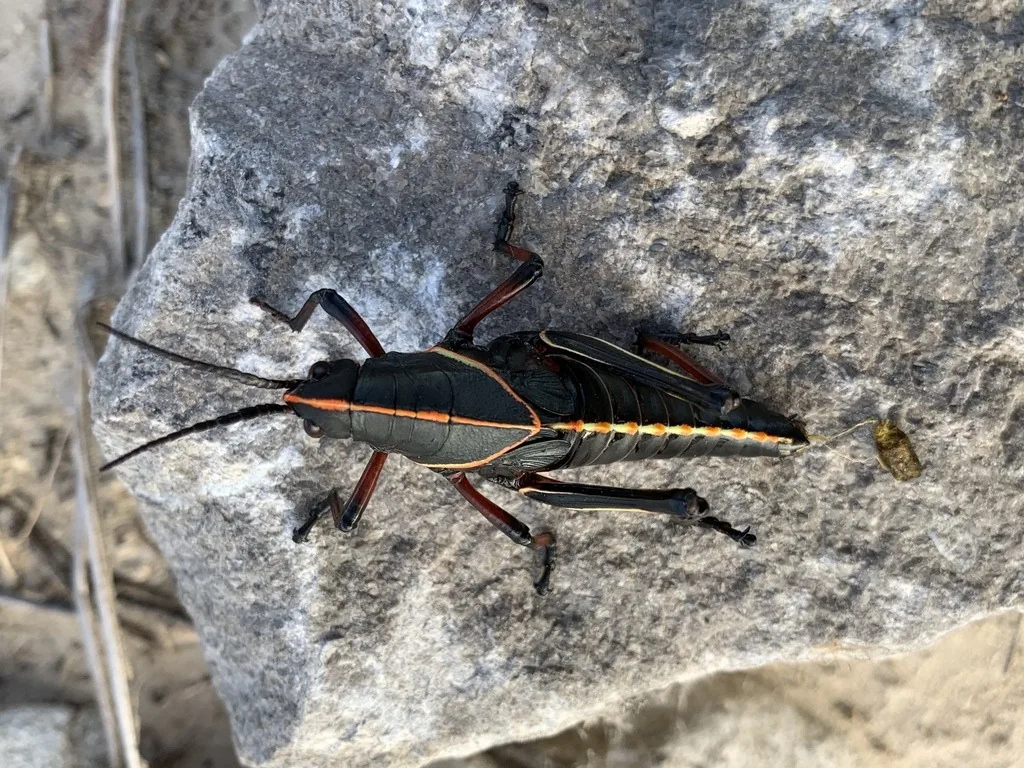
How to identify it
- Adults are colorful, often yellow or tawny with black markings; short hind wings can't lift them, so they can't fly.[1]
- Nymphs look so different they're often mistaken for another species: nearly all black with a yellow, orange or red stripe.[1]
- When disturbed they can spray toxic chemicals from their breathing holes, a defense against vertebrate predators.[1]
Look-alikes
| Look-alike | How to tell them apart |
|---|---|
| Other grasshoppers | Lubbers are larger, slower and flightless.[1] |
Where it lives
It's limited to the southeastern U.S., from North Carolina through Florida and west to central Texas.[1]
Biology and life cycle
It has one generation a year and overwinters as eggs in pods buried 1.2 to 2 inches in soil.[1]
Adults are long-lived, so nymphs or adults are present for much of the year.[1]
Damage and signs
- They prefer wet areas but nymphs disperse widely, invading crops and residential gardens.[1]
Health risk
Their toxic defensive spray deters vertebrate predators; UF/IFAS describes it as an anti-predator defense.[1]
Control
Prevention
Grow less attractive plants and mow border vegetation to expose them to predators.[1]
Traps and physical control
Hand-pick, shake plants or spray water to remove them.[1]
Pesticides
If needed, spot-treat aggregations, especially young nymphs.[1]
Common questions
Sources
- University of Florida IFAS Extension (Featured Creatures), “Eastern Lubber Grasshopper, Romalea microptera (EENY-006).” edis.ifas.ufl.edu/publication/IN132 (accessed 2026-10-06)
- iNaturalist, “Romalea microptera taxon page (order and family).” www.inaturalist.org/taxa/466003 (accessed 2026-10-06)