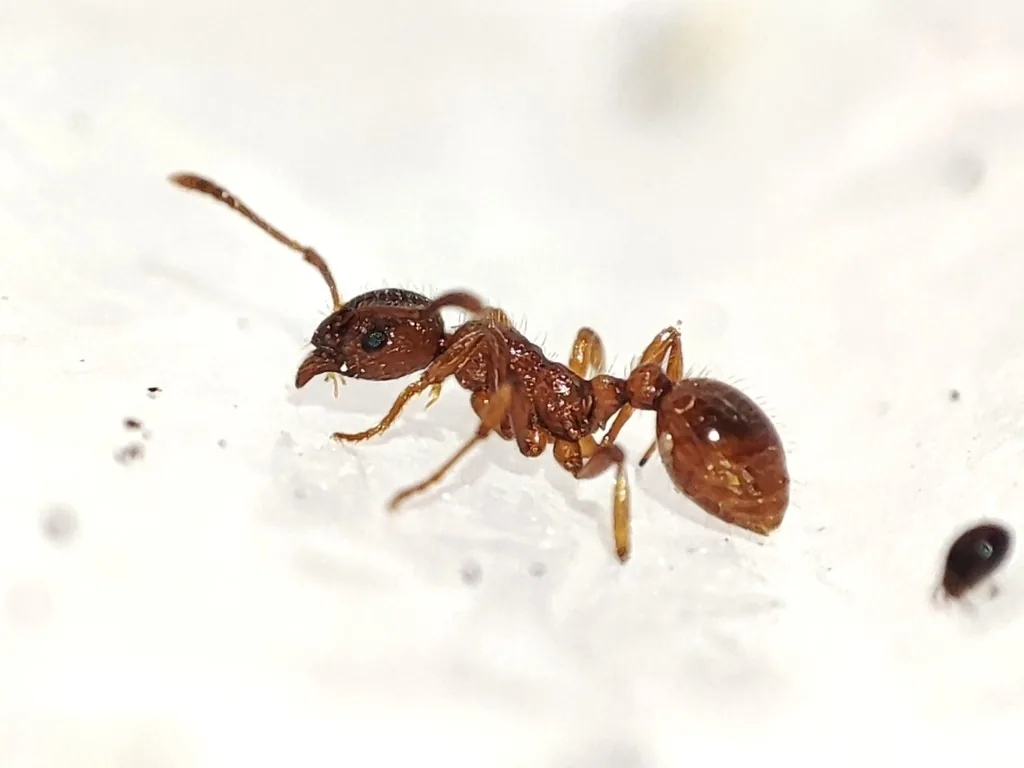
How to identify it
- Workers are about 3/16 inch long and red; queens are a little larger.[1][2]
- The waist has two segments, while most native ants have only one.[1][2]
- Two backward-pointing spines sit on the middle body section, visible only with a magnifying glass.[1][2]
- Nests are found under rocks, wood and debris rather than in large soil mounds, often 10 to 12 nests in a 10-by-10-foot area.[1]
Look-alikes
| Look-alike | How to tell them apart |
|---|---|
| Pavement ant | Shares some of the same features, so have ants identified by Extension before treating; many native red ants also look similar.[1][2] |
| Red imported fire ant | The true fire ants are Solenopsis species of the southern U.S. and Latin America, only distantly related to the European fire ant.[1] |
Where it lives
Native to cold regions of Europe and Asia, it is established in many coastal Maine communities, confirmed in Cumberland, Hancock, Kennebec, Knox, Penobscot, Sagadahoc, Waldo, Washington and York counties.[1]
Biology and life cycle
Colonies range from a few hundred to ten thousand workers and usually have several egg-laying queens.[1]
In Maine they live in lawns, old fields, shrubby areas and deciduous woods, in soil, rotting logs, grass clumps and leaf litter; they don't nest in houses.[1]
They spread when people move infested potted plants, mulch, compost, wood chips or soil, and locally when a group of workers carries a queen off to start a nearby nest.[1][2]
Mating flights by winged queens don't appear to be a common way they spread in their invaded range.[1]
Damage and signs
Health risk
A sting burns at first and usually leaves an inflamed red area 1 to 4 inches across, sometimes with a raised white center. Soreness can last a few hours to a day or more, and reactions vary by person.[1]
Control
Prevention
Inspect plants, wood chips, compost, logs and soil before bringing them home, and don't share or move materials that might carry these ants.[2]
Sanitation
Remove stones, boards, leaves, logs and debris that offer nest sites, and reduce irrigation and shade, since these ants need moist habitat.[2]
Pesticides
UMaine found baits the most effective treatment; in its trials, broadcast baits with indoxacarb, hydramethylnon or spinosad worked best, and liquid imidacloprid baits did best in bait stations.[2]
Bait in Maine between June 1 and September 1 when it is above 60°F, not right before or after rain or watering, and follow the label.[2]
When to call a professional
Send suspected specimens to the UMaine Extension Diagnostic and Research Laboratory for identification before treating.[1][2]
Common questions
- Is the European fire ant a real fire ant?
- No. It is a Myrmica ant only distantly related to the true fire ants of the South, though its sting is painful.[1]
- Do boiling water or boric acid work on European fire ants?
- Not in UMaine field tests: boiling water, plain cornmeal grits and both homemade and commercial boric acid products failed.[2]
- Can European fire ants be eliminated?
- Established infestations may not be eliminated, but baiting can reduce them, and neighbors can work together on colonies that cross property lines.[2]
Sources
- University of Maine Cooperative Extension, “Bulletin #2550, European Fire Ant: A New Invasive Insect in Maine (reviewed 2025).” extension.umaine.edu/publications/2550e/ (accessed 2026-10-06)
- University of Maine Cooperative Extension, “Bulletin #2551, European Fire Ant: Management for Homeowners: Least Toxic Management Strategies.” extension.umaine.edu/publications/2551e/ (accessed 2026-10-06)
- iNaturalist, “Myrmica rubra taxon page (order and family).” www.inaturalist.org/taxa/1404712 (accessed 2026-10-06)