Pest profile

Florida Harvester Ant

Pogonomyrmex badius · Hymenoptera: Formicidae[2]

Florida harvester ants are the only harvester ants east of the Mississippi, and their sting is extremely painful.[1]

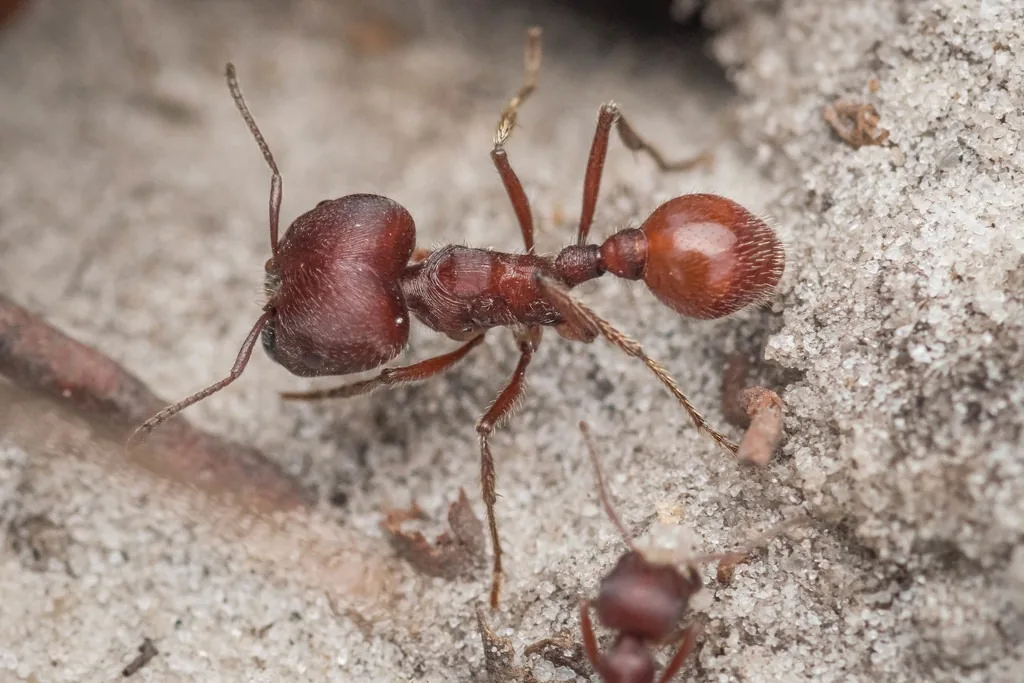
Florida harvester ant, a large rust-red ant, on sandy ground
Florida harvester ant, a large rust-red ant, on sandy ground. (c) Nash Turley, some rights reserved (CC BY) — via iNaturalist, CC BY 4.0

How to identify it

  • Workers are dark rust-red and vary in size from 1/4 to 3/8 inch; major workers have very large heads.[1]
  • Nests are flat, low mounds 12 to 24 inches across with one or several central entrances.[1]

Look-alikes

Look-alikeHow to tell them apart
Red harvester antOf 22 U.S. harvester ant species, only the Florida harvester ant occurs east of the Mississippi.[1]

Where it lives

It ranges from Florida to North Carolina and west into Mississippi and Louisiana.[1]

US map: public records from 6 states since 1990 (GBIF).

Biology and life cycle

Workers collect seeds for food.[1]

Health risk

Its sting is extremely painful; avoid disturbing nests.[1]

Control

Prevention

Control usually isn't needed unless nests are where small children play; adults can simply avoid the ants.[1]

Common questions

Does the Florida harvester ant sting?
Yes, and the sting is extremely painful.[1]
Should I treat a harvester ant nest?
Usually not, unless it's where small children play.[1]

Sources

  1. University of Florida IFAS Extension (Featured Creatures), “Florida Harvester Ant, Pogonomyrmex badius (EENY-298).” edis.ifas.ufl.edu/publication/IN536 (accessed 2026-10-06)
  2. iNaturalist, “Pogonomyrmex badius taxon page (order and family).” www.inaturalist.org/taxa/228477 (accessed 2026-10-06)

Updated 2026-10-14. Built from sourced records. Spot an error? Tell us.