How to identify it
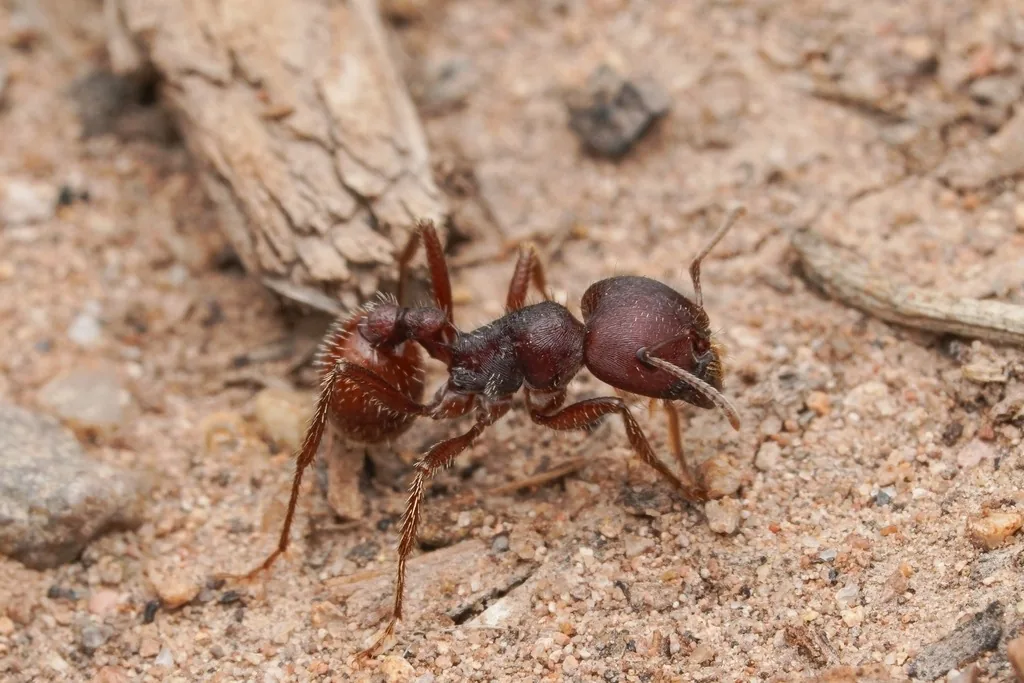
- Workers are 1/4 to 1/2 inch long, red to dark brown, with square heads.[2][1]
- A beard-like row of long hairs under the head, called a psammophore, lets them carry large loads.[1]
- Workers are basically one size, have 12-segmented antennae without a club, and carry a powerful sting.[1]
- The nest is easy to spot: a single entry hole in the middle of a bare circle, often with cleared foraging trails leading out to vegetation.[1][2]
Look-alikes
| Look-alike | How to tell them apart |
|---|---|
| Florida harvester ant | The only harvester ant east of the Mississippi River; it has workers of several sizes, including big-headed majors, and does not clear vegetation around its low mound.[3] |
| Pyramid ants | Much smaller ants that often nest on the cleared surface of harvester ant nests.[4] |
Where it lives
Ranges from Kansas and Oklahoma through western Texas, New Mexico and Arizona into Mexico, with scattered records in extreme southern Utah; it nests in soil on open land.[1]
Biology and life cycle
Seeds are the main food; workers prefer small seeds such as alfalfa, clover, grasses, oats, wheat, sunflower and mesquite, and also scavenge dead insects.[1][2]
The cleared nest area averages about 12 feet across but can range from 3 to 35 feet, and foraging trails may stretch 200 feet.[1]
Nests can go very deep; one reportedly reached 15 feet with 436 chambers.[1]
Mating flights happen mostly after rains in August and September; a newly mated queen sheds her wings and digs a burrow to start a new colony.[1][2]
Damage and signs
Health risk
Workers are generally reluctant to sting, but the sting is very painful, its effects can spread along lymph channels, and it may be medically serious; at least one child's death in Oklahoma has been credited to red harvester ant stings.[2][3]
Control
Prevention
For its eastern relative, the Florida harvester ant, UF/IFAS advises control mainly where small children play, since adults can simply avoid the nest.[3]
Traps and physical control
Regular discing and mowing that destroys nests and habitat may eliminate harvester ants without insecticides.[1]
Pesticides
Baits labeled for harvester ants in lawns are very effective, and any insecticide registered for ants can be used.[1]
Labeled dust insecticides injected into the entry hole also work; drenching the whole mound is the least desirable option.[1]
Common questions
- Why is there a bare circle in my yard with big red ants?
- Red harvester ants remove vegetation around the nest so the sun keeps it warm and dry, leaving a cleared circle often 3 to 6 feet or wider around a single hole.[1][2]
- How bad is a harvester ant sting?
- Very painful. UF/IFAS ranks the related Florida harvester ant's sting among the most painful ant stings, and Texas A&M notes red harvester ant sting effects can spread along lymph channels.[3][2]
- Are these the ants sold in ant farms?
- Yes, harvester ant workers are commonly sold as inhabitants of ant farms.[2]
Sources
- Texas A&M Center for Urban and Structural Entomology, “Red Harvester Ant.” urbanentomology.tamu.edu/urban-pests/ants/red_harvester/ (accessed 2026-10-06)
- Texas A&M AgriLife Extension, “Red Harvester Ant (Field Guide to Common Texas Insects).” texasinsects.tamu.edu/red-harvester-ant/ (accessed 2026-10-06)
- University of Florida IFAS Extension, “Florida Harvester Ant, Pogonomyrmex badius (Featured Creatures, IN536).” edis.ifas.ufl.edu/publication/IN536 (accessed 2026-10-06)
- Texas A&M Center for Urban and Structural Entomology, “Pyramid Ant.” urbanentomology.tamu.edu/urban-pests/ants/pyramid/ (accessed 2026-10-06)
- iNaturalist, “Pogonomyrmex barbatus taxon page (order and family).” www.inaturalist.org/taxa/1340200 (accessed 2026-10-06)