How to identify it
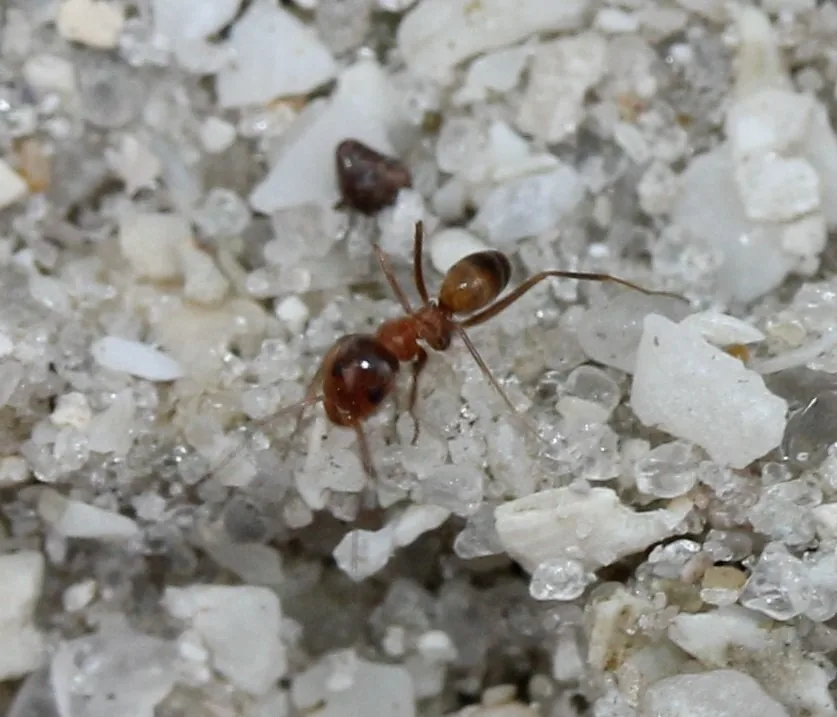
- Workers are about 1/8 inch long and all one size, with a pyramid-shaped projection on top of the thorax.[1][2]
- Color ranges from yellow or orange-brown to reddish with a black abdomen, or black, depending on the species.[1][2][3]
- They have a single node in the waist and 12-segmented antennae without a distinct club.[1][2]
- Workers move extremely fast and give off an unpleasant odor; several similar species exist, and D. bureni of the Southeast is used here as the example.[3]
Look-alikes
| Look-alike | How to tell them apart |
|---|---|
| Red imported fire ant | Pyramid ants lack a sting and actually attack fire ant workers and newly mated queens, often leaving the bodies scattered around their crater.[3] |
| Red harvester ant | Pyramid ants are much smaller and often nest right on the cleared ground of harvester ant nests.[1] |
Where it lives
Pyramid ants occur widely across the United States, probably more commonly in the South, and also in Mexico, South America and the West Indies; D. bureni is common in the Southeast from Texas to Maryland.[1][3]
Biology and life cycle
Colonies are usually small, with a single queen and a few hundred to a few thousand workers.[1]
Nests are dug in bare, sunny soil, often sandy, and the excavated soil forms a circular crater around the entrance; several colonies may sit close together.[1][3]
They eat live and dead insects and honeydew and prefer sweets.[2][3]
Winged ants swarm in summer; D. bureni mating flights happen on warm nights from spring through fall, sometimes after rain.[1][3]
Damage and signs
Health risk
Pyramid ants have no sting; Utah State notes they can bite, while Mississippi State reports D. bureni does not readily bite and is considered beneficial for its predatory habits.[2][3]
Control
Prevention
Mississippi State considers D. bureni beneficial because it preys on pest insects, including imported fire ants, so colonies away from the house can often be left alone.[3]
Keep them out
If ants are found indoors, follow them back to the foundation to find the entry point, and seal cracks and crevices.[2]
Pesticides
Because nest chambers are just below the surface, a colony can be treated by injecting a labeled insecticide directly into the entrance hole.[1][2]
Where workers are active but the nest can't be found, baits with a sweet attractant can work.[1][2]
Common questions
Sources
- Texas A&M Center for Urban and Structural Entomology, “Pyramid Ant.” urbanentomology.tamu.edu/urban-pests/ants/pyramid/ (accessed 2026-10-06)
- Utah State University Extension, “Pyramid Ants (IPM nuisance pest notes).” extension.usu.edu/planthealth/ipm/notes_nuisance/pyramid-ants (accessed 2026-10-06)
- Mississippi Entomological Museum, Mississippi State University, “Dorymyrmex bureni (Trager), pyramid ant.” mem.org.msstate.edu/Researchtaxapages/Formicidaepages/genericpages/Dorymyrmex.bureni.htm (accessed 2026-10-06)
- iNaturalist, “Dorymyrmex bureni taxon page (order and family).” www.inaturalist.org/taxa/319444 (accessed 2026-10-06)