How to identify it
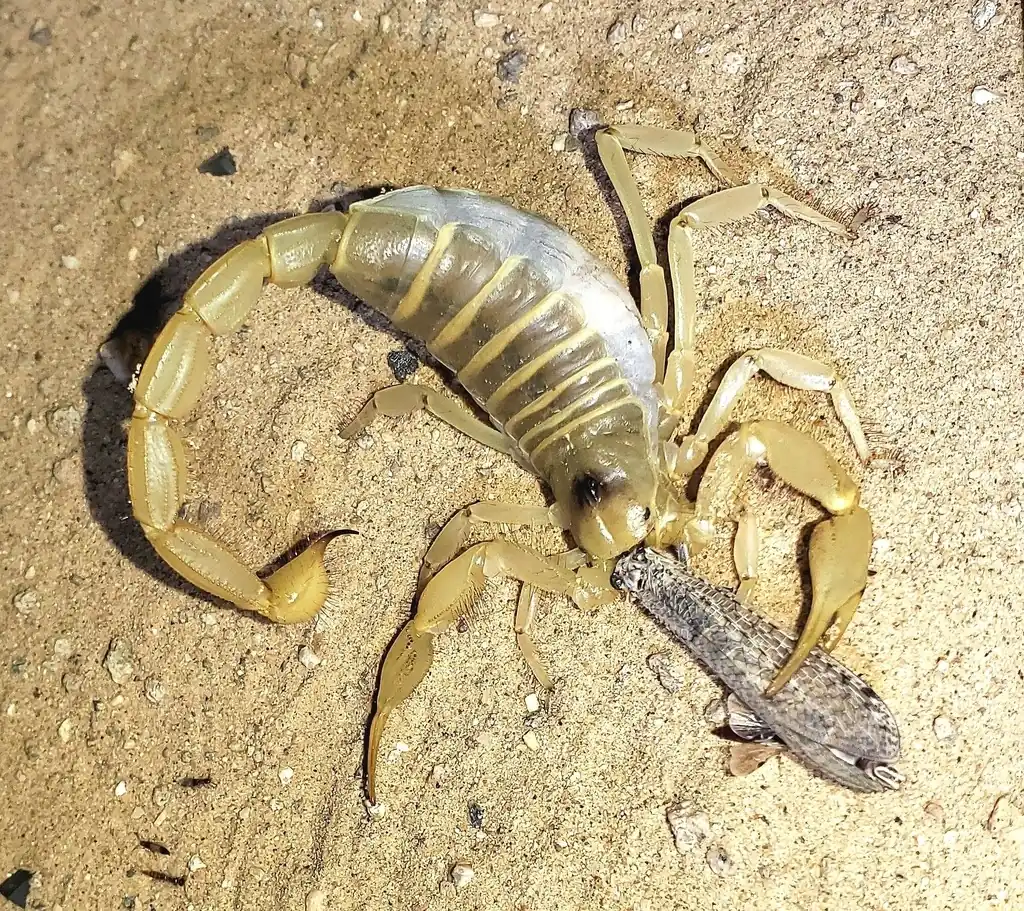
- Adults are heavy-bodied and often longer than 5 inches; UC IPM gives a mature length of 5 to 7 inches.[1][2]
- Seen from above, the body is often darker with pale sides, while the pincers, legs and tail are a pale buff color.[1]
- The pincers are strong and used to grip prey.[1]
- Like other scorpions, it has four pairs of legs, a pair of pincers, and a long segmented tail ending in a stinger.[2]
Look-alikes
| Look-alike | How to tell them apart |
|---|---|
| Arizona bark scorpion | Much smaller, about 3 inches at most, with a very thin tail; it climbs walls, and its sting is the only U.S. scorpion sting that is a health hazard.[2][1] |
| Stripe-tailed scorpion | A common burrowing scorpion that is full grown at under 3 inches, with stripes on the upper side of the body.[1][2] |
Where it lives
Sonoran and Mojave Desert areas of Arizona, California, Nevada and Utah, plus Sonora and Baja California Norte in Mexico; in California it is reported from Imperial, Inyo, Kern, Los Angeles, Riverside, San Bernardino and San Diego counties.[1][2]
Biology and life cycle
It favors low, sandy areas, which is why it is also called the desert hairy scorpion.[1]
It spends most of its time in shallow burrows or under rocks, logs and other objects lying on the ground.[1][2]
It hunts at night and eats a wide range of prey, including insects, other arachnids and small lizards; it eats Arizona bark scorpions voraciously.[1]
Water, swimming pools, irrigated areas and outdoor lights draw it in, because those spots attract beetles, cockroaches, crickets and moths.[2]
Scorpions are born live and ride on the mother's back until their first molt; on average they live 3 to 5 years, and some species much longer.[2]
Damage and signs
Health risk
Its venom is mild. UC IPM says a Hadrurus sting is usually no more serious than an ant, bee or wasp sting unless the person has an allergic reaction, with burning pain that usually fades in about 30 minutes.[1][2]
Control
Prevention
Shake out shoes, clothing and towels before use, don't leave them outdoors, wear gloves for yard work, and wear shoes outside in the evening.[2]
Use yellow outdoor bulbs, which attract fewer of the insects scorpions hunt.[2]
Keep them out
Install weatherstripping on loose doors and windows, caulk around eaves and pipes, and keep window screens tight and in good repair.[2]
Sanitation
Clear trash, logs, boards, stones and bricks away from the foundation, and check firewood before bringing it inside to burn.[2]
Traps and physical control
Find scorpions at night with a black (UV) light, since they glow brightly, then trap one under a glass jar or pick it up with 10- to 12-inch forceps.[2][1]
Pesticides
Pesticides often fail because scorpions hide in crevices by day and large adults are hard to kill; use them only alongside the steps above.[2]
Common questions
- Is the giant hairy scorpion dangerous?
- No. Only Arizona bark scorpion stings are a hazard to human health; the giant hairy scorpion's sting is usually like a bee sting unless you're allergic.[1][2]
- Should I kill giant hairy scorpions in my yard?
- University of Arizona Extension calls them a beneficial addition to the home landscape, because they eat bark scorpions.[1]
- What should I do after a sting?
- Seek medical attention if you have an allergic reaction. Keep the person calm, and an ice pack on the sting site may help.[2]
Sources
- University of Arizona Cooperative Extension, “Scorpions of the Desert Southwest United States, AZ1768 (May 2018).” extension.arizona.edu/sites/extension.arizona.edu/files/pubs/az1768-2018.pdf (accessed 2026-10-06)
- University of California Statewide IPM Program, “Scorpions (Pest Notes, Home and Landscape).” ipm.ucanr.edu/home-and-landscape/scorpions/ (accessed 2026-10-06)
- iNaturalist, “Hadrurus arizonensis taxon page (order and family).” www.inaturalist.org/taxa/119165 (accessed 2026-10-06)