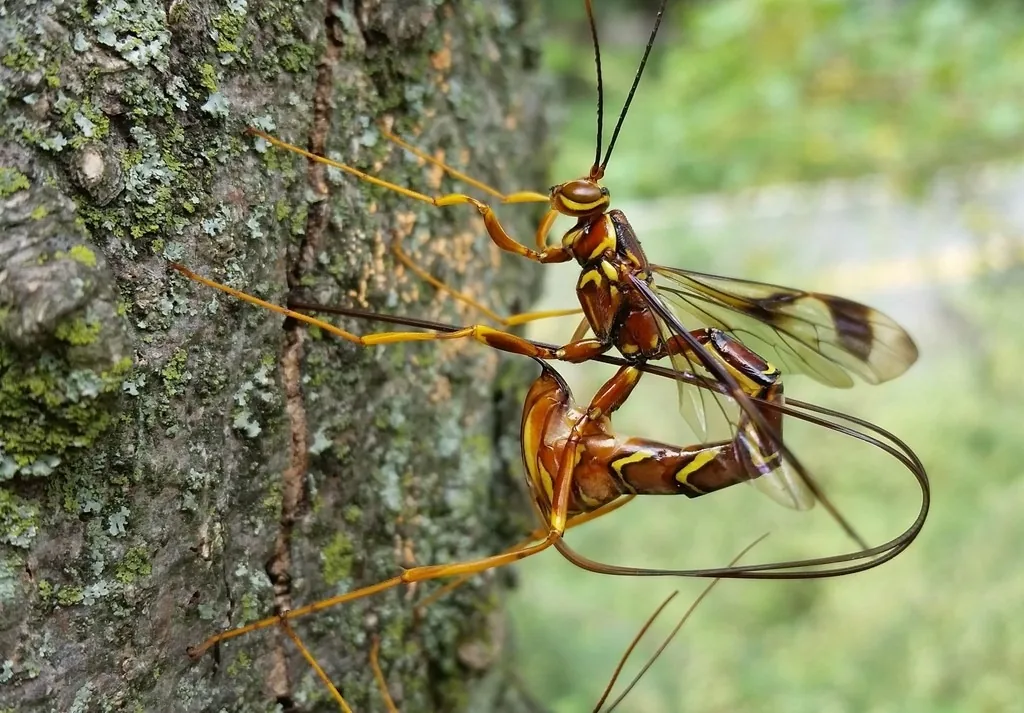
How to identify it
- The body is about 1 1/2 inches long, and the female's threadlike egg-laying tube, or ovipositor, adds another 2 to 3 inches or more.[1][3]
- Megarhyssa macrurus is reddish brown with yellow and black markings; M. atrata is mostly black with a yellow to orange head.[1][2]
- Two protective sheaths run alongside the ovipositor, so the female looks like she has three tails.[1][4]
- Males look similar but have long, slender abdomens with no ovipositor.[4]
Look-alikes
| Look-alike | How to tell them apart |
|---|---|
| Horntails (wood wasps) | Horntails, their hosts, have thick cylindrical bodies with no narrow waist; their sturdy ovipositor is not nearly as long as the giant ichneumon's.[5][4] |
Where it lives
Found on and around declining or recently dead hardwood trees and logs, mostly from May through July in Minnesota; in Texas, adults can turn up on dead trees as early as March.[1][3]
Biology and life cycle
Females lay eggs on horntail larvae, which tunnel in dying or recently dead hardwoods such as oak, maple, birch and elm; the pigeon tremex is a favored host.[1][4][3]
A female locates a larva deep in the wood, drills in with her ovipositor, paralyzes the larva with venom and lays an egg beside it.[4][1]
The wasp larva feeds on the horntail larva, killing it, then pupates in the tunnel and emerges as an adult the next spring.[1][4][3]
Damage and signs
Health risk
Not aggressive toward people. If mishandled, a female may jab with her ovipositor in self-defense, which generally causes only a minor wound.[1][2]
Control
Prevention
No control is needed: ignore them and they'll leave on their own. Pesticide treatment isn't necessary.[1][3]
Their presence points to declining or dead hardwoods with horntails inside; the wasps themselves are beneficial parasites.[1][3]
Common questions
- Can a giant ichneumon wasp sting me with that long tail?
- It isn't aggressive and avoids people. The long tail is an egg-laying tube; a female handled roughly may jab with it, usually causing only a minor wound.[1][2]
- Is it killing my tree?
- No. It drills into the wood only to lay eggs on horntail larvae and doesn't hurt the tree, though the horntails it hunts live in trees that are already declining or dead.[1]
Sources
- University of Minnesota Extension, “Ichneumonid Wasp (Yard and Garden Insects, reviewed 2024).” extension.umn.edu/yard-and-garden-insects/ichneumonid-wasp (accessed 2026-10-06)
- University of Minnesota Extension, “Giant Ichneumon Wasps (What Insect Is This?).” apps.extension.umn.edu/garden/diagnose/insect/general-curiosity-insects/flies/large/giantichneumon.html (accessed 2026-10-06)
- Texas A&M AgriLife Extension, “Ichneumon Wasp (Field Guide to Common Texas Insects).” texasinsects.tamu.edu/ichneumon-wasp/ (accessed 2026-10-06)
- Mississippi State University Extension, “Black Giant Ichneumon Wasp, Bug's Eye View Vol. 7, No. 30 (2021).” extension.msstate.edu/newsletters/bugs-eye-view/2021/black-giant-ichneumon-wasp-vol-7-no-30 (accessed 2026-10-06)
- University of California Statewide IPM Program, “Pest Notes: Wood Wasps and Horntails, Publication 7407.” ipm.ucanr.edu/home-and-landscape/wood-wasps-and-horntails/ (accessed 2026-10-06)
- iNaturalist, “Megarhyssa macrurus taxon page (order and family).” www.inaturalist.org/taxa/47963 (accessed 2026-10-06)