How to identify it
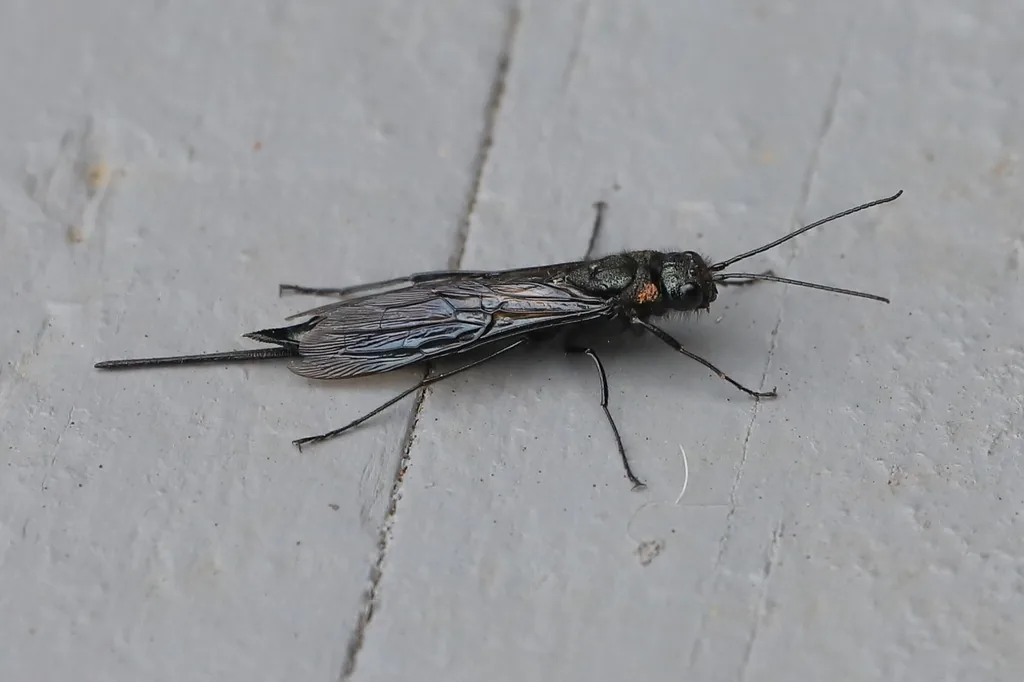
- Large, usually 1 inch or longer, with a long cylindrical body that has no narrow wasp waist; often black or metallic dark blue, or black with red and yellow.[1]
- Both sexes have a spearlike point at the tail end, which gives horntails their name.[2]
- Females are larger and carry a long egg-laying tube that can be longer than the body; it's used only to drill into wood and can't sting.[1]
- They make a loud buzz in flight, and emerging adults leave round exit holes about 1/4 to 1/2 inch across.[1]
Look-alikes
| Look-alike | How to tell them apart |
|---|---|
| Powderpost beetle | Wood-boring beetles like powderpost beetles can attack furniture and structural wood; horntails attack only trees and won't bore into wood in buildings or furniture.[1] |
| Old house borer | Horntails won't lay eggs in dry, finished lumber, so there's no second generation in the studs.[1][2] |
Where it lives
Horntails can show up anywhere infested timber is used for construction; about a dozen similar species occur in California, Oregon and Washington, and emergences in new homes have been reported in Iowa.[1][2]
Biology and life cycle
A female drills nearly 3/4 inch into a weakened or dying tree, lays 1 to 7 eggs per hole along with a wood-softening fungus, and may lay up to 200 eggs in all.[1]
As a group, horntails lay eggs in both hardwood and conifer trees, especially weakened, dying or recently cut ones.[3]
Legless, whitish larvae tunnel through the wood for at least a year, and up to 5 years in cool climates, leaving galleries 10 to 12 inches long.[1]
Studs cut from infested logs can carry larvae that survive milling, especially when the lumber wasn't kiln dried or was dried inadequately.[2]
Damage and signs
- Damage in buildings is cosmetic rather than structural; usually fewer than a dozen wasps emerge in a house.[1]
- Emerging adults chew through drywall, plaster, hardwood floors, linoleum, carpet and other surfaces covering the infested wood.[1][2]
- Most emerge within the first year after construction, though a few may appear 2 or 3 years later.[2]
Health risk
Horntails don't sting or bite people; the female's long tail is only for laying eggs in trees.[1][2]
Control
Prevention
Kiln drying or vacuum fumigation of lumber is the only effective way to kill larvae that survive milling; fumigating finished buildings hasn't worked.[1]
Traps and physical control
Swat or spray individual wasps as they emerge, then patch and repaint the exit holes; there's no practical way to treat lumber already inside walls.[2]
If five or more horntails emerge from a single stud, it may be damaged enough to justify replacing it.[2]
Common questions
Sources
- University of California Statewide IPM Program, “Pest Notes: Wood Wasps and Horntails, Publication 7407.” ipm.ucanr.edu/home-and-landscape/wood-wasps-and-horntails/ (accessed 2026-10-06)
- Iowa State University Extension and Outreach, “Horntail Wasp (Yard and Garden, last reviewed October 2022).” yardandgarden.extension.iastate.edu/encyclopedia/horntail-wasp (accessed 2026-10-06)
- University of Maine Cooperative Extension, “Horntails (Home and Garden IPM).” extension.umaine.edu/home-and-garden-ipm/fact-sheets/common-name-listing/horntails/ (accessed 2026-10-06)
- iNaturalist, “Sirex areolatus taxon page (order and family).” www.inaturalist.org/taxa/788019 (accessed 2026-10-06)