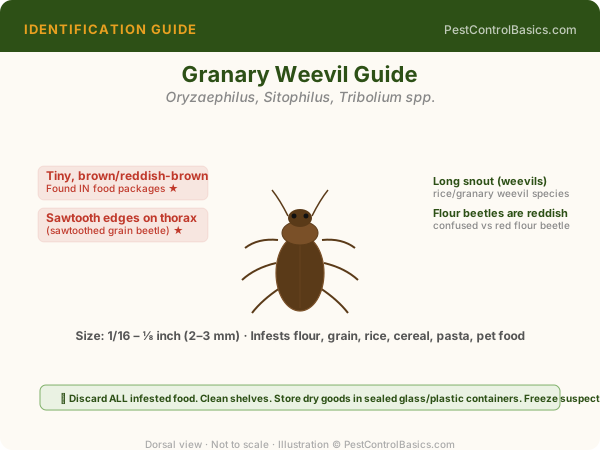
Sitophilus oryzae / S. granarius · Coleoptera: Curculionidae
Grain weevils are the most destructive stored grain pest worldwide. They hollow out individual kernels from the inside — making infested grain look intact until you notice the damage.
Original illustration by PestControlBasics.com. Use the labeled features above to confirm your identification.
🔬
PestControlBasics Editorial Team
Reviewed by Derek Giordano · Updated 2026
🔍 Identification
Rice Weevil (S. oryzae): 2-3mm; reddish-brown with 4 pale spots on wing covers; can fly; infests rice, corn, wheat. Granary Weevil (S. granarius): 2-4mm; darker brown; no spots; cannot fly; infests wheat, rye, oats, barley. Both have the distinctive snout (rostrum) of all weevils — the definitive ID feature that distinguishes them from flour beetles.
🧬 Biology & Behavior
Females drill into grain kernels with their rostrum, deposit one egg, and seal the hole. Larvae develop entirely inside — egg, larval, and pupal stages all occur inside the kernel. Adults emerge by chewing through the kernel wall. You can spot early infestation by floating grain — hollowed kernels float.
⚠️ Damage & Health Risk
Hollow, ruined grain kernels; significant economic losses in stored grain; musty grain odor; flour from infested grain has reduced quality and baking properties. Adults of flying species (rice weevil) spread rapidly to new grain supplies.
🔧 DIY Treatment
Find and discard all infested grain. Freeze clean grain at 0°F for 72 hours to kill any undetected eggs or larvae. Transfer ALL grain products to sealed, airtight glass or hard plastic containers. Inspect regularly. Clean shelves thoroughly with white vinegar between uses. For large bulk storage, food-grade diatomaceous earth mixed into grain prevents establishment.
👷 When to Call a Pro
For grain elevator or commercial storage operations, phosphine fumigation and heat treatment are standard professional options.
❓ FAQ
Can you eat grain with weevils?
Grain with weevils is safe to eat from a toxicity standpoint — weevils are not toxic. However, the quality and nutritional value of heavily infested grain is reduced, and most people find the idea unappetizing. Freeze infested grain to kill insects, then use as bird feed or discard.
How do weevils get into sealed packages?
Most grain weevil infestations begin at the farm, elevator, or processing facility. Female weevils lay eggs in grain before it's packaged — the infested grain goes into the sealed bag. The first sign of infestation often appears 6-8 weeks after purchase when larvae complete development and adults emerge.
DG
Derek Giordano
Certified Pest Control Operator · Former Business Owner
Derek ran his own pest control company in Florida for several years, servicing thousands of regular customers. All content is based on hands-on field experience and current EPA & university extension guidelines.
When to escalate Stored Grain Weevil Control Guide control beyond DIY
Most Stored Grain Weevil Control Guide situations are within the range of a careful homeowner, but a handful of scenarios genuinely warrant a licensed applicator. Multi-unit buildings are at the top of that list — shared walls, plumbing, and ductwork mean a localized treatment in one unit often just relocates the population to a neighbor. Any infestation that involves wall voids, attic insulation, or sub-slab plumbing is also harder to reach with consumer products and benefits from professional equipment and labeled product concentrations.
Health-sensitive situations are the second escalation trigger. Pregnancy, infants, immunocompromised residents, and pets with known sensitivities all narrow the available product list considerably. A licensed professional can apply restricted-use products and reduced-risk reformulations that achieve control with lower household exposure than over-the-counter alternatives. The cost difference is usually less than two seasons of DIY spending once the time investment is factored in.
The third escalation point is recurrence. If the same pest returns within six weeks of an apparently successful treatment, the source is usually structural or environmental rather than chemical, and a professional inspection often finds the cause faster than a second round of self-treatment.
Confirming a Stored Grain Weevil Control Guide infestation in the field
Misidentification is the most common reason home treatment fails for Stored Grain Weevil Control Guide. Look-alike species often respond to completely different active ingredients, so a 30-second confirmation step before any spraying or baiting saves the most time over a season. The practical workflow begins with where you found the specimen — kitchen, bathroom, garden, attic — because habitat narrows the candidate list faster than morphology alone.
Specific cues for Stored Grain Weevil Control Guide include body proportions, leg count, antenna shape, and any wing structure if present. Adults are usually the easiest stage to identify, but most real-world infestations show juveniles or evidence (frass, shed skins, webbing, damage patterns) more often than adults themselves. Photograph the specimen against a ruler or coin for scale, then compare against a regional reference rather than a global one — range maps from state Extension services beat generic online identification sites.
When two species look genuinely similar, the deciding factor is often where they congregate at dusk versus dawn, or whether they leave a visible trail. A test of three common DIY treatments — one bait, one residual spray, one mechanical barrier — applied in different areas can also confirm identity by which works.
Why timing changes everything with Stored Grain Weevil Control Guide
The same product applied two weeks apart can produce a complete kill or near-zero effect depending on where the Stored Grain Weevil Control Guide population sits in its life cycle. Egg-stage pests are nearly immune to contact sprays, so a perfectly applied treatment during a major hatch event will leave the next generation completely unaffected. The professional standard is two applications spaced 10 to 14 days apart for most household pests — the first kills the active adults, the second catches anything that emerges from eggs in the interim.
Temperature also drives treatment success. Most residual sprays lose efficacy above 90°F or below 50°F, and pyrethroid products in particular can repel rather than kill when applied during high heat. The best window is early morning when surface temperatures are still moderate and target pests are moving but not yet at peak activity. Indoor treatment is less weather-dependent but still benefits from being applied when household air movement is low — running ceiling fans during application redistributes droplets away from the intended surface.
Seasonal pressure for Stored Grain Weevil Control Guide usually has two or three predictable peaks per year. A treatment calendar built around those peaks costs less and works better than reactive spraying after a problem is already established.
Prevention strategies that actually reduce Stored Grain Weevil Control Guide pressure
Most pest pressure traces back to one or two environmental conditions that are easier to fix than the infestation itself is to spray. For Stored Grain Weevil Control Guide, the highest-leverage changes typically involve moisture management, food access, and exclusion at structural entry points. Reducing standing water within 20 feet of the foundation eliminates more pest problems than any single chemical application, and the effect persists year over year rather than requiring a rebuy every quarter.
Exclusion work is unglamorous but durable. A common entry-point audit covers door sweeps, weep holes, utility penetrations, dryer vents, soffit gaps, and the base of siding. Most homes have between five and fifteen openings larger than the minimum required for the target pest to enter, and sealing even half of them measurably reduces indoor sightings within one season. Stainless steel mesh, copper wool, and exterior-grade sealant cover most situations; expanding foam alone is not sufficient because rodents and some insects chew through it.
Storage practices matter too. Pantry pests, fabric pests, and overwintering insects all exploit cardboard, paper, and natural-fiber storage in basements and garages. Switching to sealed plastic bins for seasonal storage removes a significant amount of harborage that is otherwise impossible to spray effectively.
Published: Jan 1, 2025 · Updated: Apr 7, 2026
Choosing a pest control company: questions worth asking
Pest control companies vary substantially in approach, training, and pricing, and the questions to ask before signing a contract often aren't the obvious ones. Worth asking: what's the technician's training and certification (state pest control certification is the floor; advanced training in IPM, structural inspection, or specific pest specialties is meaningful additional credentialing); what does the service include beyond visiting and spraying (inspection, monitoring, exclusion recommendations, follow-up scheduling); what guarantees apply if pests return between visits; what's the protocol for hard-to-resolve issues (some companies escalate to senior technicians or supervisors; others repeat the same approach); what active ingredients are used and whether the company will use specific products on request (homeowners with chemical sensitivities, pollinator gardens, or other concerns may want specific products); and what's the contract structure (per-visit, annual, multi-year). Worth less than expected: brand recognition and advertising spend (large national chains and small local operators both produce excellent and mediocre service); 'green' or 'organic' labels (which mean different things to different companies and often don't correspond to specific product or practice differences); price alone (typical pricing variance is modest, and the floor of cheap options often includes poor service).
Building a pest control file: documentation that compounds over years
Most homeowners treat pest issues episodically and lose information between events. Building a simple ongoing pest file — even a single document in a notes app or folder of photos — produces compounding benefits across years of property ownership. The contents that matter: date and location of every notable sighting, identification (with photos where possible), treatment applied and product names used, professional service records and warranty terms, structural sealing work performed and where, drainage and moisture correction work performed, and observations across seasons. Over two or three years, patterns emerge that aren't visible in single incidents: which months reliably bring ant activity, which exterior corner gets wasps every spring, which entry points keep failing, which products actually worked versus which were tried and abandoned. This file becomes useful at property sale (documenting professional treatment and remediation), at insurance claim time (documenting pre-existing conditions or treatment history), and at any future pest problem (where past records narrow the diagnostic space immediately). The effort to maintain is minimal — a few minutes per incident — and the cumulative information value substantial.
The role of local cooperative extension in pest decisions
State cooperative extension services — university-based educational and advisory programs in every state — are dramatically underused resources for residential pest decisions. Most state extensions employ entomologists who answer homeowner questions free of charge through county offices, online query forms, or scheduled call hours. The information available is specific to the state's pest pressure, climate, and recommended practices, and is typically much more locally accurate than national resources. Extension publications cover identification, life cycle, treatment options, and specific product recommendations for state conditions; the publications are peer-reviewed by university scientists and updated periodically based on current research. For any pest situation where identification is uncertain or treatment options are unclear, a clear photograph submitted to the state extension produces an identification, a brief biological explanation, and one or more treatment options within typically a few days. The benefit beyond any single inquiry is building familiarity with the local resource — extension contacts become a reference for future situations and produce better decisions than aggregated online advice.
Understanding pest forecast reports and what they signal
Pest forecast reports — issued by some state agricultural agencies, cooperative extension services, and commercial pest control companies — are an underutilized resource for homeowners who want to anticipate rather than react to seasonal pest activity. These reports typically combine historical pest data, current weather conditions, and growing degree day calculations to predict when specific pests will emerge or peak in specific regions. A tick forecast for an upcoming spring season, a mosquito pressure forecast after a wet winter, a termite swarm prediction for a specific week in the Southeast — these aren't speculation but reasonably calibrated predictions based on biological timing. For homeowners, the value is in scheduling preventive treatment and personal protection to match the predicted high-pressure windows rather than reacting after problems have established. Subscribing to a regional pest newsletter from a cooperative extension service or state agriculture department is free or low cost and produces these forecasts during relevant seasons. The information is dramatically more actionable than generic pest control content because it's calibrated to your specific region and current conditions.
Annual pest control budgets: planning versus reactive spending
Most households treat pest control as an emergency expense rather than a line item, and the resulting spend is almost always higher than what a planned program would have cost. A property that allocates a modest annual budget toward inspections, preventive perimeter work, and one or two scheduled treatments at high-pressure times of year typically spends a fraction of what a comparable property spends on crisis response to a single major infestation. The math is straightforward: a moderate cockroach, rodent, or bed bug job typically costs more than a year of preventive service, and the labor and disruption costs to the household are not trivial either. Building a budget also forces the kind of structured thinking that catches problems early — when a homeowner has already decided to allocate funds, they're more willing to call for an inspection at the first ambiguous sign, rather than waiting until the situation is unambiguous and more expensive. The shift from reactive to planned spending is one of the highest-leverage changes a household can make in this category.
Pest control and HOA dynamics: where they overlap
Homeowners' associations vary widely in how they engage with pest control, and the variations create practical issues that affect individual treatment decisions. Some HOAs maintain common-area pest treatment programs that handle perimeter spraying, mosquito treatment, or rodent monitoring on shared property; others leave all pest control to individual homeowners. Some have rules about treatment products or notification requirements; others don't. Some include treatment in the HOA fee structure; others bill separately. For homeowners in HOA communities dealing with persistent pest pressure, understanding what the HOA does and doesn't do is the first step in figuring out what additional individual action is needed. For HOAs without coordinated programs in areas with significant pressure, organizing a neighborhood-level treatment plan often produces dramatically better results than individual treatment efforts that don't coordinate timing or coverage. The conversations are sometimes politically awkward in HOA contexts, but the underlying problem — that some pests are neighborhood-scale and unit-level treatment can't address them — is structural rather than personal. Bringing the issue to an HOA meeting with concrete proposals tends to produce more constructive responses than complaint-style framing.
🗺️ US Distribution — Grain Weevil Control
Common Occasional Not Present
States Present
51
Occasional
0
Primary Region
Anywhere food is stored
📊 Source: University extension services, USDA, CDC vector data, and published entomological surveys.