Pest profile

Grass-Carrying Wasps

Isodontia species (Isodontia mexicana and relatives) · Hymenoptera: Sphecidae[2]

Grass-carrying wasps nest in holes and tight spaces they pack with grass; Penn State calls them at worst a minor nuisance.[1]

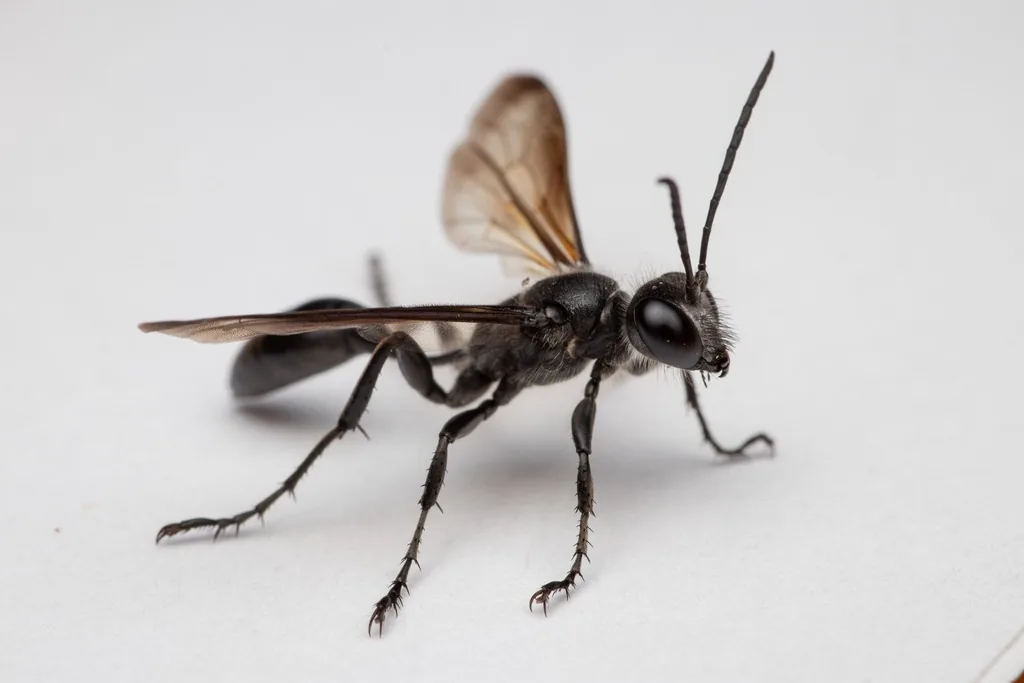
Grass-carrying wasp, a slender black wasp with smoky wings and a long thin waist, on a white surface
Grass-carrying wasp, a slender black wasp with smoky wings and a long thin waist, on a white surface. (c) DiegoH, some rights reserved (CC BY) — via iNaturalist, CC BY 4.0

How to identify it

  • Adults are about 0.7 inch long, black or reddish brown, with smoky wings and the abdomen on a long, thin stalk.[1]
  • Nests are packed and plugged with grass that can stick out two inches; females may be seen carrying long grass blades.[1]

Look-alikes

Look-alikeHow to tell them apart
Carpenter beesGrass-carrying wasps often reuse abandoned carpenter bee holes rather than drilling their own.[1]

Where it lives

Six species occur in North America, five of them in Pennsylvania.[1]

US map: public records from 46 states since 1990 (GBIF).

Biology and life cycle

Adults emerge in early summer, and females nest in window runners, bee hotels, hollow branches and similar spaces.[1]

Females paralyze tree crickets, katydids and other orthopterans to feed their young.[1]

Damage and signs

  • They're a minor nuisance; nests can block window tracks or folded patio umbrellas.[1]

Health risk

Females can sting if handled but aren't aggressive and don't defend their nests.[1]

Control

Traps and physical control

Leave nests that can stay; remove ones in window tracks by hand. Pesticides aren't needed or recommended.[1]

Common questions

Why is there grass sticking out of my window track?
A grass-carrying wasp has likely built its nest there and plugged it with grass.[1]
Will grass-carrying wasps sting me?
Only if handled; they aren't aggressive and don't defend nests.[1]

Sources

  1. Penn State Extension, “Grass-Carrying Wasp.” extension.psu.edu/grass-carrying-wasp (accessed 2026-10-06)
  2. iNaturalist, “Isodontia mexicana taxon page (order and family).” www.inaturalist.org/taxa/203340 (accessed 2026-10-06)

Updated 2026-10-14. Built from sourced records. Spot an error? Tell us.