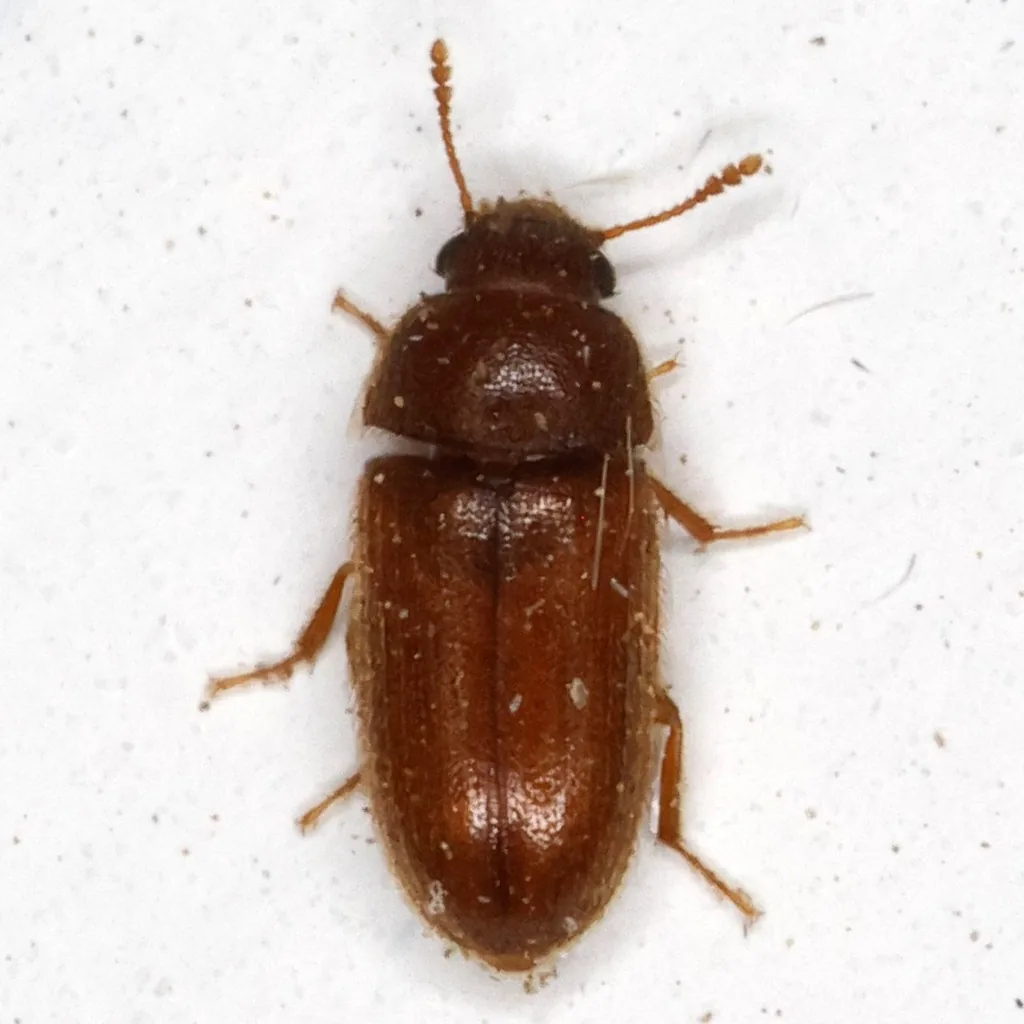
How to identify it
- Adults are oblong-oval, brown beetles with black eyes, only 2 to 3 mm (about 1/10 inch) long.[1]
- The body is covered with short, stout hairs; on the wing covers the hairs line up in rows, making faint lengthwise stripes.[1]
- The antennae are slender, with the last three segments enlarged into a loose club, and adults can fly.[1]
- Mature larvae are whitish to pale brown, about 1/6 inch long, with darker projections at the tail end like those of flour beetle larvae.[1]
Look-alikes
| Look-alike | How to tell them apart |
|---|---|
| Foreign grain beetle | Another fungus-feeding beetle often found alongside it in damp grain; it is reddish brown, with a small knob at each front corner of the thorax.[2][8] |
| Confused flour beetle | Its larvae look similar at the tail end, but flour beetles feed on flour and milled grain itself rather than mainly on mold.[1][9] |
| Mycetophagus punctatus | Ohio State Extension uses the name hairy fungus beetle for this different mold-feeding beetle, so check the scientific name when reading about it.[7] |
Where it lives
Occurs frequently in stored grain, often in large numbers; USDA researchers have studied it in stored barley in Minnesota, corn in South Carolina, wheat in Florida, and farm wheat bins in Kansas.[3][4]
Biology and life cycle
It is a scavenger that feeds mostly on molds and has been reared on pure cultures of molds common in grain.[1]
It may live indoors or outdoors wherever grain or food is stored under conditions that let mold grow, and adults fly or crawl into buildings from moist, moldy residues nearby.[1]
In Kansas farm bins it was among the most numerous insects flying into newly harvested wheat, entering mostly at the bin cap.[4]
In stored grain it concentrates near the spoutline, a central zone high in broken grain and debris, with peak activity soon after fall harvest and again in spring.[3]
Purdue notes that mold, grain mites and fungus-feeding insects such as this beetle and the foreign grain beetle are often found together when grain moisture runs high.[2]
Damage and signs
Health risk
It doesn't bite people, but researchers note it can carry mycotoxin-producing fungi, and UC IPM advises throwing out infested food because pantry pests may introduce mycotoxin-forming microbes.[5][6]
Control
Prevention
Keep stored grain and foods dry: good airflow to prevent moisture buildup and regular checks for water leaks greatly reduce the risk of severe infestations.[1]
Keep them out
For grain bins, USDA research suggests screening openings between the bin cap and roof, or the roof and side walls, to reduce insects flying in.[4]
Sanitation
Clean up moist organic matter and moldy residues regularly, since that is what the beetles breed in.[1]
At home, throw away infested food, wash shelves and vacuum cracks, and store dry goods in containers with tight-fitting lids.[6]
Pesticides
Residual pesticides can kill these beetles, but damp conditions reduce how well they work; insecticides aren't recommended for pantry pests in homes.[1][6]
Common questions
- What does it mean if I find hairy fungus beetles in my grain or feed?
- It means the grain or food is likely too damp and growing mold. Purdue treats this beetle as a good indicator of damp storage conditions.[1]
- Will spraying get rid of hairy fungus beetles?
- Not reliably. Purdue says moisture lowers the effectiveness of residual pesticides, so sanitation, airflow and fixing leaks are the main controls.[1]
Sources
- Purdue University Extension, Department of Entomology, “Stored Product Pests: Hairy Fungus Beetle, Typhaea stercorea, E-226-W (October 2018).” www.extension.entm.purdue.edu/publications/E-226/E-226.pdf (accessed 2026-10-06)
- Purdue University Cooperative Extension Service, “Grain Quality Fact Sheet #13: Grain Mite Infestation, Prevention and Control.” www.extension.purdue.edu/extmedia/GQ/GQ-13.html (accessed 2026-10-06)
- Arbogast, Kendra, Weaver and Subramanyam, USDA-ARS (Journal of Economic Entomology), “Phenology and spatial pattern of Typhaea stercorea (Coleoptera: Mycetophagidae) infesting stored grain: estimation by pitfall trapping. J. Econ. Entomol. 93(2):240-251 (2000).” doi.org/10.1603/0022-0493-93.2.240 (accessed 2026-10-06)
- Hagstrum, USDA-ARS (Journal of Stored Products Research), “Immigration of insects into bins storing newly harvested wheat on 12 Kansas farms. J. Stored Prod. Res. 37(3):221-229 (2001).” doi.org/10.1016/s0022-474x(00)00023-0 (accessed 2026-10-06)
- Eason and Mason, Purdue University (Insects), “Characterization of microbial communities from the alimentary canal of Typhaea stercorea. Insects 13(8):685 (2022).” doi.org/10.3390/insects13080685 (accessed 2026-10-06)
- University of California Statewide IPM Program, “Pest Notes: Pantry Pests, Publication 7452.” ipm.ucanr.edu/home-and-landscape/pantry-pests/ (accessed 2026-10-06)
- Ohio State University Extension, “Fungus Beetles, HYG-2084.” ohioline.osu.edu/factsheet/HYG-2084-10 (accessed 2026-10-06)
- University of Kentucky College of Agriculture, Entomology, “ENTFACT-610: Foreign Grain Beetle (revised March 2026).” entomology.mgcafe.uky.edu/ef610 (accessed 2026-10-06)
- Virginia Cooperative Extension, Virginia Tech, “Darkling Beetles and Mealworms, ENTO-283NP (revised February 2023).” pubs.ext.vt.edu/ENTO/ENTO-283/ENTO-283.html (accessed 2026-10-06)
- iNaturalist, “Typhaea stercorea taxon page (order and family).” www.inaturalist.org/taxa/203380 (accessed 2026-10-06)