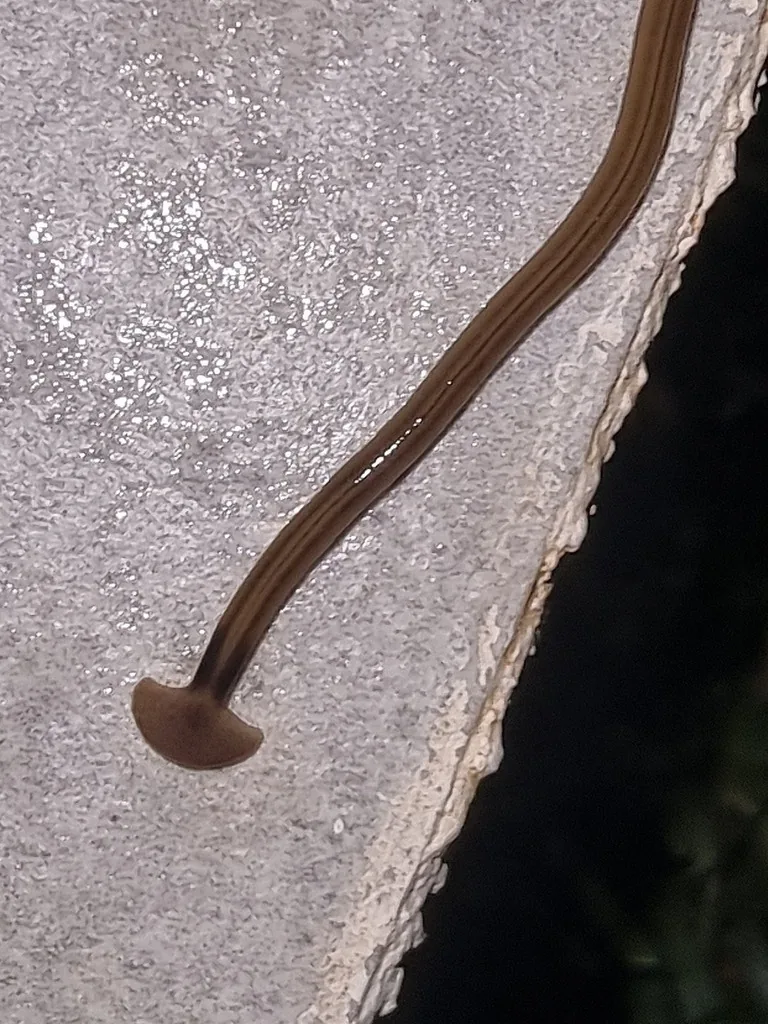
How to identify it
- A long, flat, slimy worm with a broad, shovel- or half-moon-shaped head, like a hammerhead shark or pickaxe.[3][4][1]
- One to several dark stripes run down the length of the body; Bipalium kewense is pale with a dark line down the middle and a dark patch at the neck.[3][1]
- Bipalium kewense is one of the largest flatworms, reaching about 10 to 12 inches long.[2][1]
- They glide smoothly on a strip of tiny hairs over a film of mucus and can lower themselves from leaves or branches on a string of slime.[1][2]
Look-alikes
| Look-alike | How to tell them apart |
|---|---|
| Earthworms, including jumping worms | Hammerhead worms closely resemble earthworms but have one or more stripes down the body and a flattened, shovel-shaped head.[3] |
| Slugs | Slime trails can come from slugs or snails as well as land planarians, so check under rocks and logs for the animal itself.[1] |
Where it lives
Native to Southeast Asia and spread worldwide in the soil of potted plants. In the U.S. it lives outdoors in the warm, humid South and Pacific Coast and has spread north along the Atlantic Coast and into greenhouses in many states.[1][4][3]
Biology and life cycle
Hammerhead worms hunt at night, tracking earthworms, slugs, insect larvae and even each other by chemical scent, then pin prey with sticky mucus and digest it.[1][3][2]
They need high humidity and hide by day under rocks, logs, leaf litter and mulch; they are most abundant in spring and fall.[1][3]
They reproduce mainly by pinching off a piece of the tail, which starts growing a new head within 7 to 10 days; they also lay egg cocoons.[1][3]
They can survive many weeks without food by slowly shrinking in size.[1]
Damage and signs
Health risk
They can't bite or sting. Some Bipalium species carry tetrodotoxin in their mucus, which can irritate the skin, eyes or mouth, so wear gloves, wash your hands and keep pets from eating them.[4][3]
Control
Prevention
Inspect potted plants, nursery stock, mulch and soil before bringing them in; isolate infested plants, and heat-sterilize suspect potting soil before using or moving it.[3][2]
Traps and physical control
Don't cut them up, since each piece can grow into a new worm. Pick them up with gloves or tweezers and seal them in a jar or bag.[3][4]
Kill bagged worms with salt, vinegar, rubbing alcohol or hand sanitizer, or by freezing, then put the container in the trash and wash your hands.[3][4]
Pesticides
No pesticide treatment is recommended. Deal with worms one at a time, and don't spread salt or pesticides on the ground, which harms plants and beneficial organisms.[2][4]
Common questions
- Are hammerhead worms dangerous to touch?
- The risk is low, but their mucus can contain tetrodotoxin. Use gloves, avoid getting slime in your eyes or mouth, and see a doctor if you react after handling one.[4][3]
- What if my dog or cat eats a hammerhead worm?
- Call your veterinarian if your pet shows symptoms after licking or eating one; if you can, photograph the worm or save it in hand sanitizer to show the vet.[4]
- Why shouldn't I chop a hammerhead worm in half?
- They reproduce by breaking into pieces, and each fragment can regrow a head, so cutting them makes more worms.[3][1]
Sources
- University of Florida IFAS Extension (EDIS), “Land Planarians, Bipalium kewense Moseley and Dolichoplana striata Moseley (Featured Creatures, IN206).” edis.ifas.ufl.edu/publication/IN206 (accessed 2026-10-06)
- Texas A&M AgriLife Extension, “Land planarians (ENT-1004).” citybugs.tamu.edu/factsheets/landscape/others/ent-1004/ (accessed 2026-10-06)
- University of Illinois Extension, “Hammerhead Worm.” extension.illinois.edu/invasives/hammerhead-worm (accessed 2026-10-06)
- Virginia Tech News (Insect Identification Lab, Department of Entomology), “Toxic hammerhead worms; expert provides advice for dealing with the invasive species at home (Aug. 15, 2023).” news.vt.edu/articles/2023/08/hammerhead_worms_expert.html (accessed 2026-10-06)
- iNaturalist, “Bipalium kewense taxon page (order and family).” www.inaturalist.org/taxa/64221 (accessed 2026-10-06)