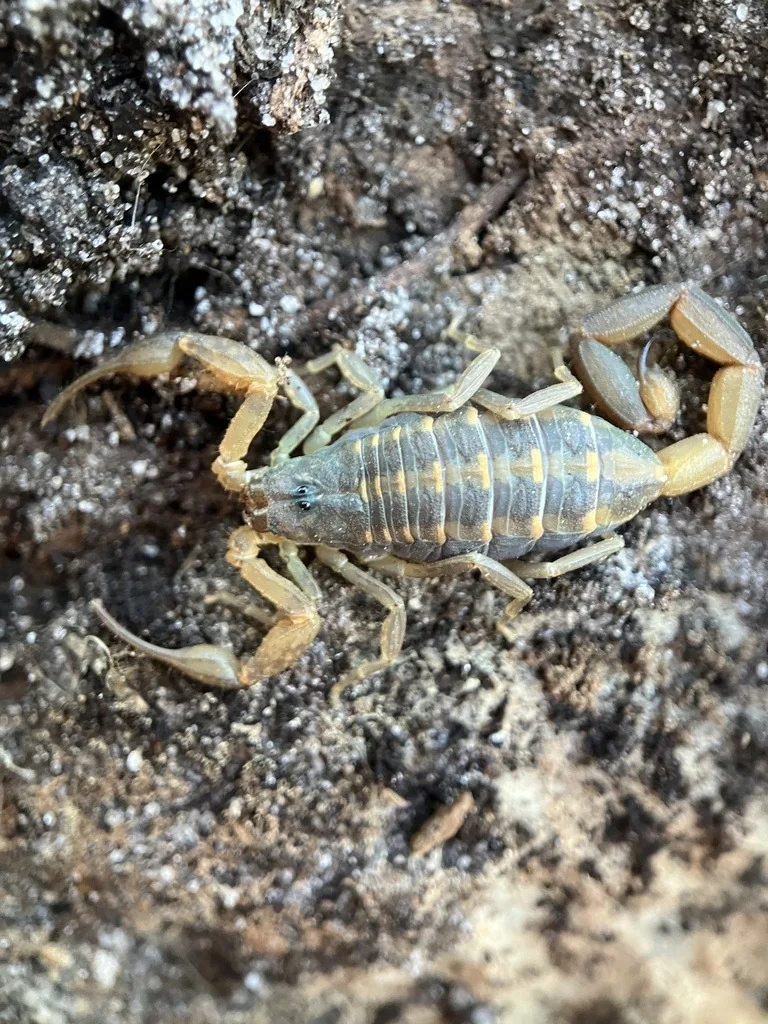
How to identify it
- Its back has dark stripes separated by a narrow yellow stripe, usually about half as wide as the dark stripes.[2]
- The shield over the head is evenly mottled light brown, without the dark triangle over the eyes seen in the striped bark scorpion.[2]
- The pincer fingers and legs are dusky or darkened rather than plain yellow.[2]
- Like other scorpions, it glows bright green under an ultraviolet light.[1]
Look-alikes
| Look-alike | How to tell them apart |
|---|---|
| Striped bark scorpion | Found from Texas and the Central Plains rather than Florida; it has a black triangle on the head shield, a wider yellow center stripe and plain yellow legs and pincers.[2] |
| Arizona bark scorpion | A desert scorpion; the venomous scorpions of real medical concern in the U.S. live mainly in the southwestern deserts, not Florida.[3][1] |
| Slender brown scorpion | Another of the three scorpions seen most often in Florida, along with the Keys bark scorpion.[1] |
Where it lives
Occurs statewide in Florida and in adjacent southern Alabama and southern Georgia; finds in the Carolinas are thought to be accidental hitchhikers.[2]
Biology and life cycle
It usually lives under leaf litter, logs, stones and the bark of dead trees, and it often enters houses.[2][1]
Scorpions hunt insects and other small animals at night and help keep pest numbers in check.[1][4]
Indoors, scorpions usually point to a nearby moisture source, such as plumbing fixtures, condensers or air conditioning units.[1]
Damage and signs
Health risk
A sting is painful, but redness, irritation or swelling usually clears within a few hours; most North American scorpion stings need no treatment, but children 6 and younger are more likely to have harmful effects from venomous species.[1][3]
Control
Keep them out
Fill cracks and crevices, weather-strip doors and seal gaps where pipes and wires enter; sealing and cleanup are the best long-term control.[1][4]
Sanitation
Find and fix moisture sources around plumbing, condensers and air conditioning units, and clear stones, boards and debris near the house.[1][4]
Traps and physical control
Sticky boards along walls and under furniture catch scorpions without pesticides; shake out shoes and clothing in areas where scorpions occur.[4]
Pesticides
Exclusion can be supplemented with a labeled perimeter insecticide applied around doors, vents and the foundation, following the label.[4]
Common questions
- Are Florida scorpions dangerous?
- The scorpions found in Florida aren't known to cause significant medical issues; stings are usually compared to a bee or wasp sting.[1]
- What should I do if a scorpion stings me?
- Wash the area with soap and water and apply wrapped ice 10 minutes on, 10 off. For questions or severe symptoms, call Poison Help at 1-800-222-1222 or 911.[3]
Sources
- UF/IFAS Extension Sarasota County, “The Spooky Bug Brigade: Scorpions (October 17, 2024).” blogs.ifas.ufl.edu/sarasotaco/2024/10/17/the-spooky-bug-brigade-scorpions/ (accessed 2026-10-06)
- Shelley, R. M. and W. D. Sissom, Journal of Arachnology (scan via Internet Archive/BioStor), “Distributions of the scorpions Centruroides vittatus (Say) and Centruroides hentzi (Banks) in the United States and Mexico (Scorpiones, Buthidae). Journal of Arachnology 23:100-110 (1995).” archive.org/download/biostor-214620/biostor-214620.pdf (accessed 2026-10-06)
- UF Health, University of Florida Health, “Scorpions (conditions and treatments).” ufhealth.org/conditions-and-treatments/scorpions (accessed 2026-10-06)
- University of Kentucky Entomology, “ENTFACT-633: Scorpions in Kentucky.” entomology.mgcafe.uky.edu/ef633 (accessed 2026-10-06)
- iNaturalist, “Centruroides hentzi taxon page (order and family).” www.inaturalist.org/taxa/199583 (accessed 2026-10-06)